
Sale!

Reproductive System Complete Trail Kit | A&P II

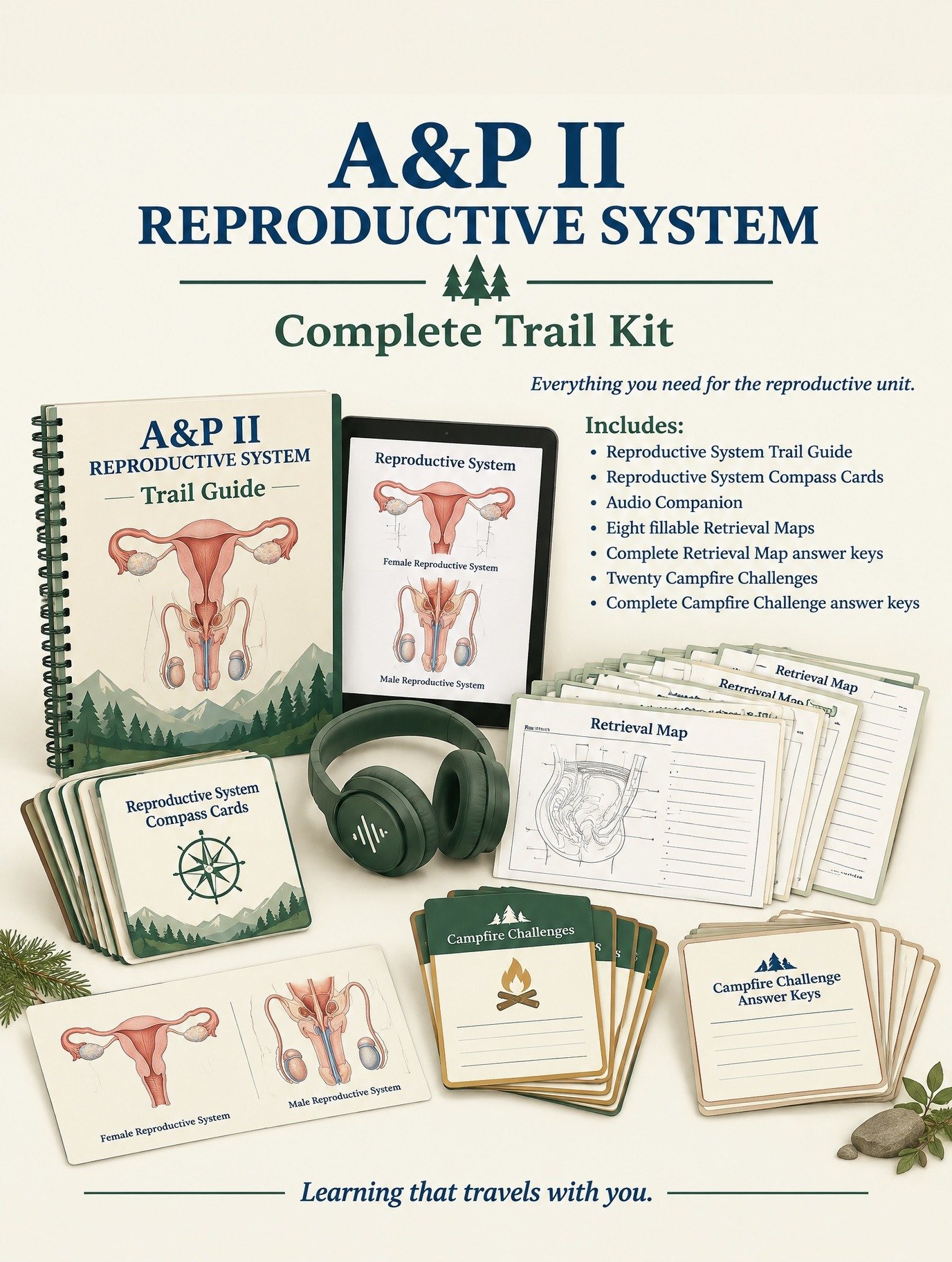
A complete A&P II study system with the 28-page Trail Guide, Compass Cards, Audio Companion, 8 fillable Retrieval Maps, and 20 Campfire Challenges with answer keys.

Original price was: $18.99.Current price is: $9.99.

DIGITAL · INSTANT ACCESS

What You'll Learn

Build a connected understanding of reproductive anatomy physiology and hormonal regulation.
Organize the HPG axis and its male and female branches.
Trace spermatogenesis oogenesis sperm transport and follicular development.
Connect reproductive structures with their specific functions.
Compare the ovarian and uterine cycles and their dominant hormones.
Explain sexual response physiology and accessory gland contributions.
Recognize puberty menopause and reproductive lifespan changes.
Retrieve major pathways from memory using fillable visual maps.
Apply reproductive concepts to focused Campfire Challenge scenarios.
Use complete answer keys to identify knowledge gaps and guide additional review.

Table of contents

28 Page Reproductive System Trail Guide
Reproductive System Compass Cards
Reproductive System Audio Companion
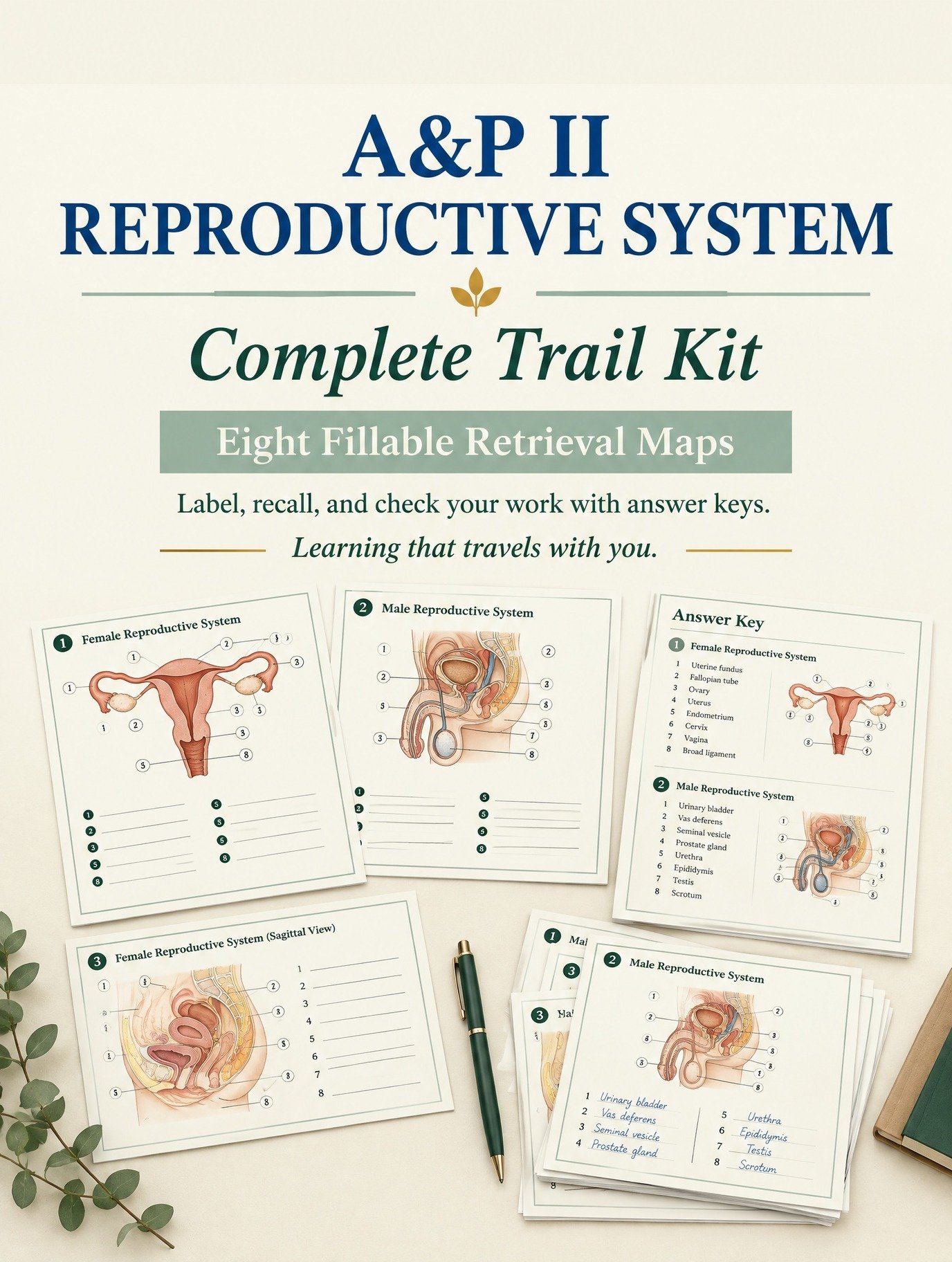
8 Fillable Retrieval Maps
Complete Retrieval Map Answer Keys
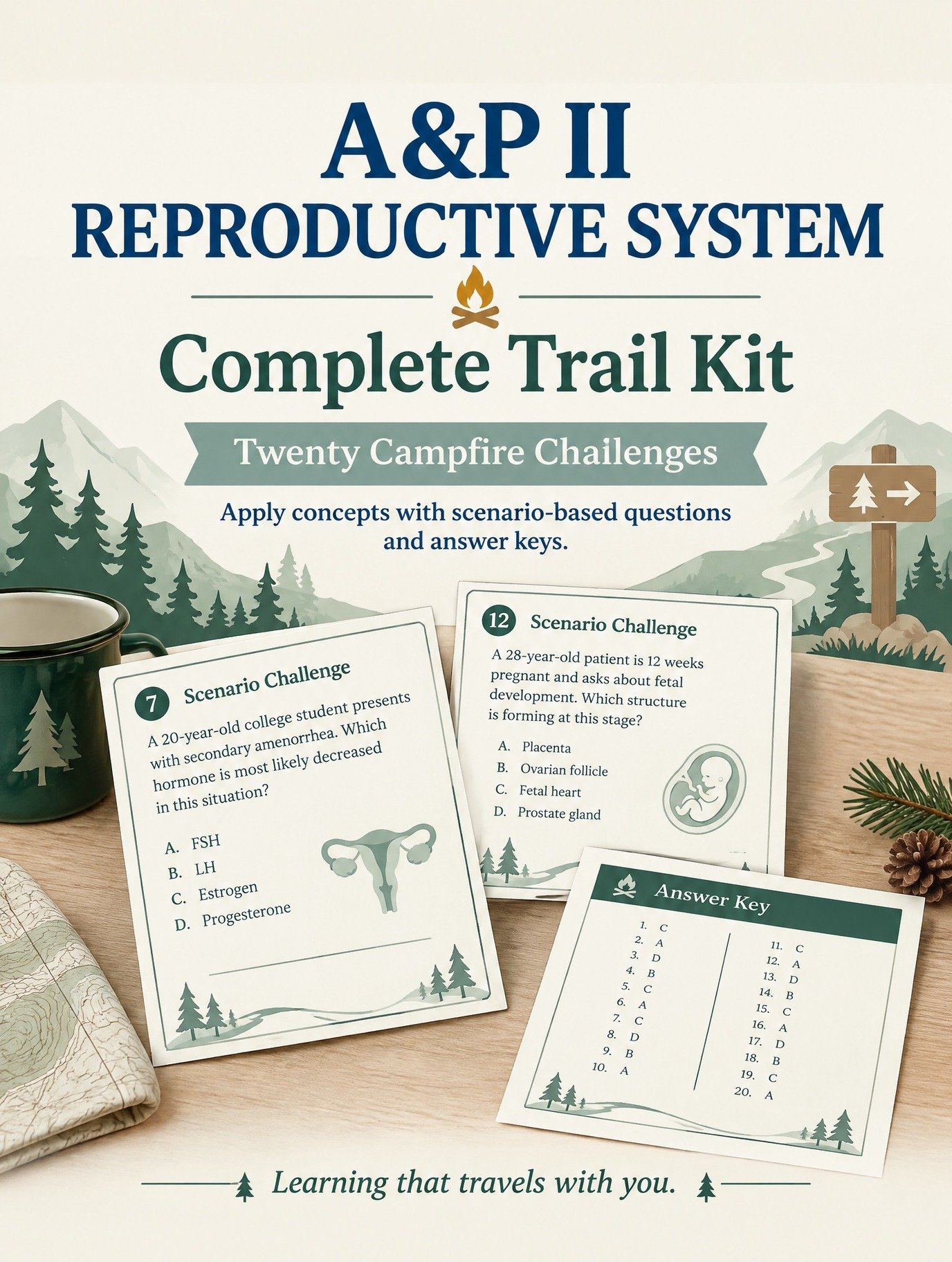
20 Campfire Challenges
Complete Campfire Challenge Answer Keys

The A and P II Reproductive System Complete Trail Kit provides a coordinated study system for learning, organizing, retrieving, recognizing, and applying reproductive anatomy and physiology. Instead of relying on passive rereading alone, students move from guided understanding into visual review, active recall, and focused application.

The 28-page Trail Guide builds a connected foundation using realistic medical illustrations, concise explanations, and pathway diagrams. The Compass Cards provide focused visual review, while the Audio Companion makes continued study possible away from the screen. Eight fillable Retrieval Maps ask learners to reconstruct major anatomical routes, hormonal pathways, gamete-development sequences, and reproductive cycles from memory. Twenty Campfire Challenges then require learners to interpret and apply those concepts in short scenarios.

Complete answer keys help students check their work, recognize gaps, and return to the exact concept that needs reinforcement. The kit complements A and P II coursework by bringing the reproductive learning sequence together in one organized and portable study experience.
Reviews

There are no reviews yet.

Be the first to review “Reproductive System Complete Trail Kit | A&P II”

Your email address will not be published. Required fields are marked *

How It Works: Your Learning Journey

LEARN

The Guide Teaches The Journey.

REMEMBER

Reinforce important concepts.

CHALLENGE

Test your knowledge and build confidence.

dashed arrow set vector doodle dot line thin pointer arrows | Basecamp Compass, LLC

Campfire Challenge Preview

Take a look inside

Sample 1 — Starting the Signal (Challenge 01)
A patient has damage to the brain region that normally begins the hormonal signaling pathway controlling reproductive function. An immediate decrease in stimulation of the anterior pituitary is expected. YOUR CHALLENGE: Which hormone would decrease first? A. Follicle-stimulating hormone B. Gonadotropin-releasing hormone C. Luteinizing hormone D. Inhibin. TRAIL TIP: Trace the reproductive hormone pathway from the brain to the pituitary and then to the gonads.
Sample 2 — After Ovulation (Challenge 13)
Scenario: Following ovulation, the ruptured ovarian follicle becomes a temporary endocrine structure that supports the uterine lining. YOUR CHALLENGE: Which hormone is secreted in the greatest amount by this structure? A. Gonadotropin-releasing hormone B. Follicle-stimulating hormone C. Prolactin D. Progesterone. TRAIL TIP: Follow what happens to the follicle after it releases the secondary oocyte.
Sample 3 — Loss of Negative Feedback (Challenge 20)
Scenario: Following menopause, ovarian follicles are depleted and the ovaries produce much less estrogen and inhibin. YOUR CHALLENGE: Which laboratory pattern is expected because ovarian negative feedback has decreased? A. Increased follicle-stimulating hormone and luteinizing hormone B. Decreased follicle-stimulating hormone and luteinizing hormone C. Increased progesterone with decreased follicle-stimulating hormone D. Unchanged gonadotropin levels. TRAIL TIP: When negative feedback decreases, the hypothalamus and anterior pituitary increase their signaling.
Scroll to Top