
Sale!

Pregnancy, Human Development & Genetics Complete Trail Kit | A&P II

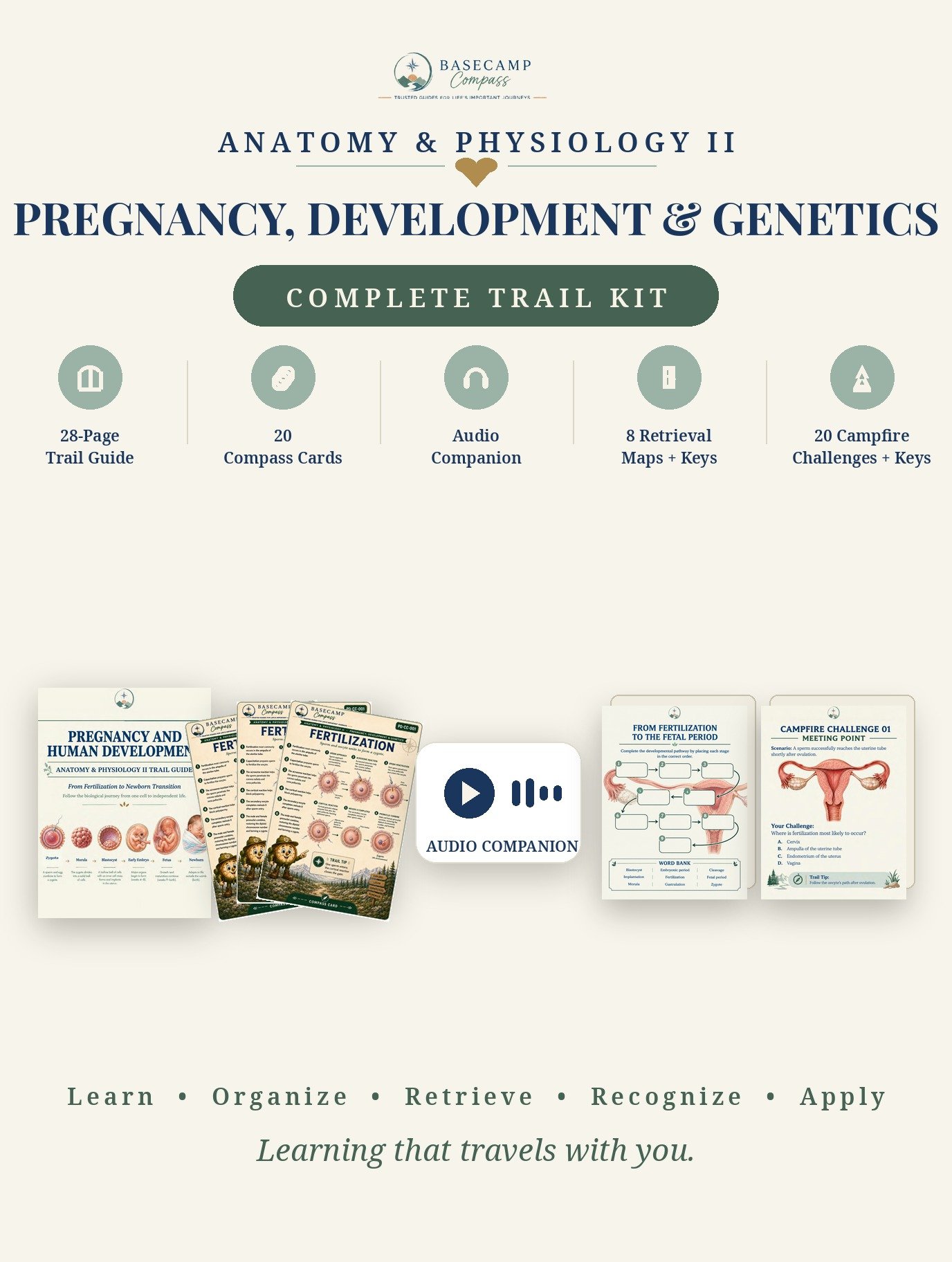
A complete A&P II study system with the 28-page Trail Guide, Compass Cards, Audio Companion, 8 fillable Retrieval Maps, and 20 Campfire Challenges with answer keys.

Original price was: $18.99.Current price is: $9.99.

DIGITAL · INSTANT ACCESS

What You'll Learn

Build a connected timeline from fertilization through newborn transition.
Organize the events of cleavage implantation gastrulation neurulation and fetal development.
Explain placental exchange fetal support structures and fetal circulation.
Connect pregnancy hormones with maternal adaptations and trimester changes.
Recognize inheritance patterns nondisjunction and selected chromosomal abnormalities.
Review prenatal testing and clinically important pregnancy complications.
Explain labor delivery newborn circulation and lactation.
Retrieve major sequences from memory using fillable visual maps.
Apply pregnancy development and genetics concepts to Campfire Challenge scenarios.
Use answer keys to locate knowledge gaps and direct additional review.

Table of contents

28 Page Pregnancy Human Development and Genetics Trail Guide
20 Pregnancy Human Development and Genetics Compass Cards
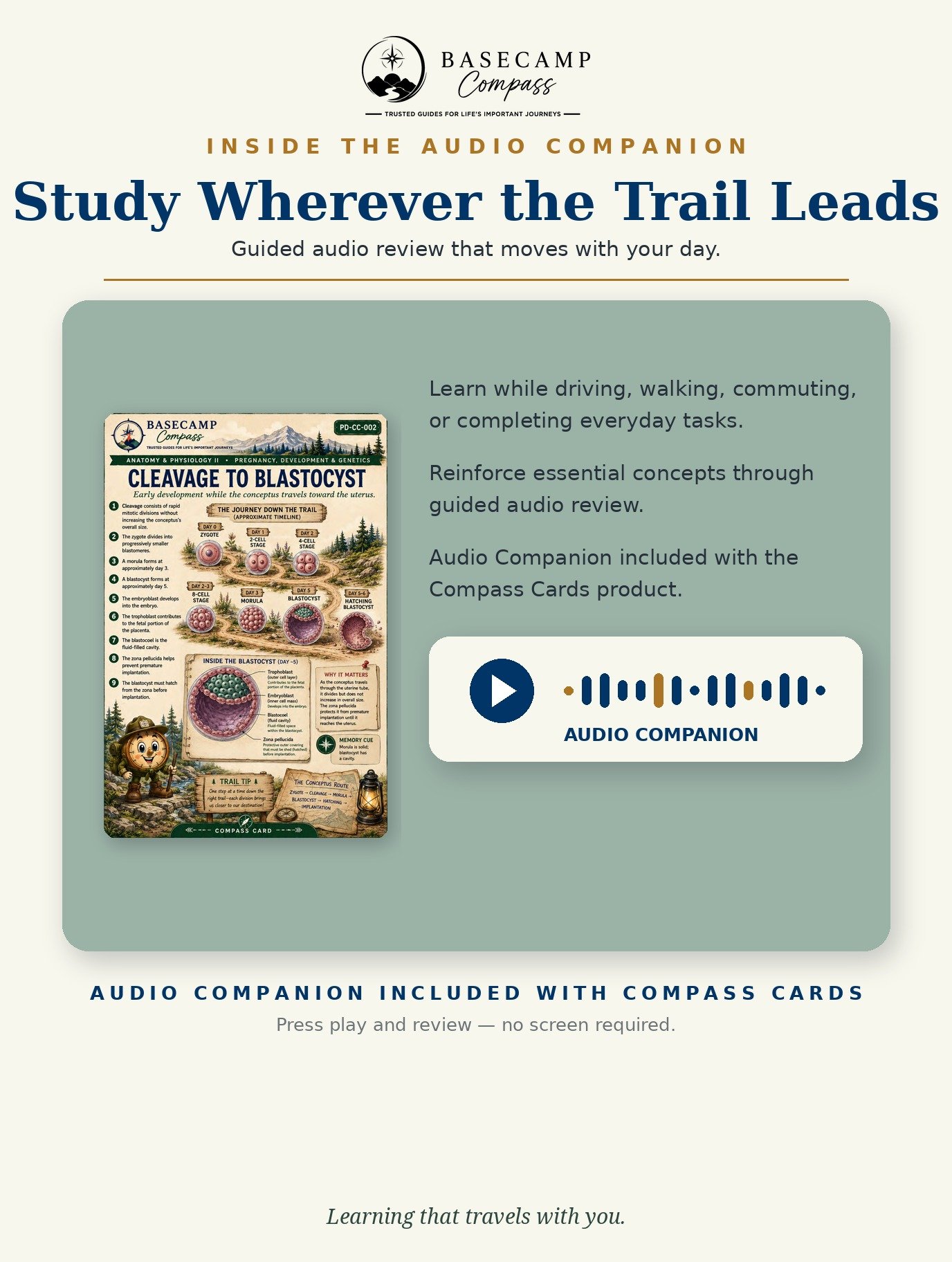
Pregnancy Human Development and Genetics Audio Companion
8 Fillable Retrieval Maps
Complete Retrieval Map Answer Keys
20 Campfire Challenges
Complete Campfire Challenge Answer Keys

The A and P II Pregnancy Human Development and Genetics Complete Trail Kit provides a coordinated study system for learning, organizing, retrieving, recognizing, and applying development, pregnancy, and inheritance concepts. It guides students from foundational understanding into active recall and scenario-based application.

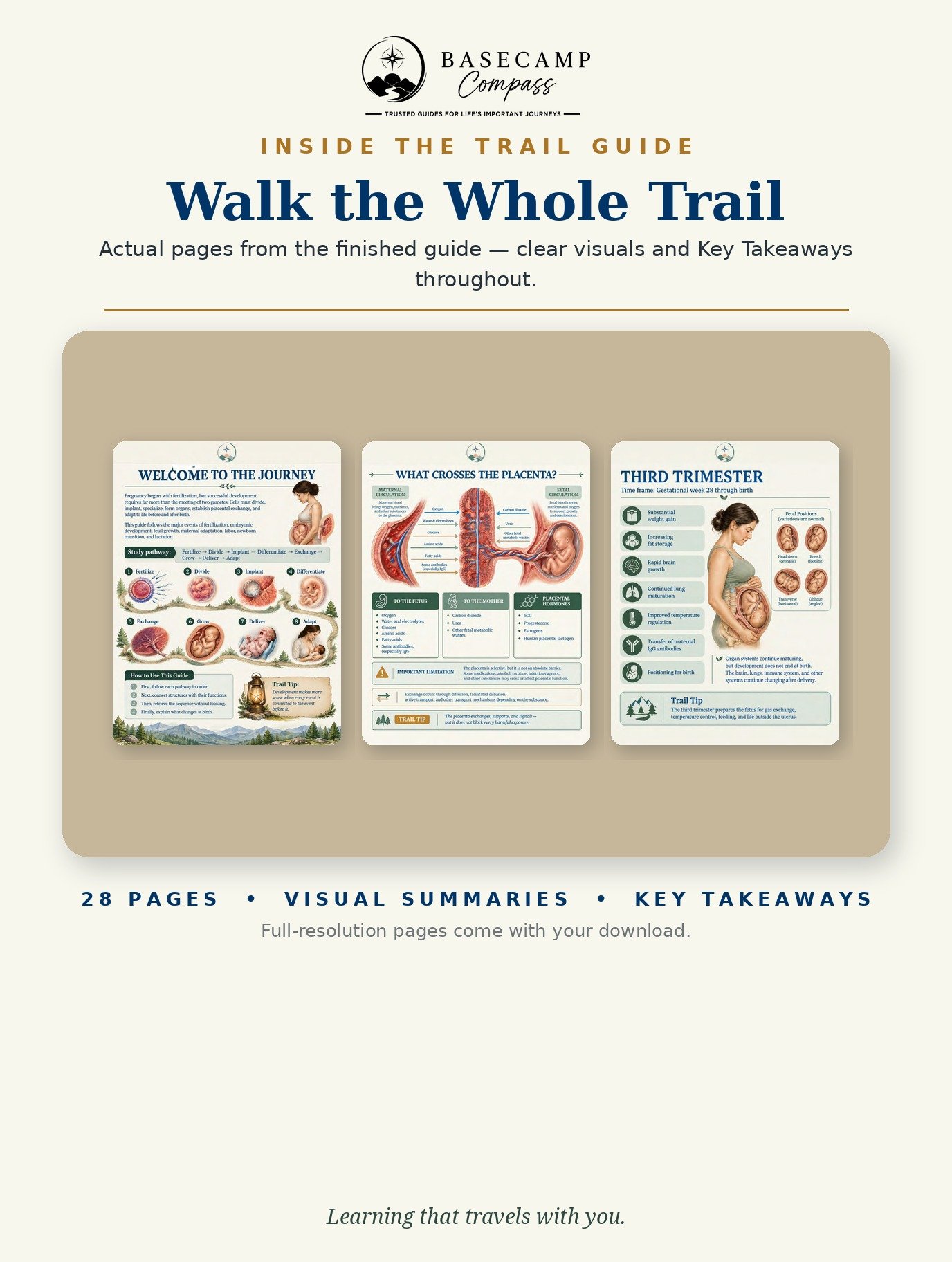
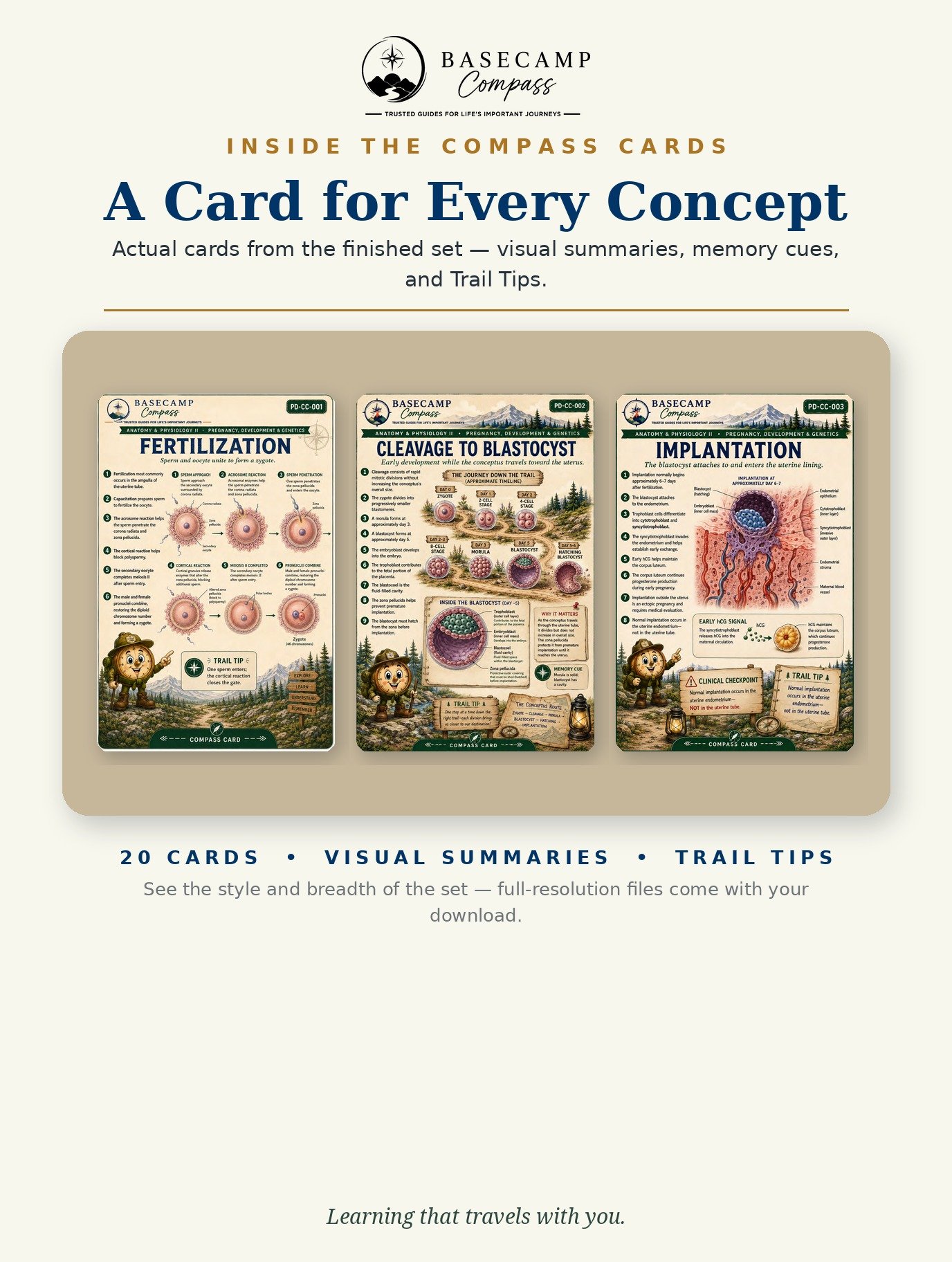
The 28-page Trail Guide creates a visual pathway from fertilization through birth, while 20 Compass Cards support focused review of development, genetics, pregnancy physiology, and clinical connections. The Audio Companion extends review beyond the screen. Eight fillable Retrieval Maps challenge learners to reconstruct major sequences and relationships from memory, and twenty Campfire Challenges require learners to interpret and apply the material.

Complete answer keys allow students to check their work, recognize gaps, and return to the concept that needs reinforcement. The kit complements A and P II coursework by combining multiple study methods in one organized and portable learning experience.
Reviews

There are no reviews yet.

Be the first to review “Pregnancy, Human Development & Genetics Complete Trail Kit | A&P II”

Your email address will not be published. Required fields are marked *

How It Works: Your Learning Journey

LEARN

The Guide Teaches The Journey.

REMEMBER

Reinforce important concepts.

CHALLENGE

Test your knowledge and build confidence.

dashed arrow set vector doodle dot line thin pointer arrows | Basecamp Compass, LLC

Campfire Challenge Preview

Take a look inside

Sample 1 — Meeting Point (Challenge 01)
Scenario: A sperm successfully reaches the uterine tube shortly after ovulation. Your Challenge: Where is fertilization most likely to occur? A. Cervix B. Ampulla of the uterine tube C. Endometrium of the uterus D. Vagina. Trail Tip: Follow the oocyte’s path after ovulation.
Sample 2 — Bypassing the Fetal Lungs (Challenge 11)
Scenario: Blood enters the fetal pulmonary trunk. Because the lungs are not yet functioning for gas exchange, much of this blood is diverted into the aorta. Your Challenge: Which fetal shunt provides this route? A. Ductus arteriosus B. Ductus venosus C. Foramen ovale D. Umbilical vein. Trail Tip: This vessel connects the pulmonary trunk with the aorta.
Sample 3 — The Milk-Ejection Reflex (Challenge 20)
Milk has already been produced. Infant suckling triggers contraction of myoepithelial cells surrounding the mammary alveoli. Your Challenge: Which hormone produces this milk-ejection response? A. Progesterone B. Human placental lactogen C. Oxytocin D. Prolactin. Trail Tip: One hormone makes milk; another helps move it.
Scroll to Top