The peripheral nervous system makes more sense when students stop treating its structures and pathways as disconnected vocabulary.
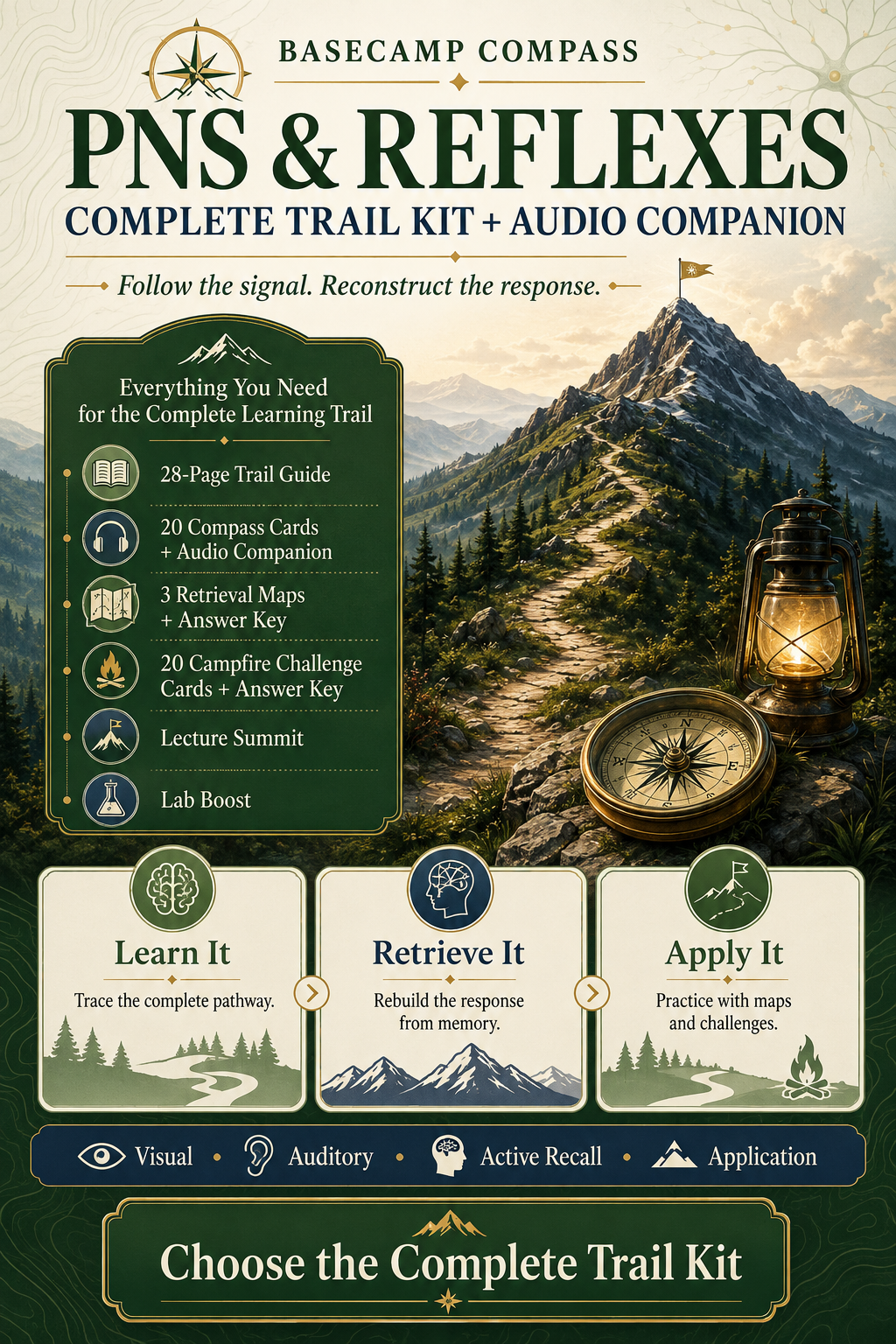
The PNS & Reflexes Trail Kit helps learners follow the signal from stimulus to response. Students examine where information begins, whether it travels toward or away from the central nervous system, how it is integrated, and what response the motor pathway produces.
The kit begins with a visually structured Trail Guide covering peripheral nerve organization, sensory and motor pathways, signal conduction, synapses, reflex arcs, sensory receptors, nerve injuries, and clinical reflex testing. Students then reinforce those concepts with Compass Cards, guided audio review, Retrieval Maps, and Campfire Challenge activities.
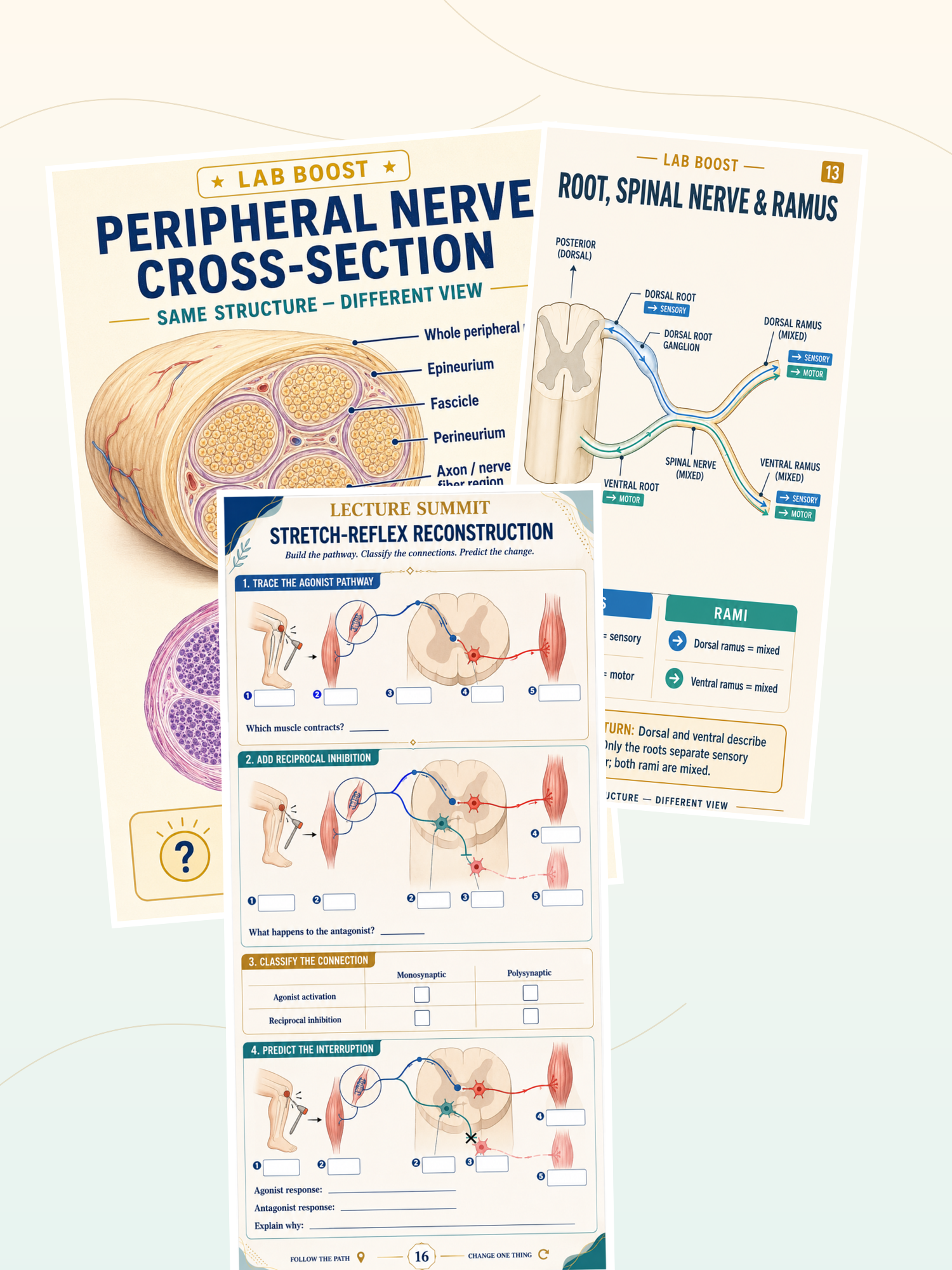
The included Lecture Summit and Lab Boost provide additional support for classroom learning and practical identification.
Rather than relying on repeated rereading, students actively trace, retrieve, reconstruct, explain, and apply the pathways.
What is included
- PNS & Reflexes Trail Guide — 28 pages
- PNS & Reflexes Compass Cards — 20 cards
- Audio Companion for all 20 Compass Cards
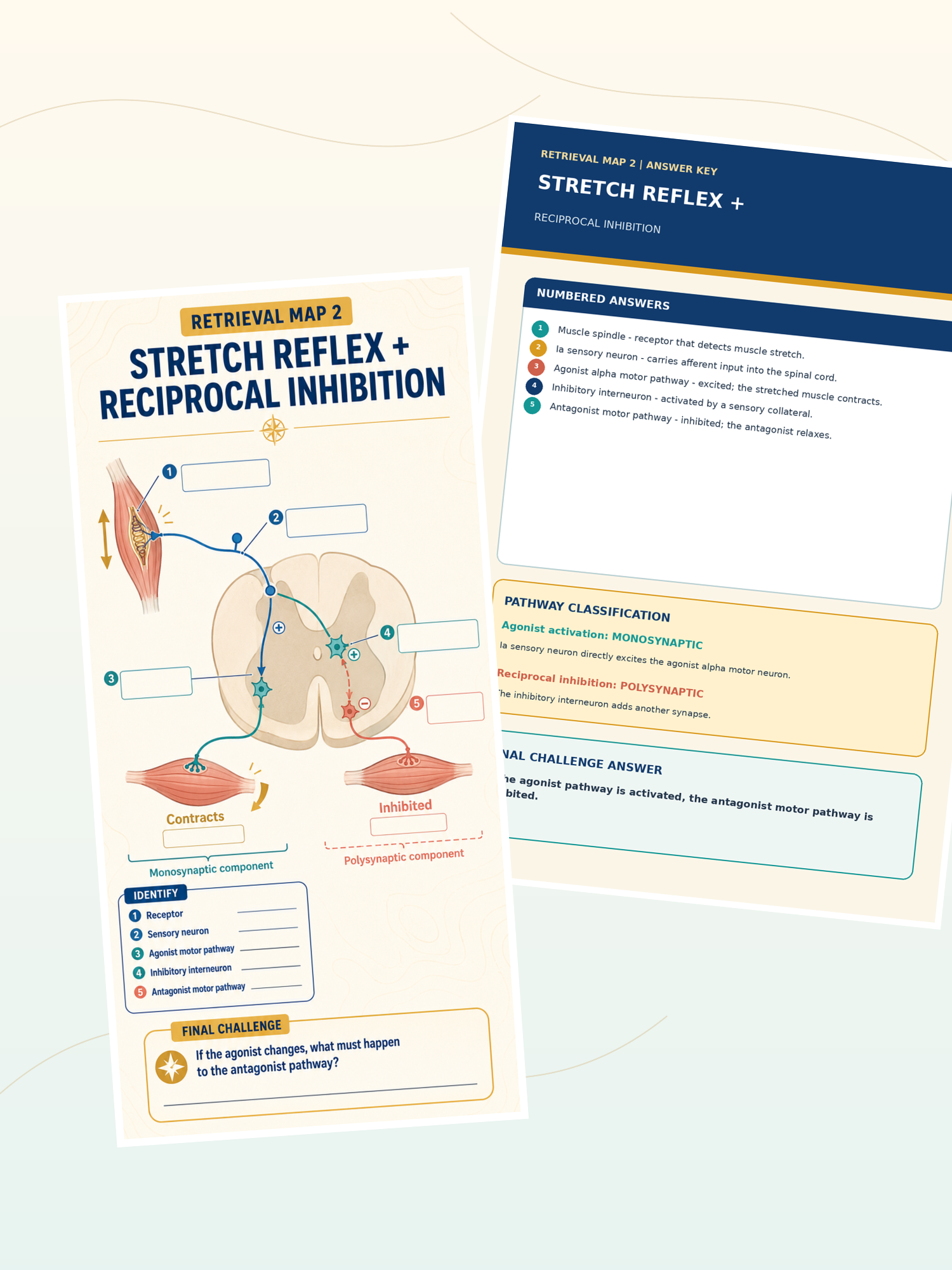
- Retrieval Maps — 3 maps
- Retrieval Maps Answer Key — 3 pages
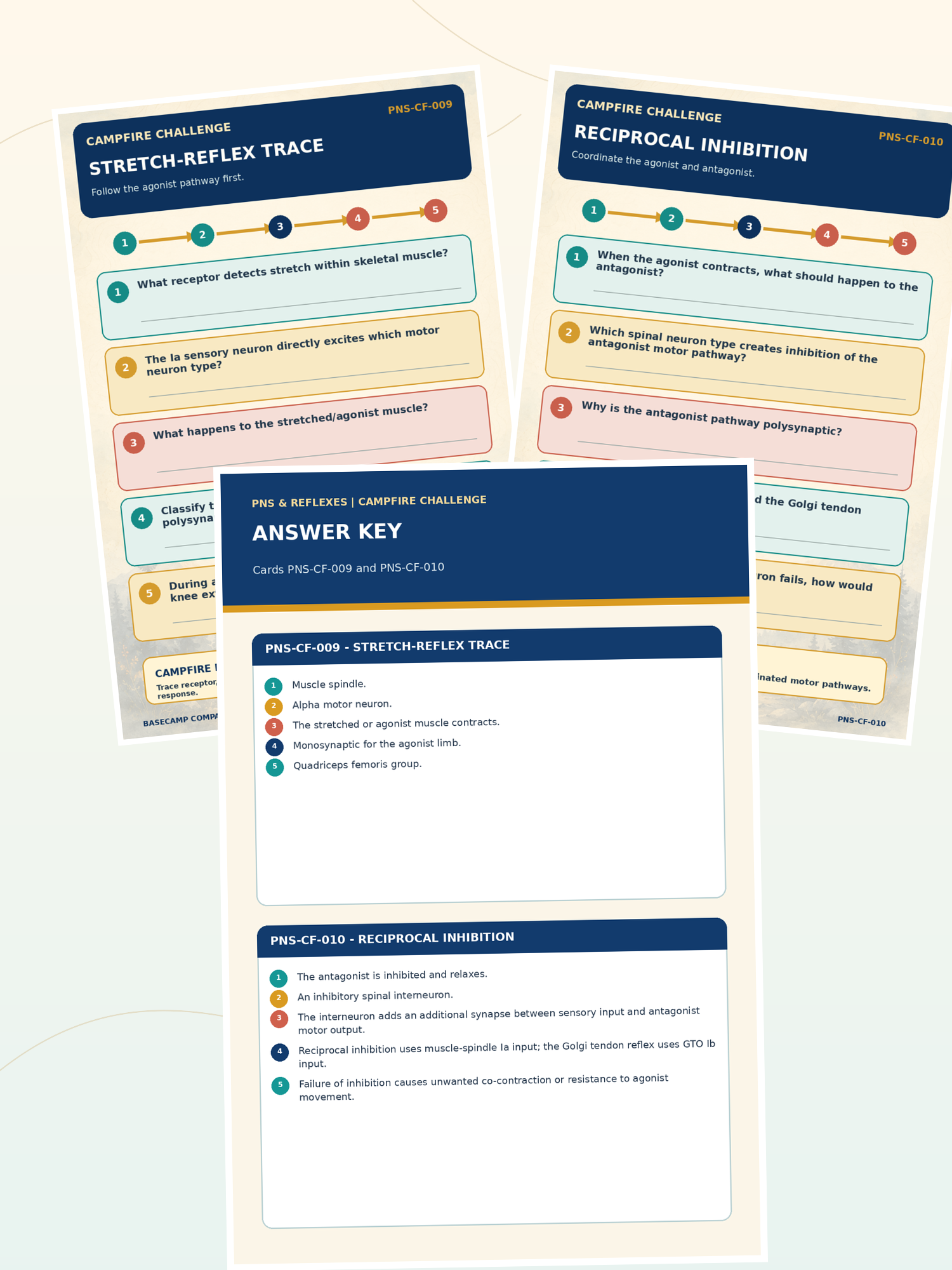
- Campfire Challenge — 20 application cards
- Campfire Challenge Answer Key — 4 pages
- PNS Lecture Summit — 4 pages
- PNS Lab Boost — 3 pages
Topics covered
- Organization and functions of the peripheral nervous system
- Afferent sensory and efferent motor pathways
- Somatic and autonomic motor architecture
- Connective-tissue layers of peripheral nerves
- Dorsal roots, ventral roots, spinal nerves, and rami
- Sensory receptors and receptor potentials
- Graded potentials and action-potential generation
- Myelination and conduction speed
- Chemical synaptic transmission
- The five-part reflex arc
- Somatic and autonomic reflexes
- Monosynaptic and polysynaptic pathways
- Stretch reflexes
- Reciprocal inhibition
- Muscle spindles and Golgi tendon organs
- Withdrawal reflexes
- Crossed-extensor reflexes
- Neuromuscular junction signaling
- Dermatomes and peripheral nerve distributions
- Peripheral nerve injury and regeneration
- Deep tendon reflex testing
Learning experience
Students are guided through a repeatable learning sequence:
- See the complete pathway.
- Trace the direction of the signal.
- Retrieve the pathway with fewer prompts.
- Rebuild it independently.
- Explain how the structures create the response.
- Apply the pathway to new questions and clinical situations.
Why students will love it
- Turns complicated neural pathways into traceable sequences
- Integrates visual, written, spoken, and active-retrieval learning
- Distinguishes structures that students commonly confuse
- Connects lecture concepts with lab and reflex-testing applications
- Includes answer keys for independent review
- Provides multiple ways to study the same concepts
- Supports short review sessions as well as comprehensive exam preparation
Perfect for
- Anatomy and Physiology students
- Nursing and allied-health students
- Pre-health and pre-nursing learners
- Students preparing for lecture examinations
- Students reviewing peripheral nervous system laboratory material
- Visual and auditory learners
- Learners who struggle to reconstruct reflex pathways from memory
- Instructors seeking supplemental learning activities
Reviews
There are no reviews yet.