
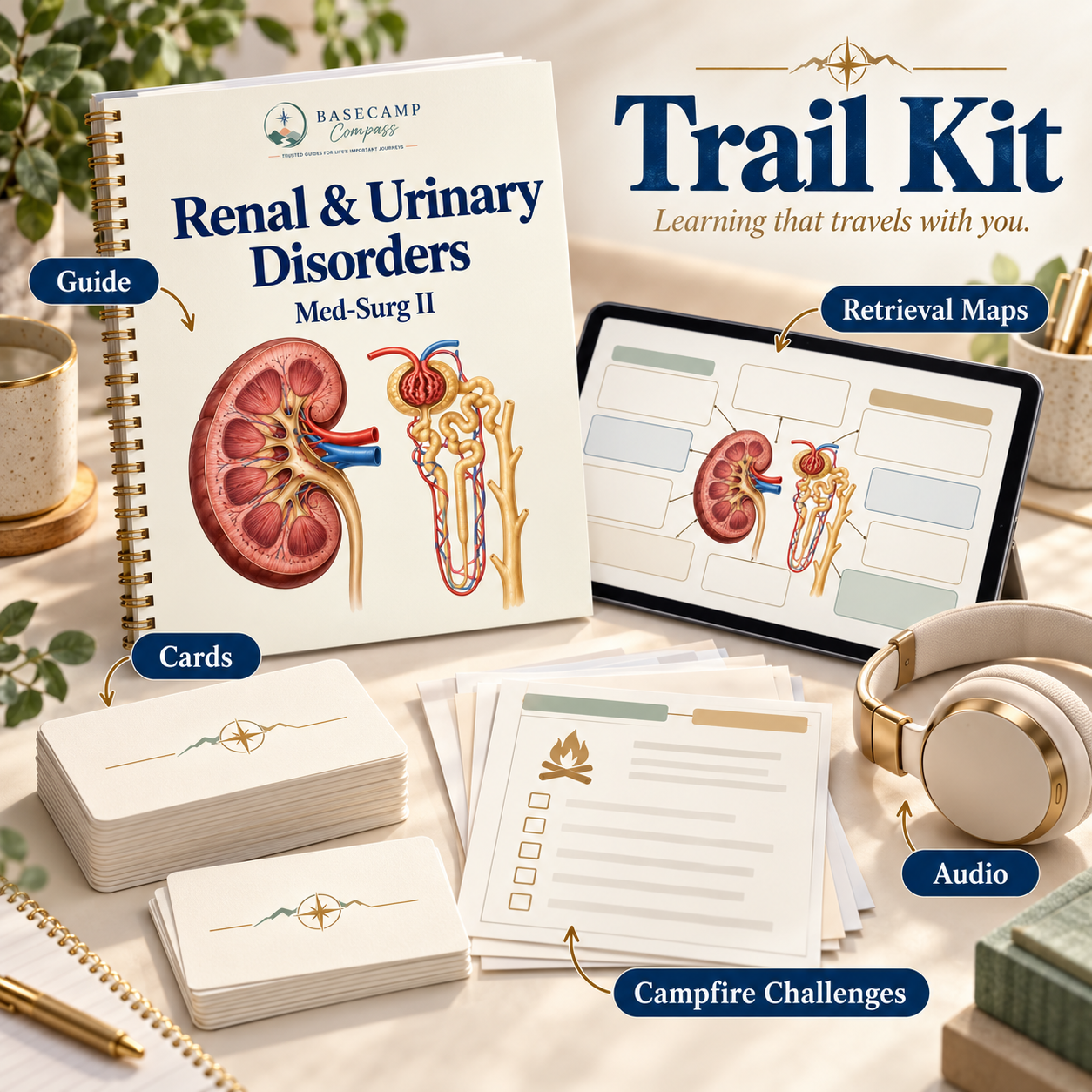
Renal and Urinary Disorders Trail Kit brings learning, review, retrieval and clinical scenario practice into one Med-Surg II study system. It includes a 40-page Trail Guide, 18 Compass Cards and matching audio, ten Retrieval Maps and twelve Campfire Challenges. The guide builds the foundations of renal assessment, AKI, CKD, dialysis and urinary care. The cards and audio revisit pattern recognition, nursing priorities and reporting instructions. Laboratory findings, volume status, perfusion and urinary drainage are connected with the patient’s current condition. Ten Retrieval Maps ask you to reconstruct kidney functions, focused assessment, AKI causes and care, CKD effects, hemodialysis, peritoneal dialysis, modality comparisons, urinary infection and urinary flow problems. Every student activity is followed immediately by its matching answer key. The maps come in printable and fillable formats containing the same activities and keys. The fillable PDF has 90 clean multiline response fields without handwriting lines. Enter and save responses in a forms-capable PDF reader, then compare your connections with the next-page key. Twelve Campfire Challenges ask you to apply renal and urinary nursing priorities to clinical scenarios. Each question is followed immediately by its best response and explanations for every alternative. Use the guide to learn, cards and audio to review, maps to retrieve and challenges to apply. The kit supports study alongside clinical instruction and current facility protocols.
Sale!
MedSurg II Renal & Urinary Disorders Trail Kit
Renal and Urinary Disorders Trail Kit brings learning, review, retrieval and clinical scenario practice into one Med-Surg II study system. It includes a 40-page Trail Guide, 18 Compass Cards and matching audio, ten Retrieval Maps and twelve Campfire Challenges.
- Estimated Reading Time: 60 minutes
- Pages: 73
- Skill Level: All Levels
- Format: Digital Download (PDF + Audio)
$15.00 Original price was: $15.00.$9.99Current price is: $9.99.
DIGITAL · INSTANT ACCESS
What You'll Learn
Organize renal and urinary concepts with the guide and revisit them with cards and audio.
Reconstruct the connections in ten activities before checking the keys.
Compare AKI causes, dialysis approaches and urinary infection patterns.
Practice volume, potassium, access, infection and obstruction decisions.
Explain the best response and safety concerns in the alternatives.
Connect treatment with reassessment and individual fluid and medicine plans.
Use immediate keys to identify topics needing another review.
Table of contents
Trail Guide with 40 learning and review pages
Compass Cards with 18 focused review pages
Matching Audio Companion
Printable and fillable Retrieval Maps with ten student/key pairs each
Map subjects: Kidney functions; renal assessment; AKI causes; AKI care; CKD effects; HD care; PD care; HD/PD comparison; urinary infection/sepsis; urinary flow problems
Campfire Challenges with twelve question/key pairs
Be the first to review “MedSurg II Renal & Urinary Disorders Trail Kit” Cancel reply
How It Works: Your Learning Journey
LEARN
The Guide Teaches The Journey.
REMEMBER
Reinforce important concepts.
CHALLENGE
Test your knowledge and build confidence.

Campfire Challenge Preview
Take a look inside
Sample 1 — A Sudden Creatinine Rise
Campfire Challenge 1 – A Sudden Creatinine Rise — Scenario: A 68-year-old has vomited for 24 hours. BP is 88/52, HR 118, and urine output 15 mL/hour for 6 hours. Creatinine rose from 1.0 to 2.4 mg/dL. Your decision: Which assessment and response has priority? Choose an answer A. Have the patient stand for orthostatic BP measurements. B. Assess airway, breathing, circulation and volume/perfusion while activating urgent help. C. Review only yesterday’s ECG. D. Delay evaluation until the next creatinine result.
Sample 2 — After Hemodialysis
Campfire Challenge 7 – After Hemodialysis — Scenario: Immediately after hemodialysis a patient stands and becomes dizzy. BP is 90/58 and HR 104. Your decision: What should the nurse do first? Choose an answer A. Give the scheduled antihypertensive immediately. B. Send the patient home to rest. C. Assist the patient to a safe supported sitting or lying position and reassess BP, symptoms and perfusion. D. Increase the next treatment’s fluid-removal goal independently.
Sample 3 — Break the CAUTI Chain
Campfire Challenge 12 – Break the CAUTI Chain — Scenario: A postoperative patient has had a urinary catheter for 2 days, is ambulatory and has clear urine. The team is reviewing whether it is still needed. Your decision: Which action best reduces ongoing infection risk? Choose an answer A. Replace the catheter on a routine daily schedule. B. Irrigate daily without an indication. C. Review need and arrange prompt removal under orders or protocol while maintaining closed unobstructed drainage. D. Collect a culture every day despite no symptoms.
Reviews
There are no reviews yet.