
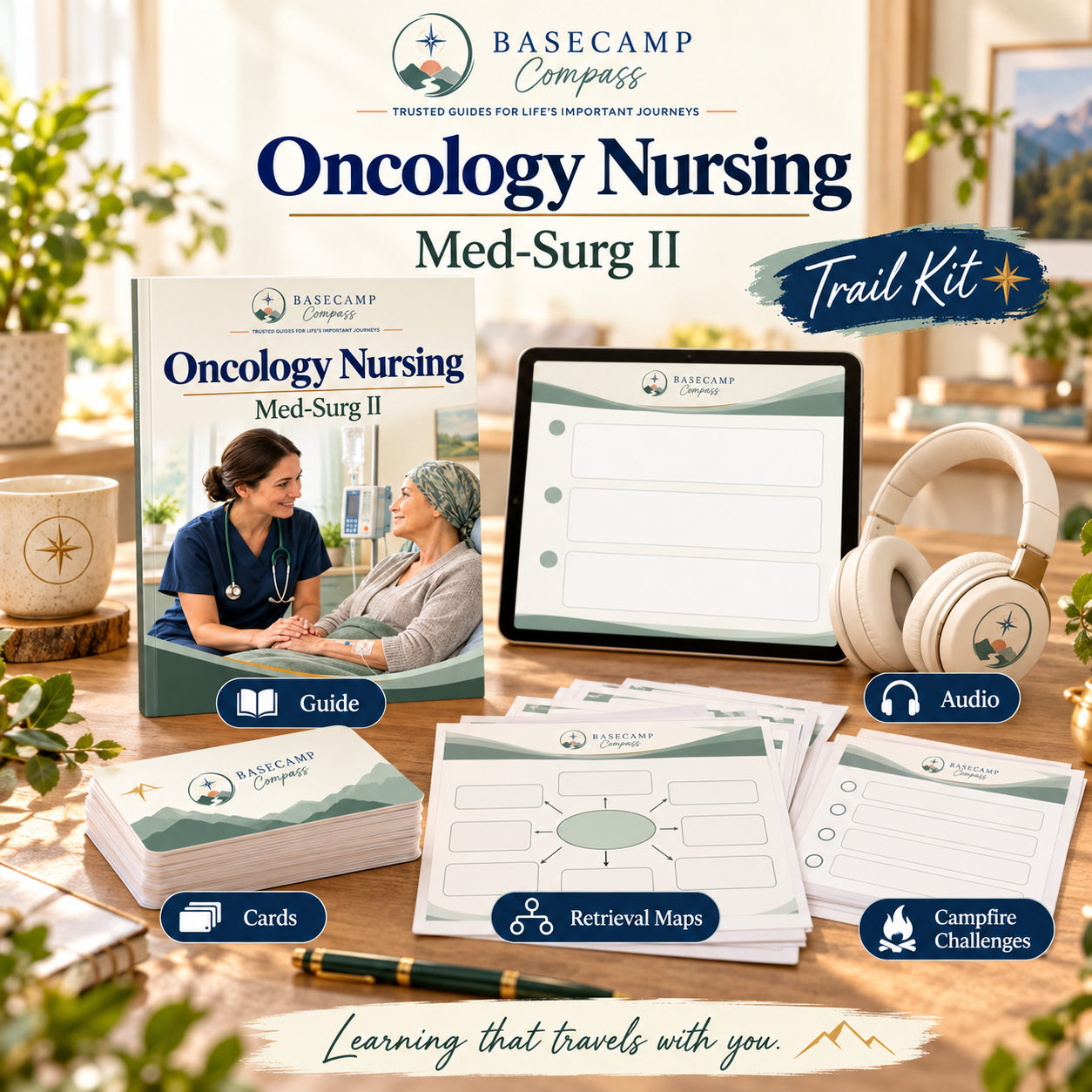
Oncology Nursing Trail Kit brings learning, review, retrieval and clinical scenario practice into one Med-Surg II study system. It includes a 40-page Trail Guide, 18 Compass Cards and matching audio, ten Retrieval Maps and twelve Campfire Challenges. The guide builds the foundations of cancer care and treatment safety. The cards and audio revisit assessment, nursing priorities and reporting instructions. Oncology emergencies are connected with blood counts, organ function, symptoms and the patient’s care goals. Ten Retrieval Maps ask you to reconstruct cancer growth and spread, diagnosis and staging, treatment modalities, safe handling, targeted and immune therapy, marrow suppression, infection, symptom management, metabolic emergencies and compression syndromes. Every student activity is followed immediately by its matching answer key. The maps come in printable and fillable formats containing the same activities and keys. The fillable PDF has 122 clean multiline response boxes without handwriting lines. Enter and save responses in a forms-capable PDF reader, then compare your connections with the next-page key. Twelve Campfire Challenges ask you to apply oncology nursing priorities to clinical scenarios. Each question is followed immediately by its best response and explanations for every alternative. Use the guide to learn, cards and audio to review, maps to retrieve and challenges to apply. The kit supports study alongside clinical instruction and current facility protocols.
Sale!
MedSurg II Oncology Trail Kit
Oncology Nursing Trail Kit brings learning, review, retrieval and clinical scenario practice into one Med-Surg II study system. It includes a 40-page Trail Guide, 18 Compass Cards and matching audio, ten Retrieval Maps and twelve Campfire Challenges.
- Estimated Reading Time: 60 minutes
- Pages: 73
- Skill Level: All Levels
- Format: Digital Download (PDF + Audio)
$15.00 Original price was: $15.00.$9.99Current price is: $9.99.
DIGITAL · INSTANT ACCESS
What You'll Learn
Organize oncology concepts with the guide and revisit them with cards and audio.
Reconstruct the connections in ten retrieval activities before checking the keys.
Compare treatment modalities and their different nursing safety needs.
Practice infection, infusion, bleeding, neurologic and metabolic decisions.
Explain the best response and safety concerns in the alternatives.
Connect symptom support with function, preferences and care goals.
Use immediate answer keys to identify topics needing another review.
Table of contents
Trail Guide with 40 learning and review pages
Compass Cards with 18 focused review pages
Matching Audio Companion
Printable and fillable Retrieval Maps with ten student/key pairs each
Campfire Challenges with twelve question/key pairs
How It Works: Your Learning Journey
LEARN
The Guide Teaches The Journey.
REMEMBER
Reinforce important concepts.
CHALLENGE
Test your knowledge and build confidence.

Campfire Challenge Preview
Take a look inside
Sample 1 — Fever With Severe Neutropenia
Campfire Challenge 1 – Fever With Severe Neutropenia — Scenario: A 62-year-old receiving lymphoma chemotherapy has ANC 400 cells/microliter, temperature 38.8 C, chills, heart rate 118 and BP 98/62. Your decision: What is the priority response? Choose an answer A. Give oral fluids and reassess in two hours. B. Use cooling measures as the only response. C. Activate urgent neutropenic-sepsis care, obtain prompt ordered cultures and start prescribed empiric antibiotics without delay. D. Restrict visitors and wait for morning rounds.
Sample 2 — Diarrhea and Dyspnea on Immunotherapy
Campfire Challenge 7 – Diarrhea and Dyspnea on Immunotherapy — Scenario: A patient on pembrolizumab has watery diarrhea six times daily, new rash, abdominal cramps and dyspnea. Oxygen saturation is 92%; heart rate 104. Your decision: What is the priority response? Choose an answer A. Assess and support breathing, arrange urgent medical evaluation now and withhold further treatment pending the oncology plan. B. Give loperamide and schedule a visit next week. C. Use a clear-liquid diet and observe for 48 hours. D. Reassure the patient and give only cough medicine.
Sample 3 — Severe Infusion Reaction
Campfire Challenge 12 – Severe Infusion Reaction — Scenario: During a first chemotherapy infusion, a patient develops hives, wheezing, dyspnea, BP 82/50 and oxygen saturation 88%. Your decision: What is the immediate first response? Choose an answer A. Stop the infusion and activate emergency help while initiating anaphylaxis care under protocol. B. Continue faster to finish the dose. C. Give an oral antihistamine and wait 30 minutes. D. Give oxygen but keep the infusion running until the provider arrives.
Reviews
There are no reviews yet.