
Sale!

MedSurg II Neurologic Disorders Trail Kit

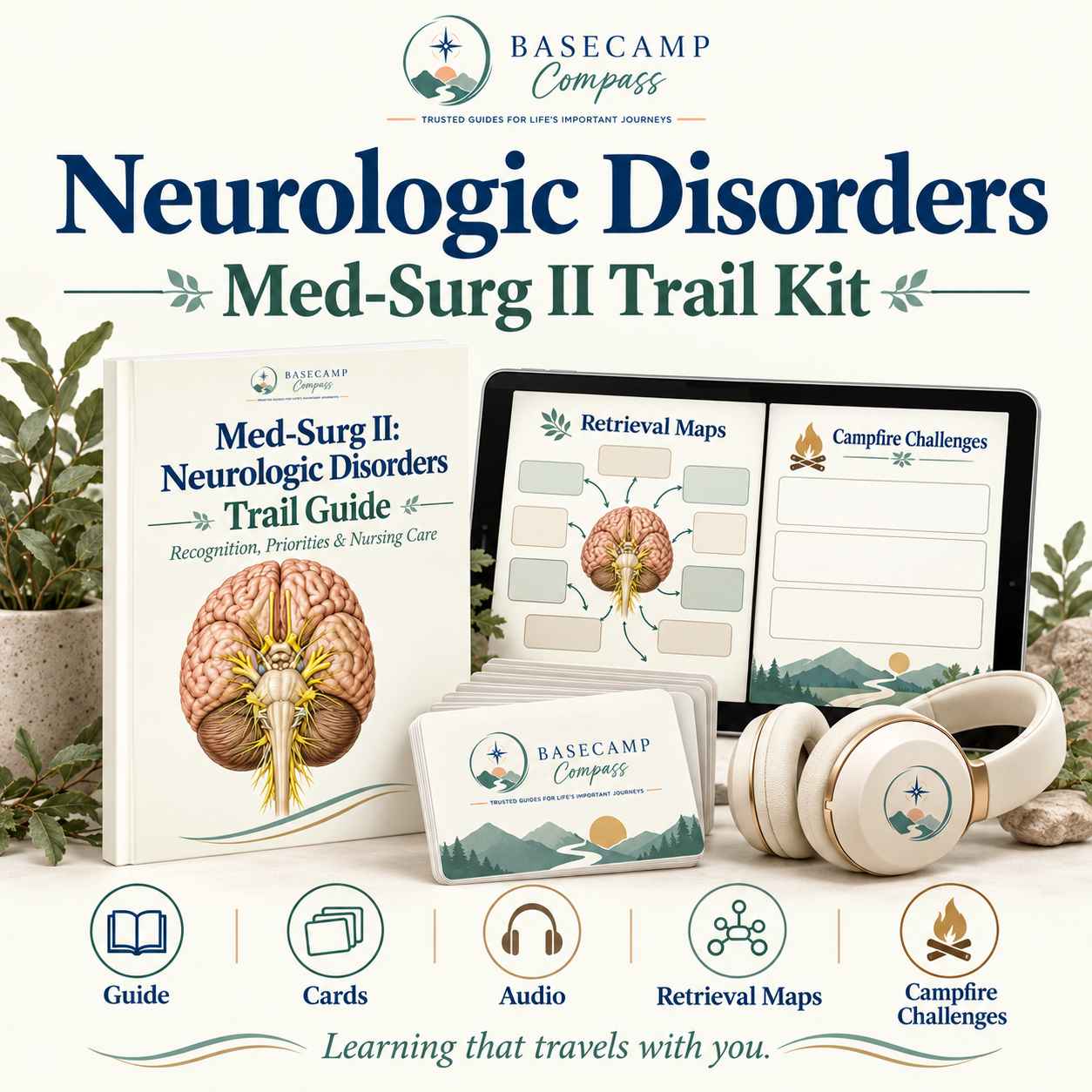
The MedSurg II Neurologic Disorders Trail Kit brings the Med-Surg II subject into one coordinated study system — a 40-page Trail Guide, 18 Compass Cards with the Audio Companion, ten Retrieval Maps, and twelve Campfire Challenges.

Original price was: $15.00.Current price is: $9.99.

DIGITAL · INSTANT ACCESS

What You'll Learn

Organize neurologic concepts with the guide and review essential patterns with the cards and audio.
Reconstruct assessment, priority and escalation connections using the ten maps.
Compare disorders that share weakness, cognitive changes or sensory findings.
Apply seizure, headache, stroke-pattern and respiratory safety principles to clinical scenarios.
Practice swallowing, mobility, skin and medication decisions.
Explain why the best scenario response is stronger than the other choices.
Check your work against immediately following keys and revisit topics that need review.

Table of contents

Trail Guide with 40 visual study pages
Compass Cards with 18 focused review pages
Audio Companion for the Compass Cards subjects
Retrieval Maps in printable and fillable formats with ten student and answer-key pairs in each
Campfire Challenges with twelve alternating question and rationale pairs
Map subjects: assessment, headaches, seizures, MS/PD, MG/GBS, ALS, dementia/delirium, neuropathy/Bell palsy/trigeminal neuralgia, functional safety and deterioration
Challenge subjects: facial weakness, thunderclap headache, seizure safety, repeated seizures, heat-related MS symptoms, Parkinson rigidity, MG swallowing, GBS weakness, progressive motor weakness, delirium, foot injury and post-craniotomy decline
Neurologic Disorders Trail Kit brings the Med-Surg II subject into one coordinated study system. Learn the concepts with a 40-page Trail Guide, review with 18 Compass Cards and the Audio Companion, retrieve the connections with ten Retrieval Maps and apply them in twelve Campfire Challenges.

The kit links assessment and diagnostic safety with headaches, seizures, demyelinating and movement disorders, neuromuscular weakness, cognitive change and peripheral disorders. Nursing support sections connect the conditions with swallowing, ventilation, mobility, skin, communication and medication decisions.

The Retrieval Maps use six consistent prompts: Pattern, Recognize, Check and connect, Priority, Nursing actions and Escalate. Comparison activities help you distinguish conditions such as MS and Parkinson disease, myasthenia gravis and Guillain-Barre syndrome, and dementia and delirium. Each student page is followed by its matching answer key.

The maps are supplied in printable and fillable PDF formats. Both contain the same ten activities and keys. The fillable version has clean blank response areas without handwriting lines, so you can enter and save your responses in a forms-capable PDF reader.

The twelve Campfire Challenges present clinical scenarios followed immediately by the best response and explanations for every answer choice. Use the kit alongside your course resources to move from learning and organizing to recall and application. It is a digital study companion and does not replace a textbook, clinical judgment or local protocols.

INCLUDED

  • 40-page Trail Guide PDF
  • 18-page Compass Cards PDF and matching Audio Companion
  • 20-page printable Retrieval Maps PDF with ten student/key pairs
  • 20-page fillable Retrieval Maps PDF with the same ten student/key pairs and 90 response fields
  • 24-page Campfire Challenges PDF with twelve question/key pairs

WHAT YOU WILL LEARN

  • Organize neurologic concepts with the guide and review essential patterns with the cards and audio.
  • Reconstruct assessment, priority and escalation connections using the ten maps.
  • Compare disorders that share weakness, cognitive changes or sensory findings.
  • Apply seizure, headache, stroke-pattern and respiratory safety principles to clinical scenarios.
  • Practice swallowing, mobility, skin and medication decisions.
  • Explain why the best scenario response is stronger than the other choices.
  • Check your work against immediately following keys and revisit topics that need review.

TABLE OF CONTENTS

  • Trail Guide with 40 visual study pages
  • Compass Cards with 18 focused review pages
  • Audio Companion for the Compass Cards subjects
  • Retrieval Maps in printable and fillable formats with ten student and answer-key pairs in each
  • Campfire Challenges with twelve alternating question and rationale pairs
  • Map subjects: assessment, headaches, seizures, MS/PD, MG/GBS, ALS, dementia/delirium, neuropathy/Bell palsy/trigeminal neuralgia, functional safety and deterioration
  • Challenge subjects: facial weakness, thunderclap headache, seizure safety, repeated seizures, heat-related MS symptoms, Parkinson rigidity, MG swallowing, GBS weakness, progressive motor weakness, delirium, foot injury and post-craniotomy decline

Reviews

There are no reviews yet.

Be the first to review “MedSurg II Neurologic Disorders Trail Kit”

Your email address will not be published. Required fields are marked *

How It Works: Your Learning Journey

LEARN

The Guide Teaches The Journey.

REMEMBER

Reinforce important concepts.

CHALLENGE

Test your knowledge and build confidence.

dashed arrow set vector doodle dot line thin pointer arrows | Basecamp Compass, LLC

Campfire Challenge Preview

Take a look inside

Sample 1 — Facial Weakness Bell Palsy or Stroke
Campfire Challenge 1 – Facial Weakness Bell Palsy or Stroke — Scenario: A 68-year-old arrives with right facial droop that began 20 minutes ago. The right forehead is weak, the right arm is weak and speech is slurred. BP 190/110 mmHg, HR 92 and irregular, RR 18, SpO2 95% on room air, glucose 110 mg/dL. The patient takes warfarin for atrial fibrillation. Your decision: Which action should the nurse take first? Choose an answer A. Reassure the patient that forehead weakness confirms Bell palsy. B. Activate the stroke protocol while assessing airway and focal deficits; keep the patient NPO. C. Give scheduled carbidopa-levodopa because facial weakness indicates Parkinson disease. D. […]
Sample 2 — Myasthenia With Worsening Swallowing
Campfire Challenge 7 – Myasthenia With Worsening Swallowing — Scenario: A 56-year-old with myasthenia gravis has new difficulty swallowing saliva, weak speech, ptosis and inability to lift the head well. RR 22, SpO2 93% on room air; the cough is weak. A lunch tray is at the bedside. Your decision: What should the nurse do first? Choose an answer A. Give pyridostigmine early without an order. B. Offer thickened liquids to test swallowing. C. Activate rapid response, withhold oral intake and support airway protection with safe positioning and suction readiness. D. Insert a feeding tube before assessing airway and breathing.
Sample 3 — Acute Decline After Craniotomy
Campfire Challenge 12 – Acute Decline After Craniotomy — Scenario: A 55-year-old is postoperative day 1 after craniotomy for tumor resection. GCS falls from 14 to 10 over an hour. The right pupil is newly dilated and nonreactive. BP 178/92, HR 52, RR 10 and irregular; the patient does not follow commands. Your decision: What is the first priority? Choose an answer A. Give mannitol without an order before assessing the airway. B. Activate emergency response and support airway and breathing; use safe ordered head and neck positioning. C. Wait 30 minutes before repeating the exam. D. Focus first on routine VTE prophylaxis.
Scroll to Top