
Sale!

Med-Surg II Burns Trail Kit

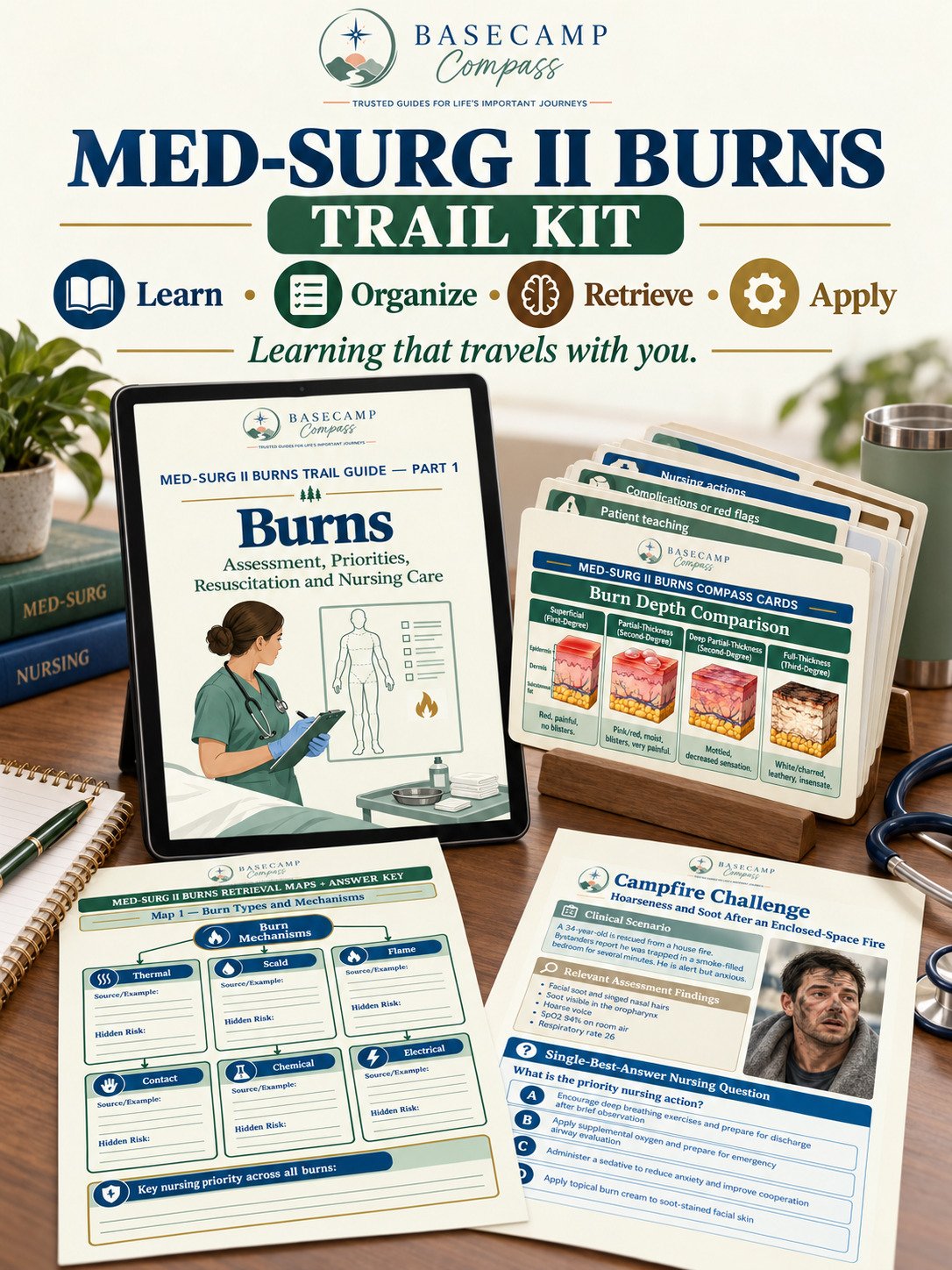
A complete burn-care study system: 40-page Trail Guide, 18 Compass Cards, 10 fillable Retrieval Maps with answer keys, and 12 Campfire Challenges with answer explanations.

Original price was: $15.00.Current price is: $9.99.

DIGITAL · INSTANT ACCESS

What You'll Learn

How to prioritize airway, breathing, circulation, exposure control, and early escalation.
How to compare burn mechanisms, depths, locations, and severity indicators.
How to recognize inhalation injury and toxic exposure patterns.
How to estimate total body surface area and connect the estimate to resuscitation planning.
How to calculate and monitor burn fluid resuscitation while watching for inadequate or excessive replacement.
How to identify complications associated with electrical, chemical, and circumferential burns.
How to plan nursing care for wounds, infection risk, pain, nutrition, mobility, and recovery.
How to retrieve key information without prompts and verify it with answer keys.
How to apply burn-care knowledge to priority nursing questions and clinical scenarios.

Table of contents

Trail Guide
Part 1: assessment, burn mechanisms, inhalation injury, depth, severity, and burn-size estimation
Part 2: burn shock, fluid resuscitation, wound care, complications, recovery, and clinical judgment
Compass Cards
18 visual cards covering burn depth, size estimation, airway and toxic exposure, shock and fluids, special burn types, wound care, and recovery
Fillable Retrieval Maps and Answer Keys
1. Burn Types and Mechanisms
2. Burn Depth Comparison
3. Estimating Total Body Surface Area
4. Initial Burn Priorities
5. Inhalation Injury and Toxic Exposure
6. Burn Shock and Fluid Shifts
7. Parkland Formula and Monitoring
8. Electrical Chemical and Circumferential Burns
9. Wound Care Infection and Pain Management
10. Nutrition Mobility and Recovery
Campfire Challenges and Answer Explanations
1. Hoarseness and Soot After an Enclosed-Space Fire
2. Calculating Burn Fluids After Delayed Arrival
3. Falling Urine Output During Burn Resuscitation
4. Increasing Pain and Reduced Pulse Below a Circumferential Burn
5. Dry Chemical Powder on the Skin
6. Electrical Burn With Dark Urine and Irregular Rhythm
7. Sudden Breathing Difficulty With a Circumferential Chest Burn
8. Worsening Wound Appearance and Systemic Deterioration
9. Timing Analgesia Before a Dressing Change
10. Protecting a New Skin Graft
11. Normal Pulse Oximetry After Smoke Exposure
12. Choosing the First Action in a Burn Emergency

The Med-Surg II Burns Trail Kit is a complete learning system for understanding, organizing, retrieving, and applying burn-care knowledge. Instead of relying on passive rereading, students move through four coordinated tools that support different stages of learning.

Begin with the 40-page Trail Guide to build a clear foundation in assessment, burn severity, resuscitation, nursing care, complications, and recovery. Use the 18 Compass Cards to organize high-yield facts and visual comparisons. Complete the 10 fillable Retrieval Maps to practice recalling information from memory, then check each response with the corresponding answer key. Finish with 12 Campfire Challenges that apply burn concepts to focused clinical scenarios with answer explanations and clinical takeaways.

The Trail Kit supports Med-Surg coursework, clinical preparation, and exam review by helping learners move from recognizing information to using it in nursing decisions. The digital format makes it easy to study in longer sessions or return for short, focused review.

Basecamp Compass products are designed as study companions. They support learning and clinical preparation but do not replace assigned course materials, professional instruction, facility policy, or clinical judgment.

Reviews

There are no reviews yet.

Be the first to review “Med-Surg II Burns Trail Kit”

Your email address will not be published. Required fields are marked *

How It Works: Your Learning Journey

LEARN

The Guide Teaches The Journey.

REMEMBER

Reinforce important concepts.

CHALLENGE

Test your knowledge and build confidence.

dashed arrow set vector doodle dot line thin pointer arrows | Basecamp Compass, LLC

Campfire Challenge Preview

Take a look inside

Sample 1 — Hoarseness and Soot After an Enclosed-Space Fire
Campfire Challenge — Hoarseness and Soot After an Enclosed-Space Fire — Clinical Scenario: A 34-year-old is rescued from a house fire. Bystanders report he was trapped in a smoke-filled bedroom for several minutes. He is alert but anxious. Relevant Assessment Findings: Facial soot and singed nasal hairs; Soot visible in the oropharynx; Hoarse voice; SpO2 94% on room air; Respiratory rate 26. Single-Best-Answer Nursing Question: What is the priority nursing action? […]
Sample 2 — Sudden Breathing Difficulty With a Circumferential Chest Burn
Campfire Challenge — Sudden Breathing Difficulty With a Circumferential Chest Burn — Clinical Scenario: A patient with circumferential full-thickness burns across the chest and abdomen becomes increasingly short of breath several hours after injury. Relevant Assessment Findings: SpO2 88% on supplemental oxygen; Respiratory rate 34; Decreased breath sounds bilaterally; Chest wall rigid with poor expansion; Tense, leathery eschar; Patient appears anxious and is using accessory muscles. Single-Best-Answer Nursing Question: What is the priority action? […]
Sample 3 — Choosing the First Action in a Burn Emergency
Campfire Challenge — Choosing the First Action in a Burn Emergency — Clinical Scenario: A patient arrives at the emergency department with a 20% total body surface area flame burn to the arms and chest. The airway is patent, but breathing is labored and the radial pulse is weak. Relevant Assessment Findings: Heart rate 132; Blood pressure 80/50; Respiratory rate 28; Cool, clammy skin; Burns involve arms and anterior chest. Single-Best-Answer Nursing Question: What is the priority first action? […]
Scroll to Top