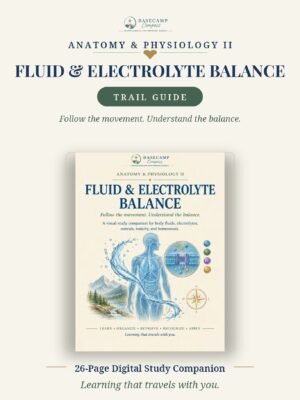
Fluid & Electrolyte Balance Trail Guide | A&P II
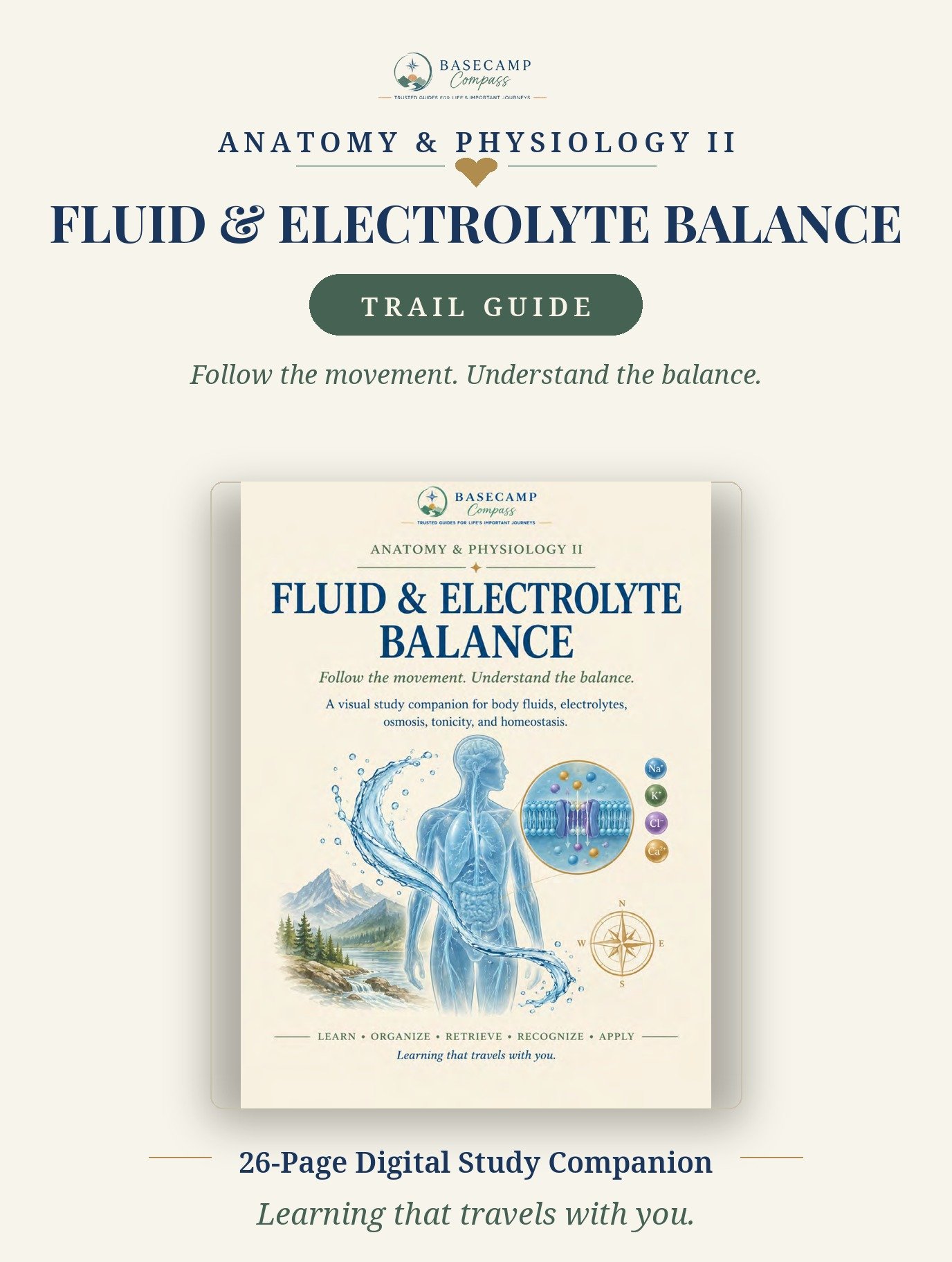
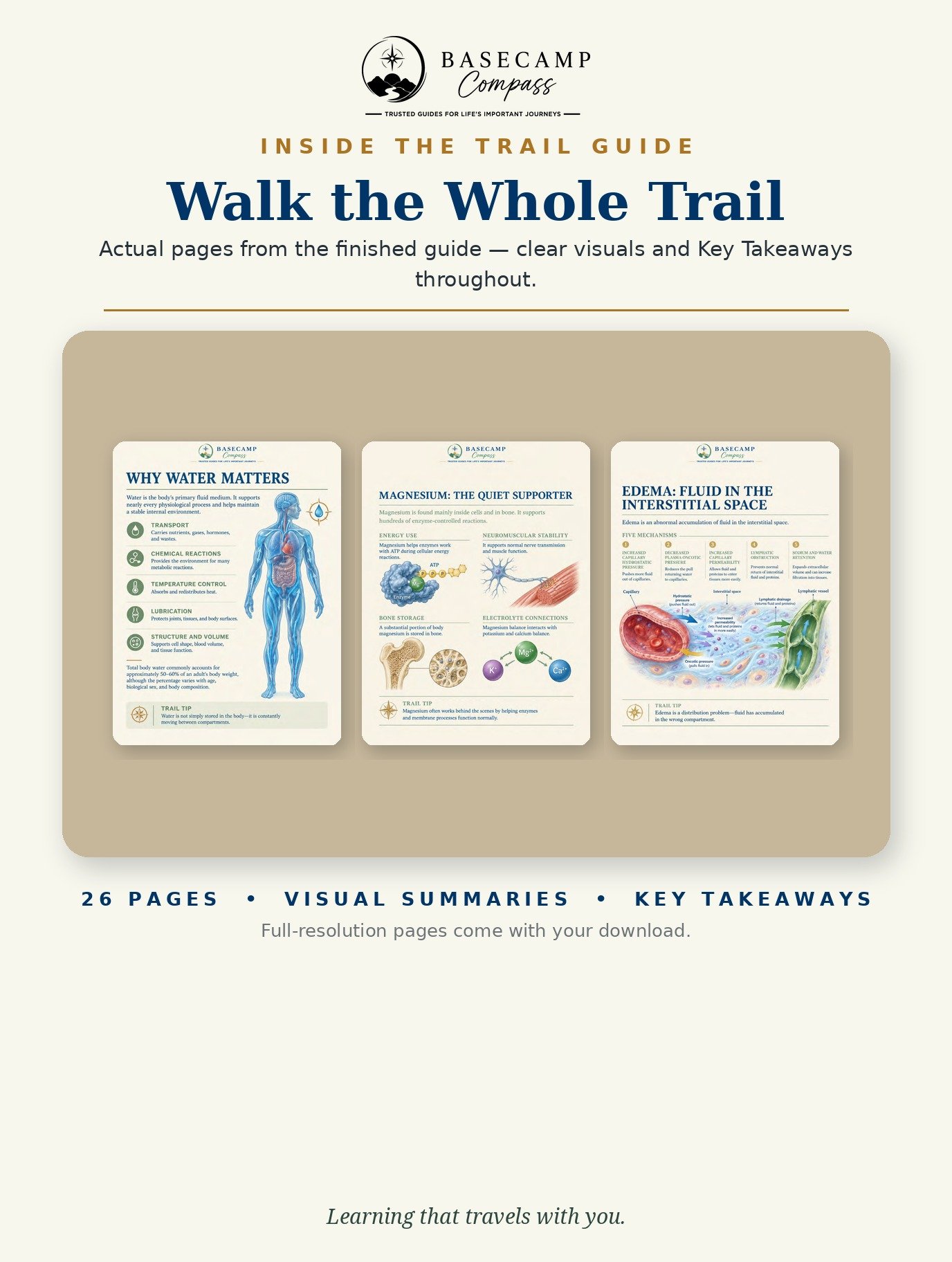
A 26-page illustrated A&P II study companion that connects body-fluid compartments, solute movement, osmolarity, tonicity, electrolytes, kidney and hormonal regulation, fluid disturbances, acid-base balance, and basic ABG interpretation.
- Estimated Reading Time: 60 minutes
- Pages: 26
- Skill Level: All Levels
- Format: Digital Download (PDF)
$11.99
PDF · Instant download
What You'll Learn
Distinguish intracellular fluid from extracellular fluid and identify the major subdivisions of ECF.
Explain diffusion, osmosis, filtration, active transport, osmolarity, and tonicity.
Predict how isotonic, hypotonic, and hypertonic solutions affect cell volume.
Identify the major physiological roles of sodium, potassium, calcium, magnesium, chloride, bicarbonate, and phosphate.
Describe filtration, reabsorption, secretion, and excretion in the nephron.
Trace the actions of ADH, RAAS, aldosterone, natriuretic peptides, and thirst.
Explain fluid gains and losses, water deficit, water excess, and edema.
Separate extracellular volume changes from osmolarity changes when analyzing a fluid disturbance.
Describe the basic relationship among chemical buffers, the lungs, the kidneys, and acid–base balance.
Table of contents
Water and the Body's Fluid Compartments
Movement of Water and Solutes
Osmolarity, Tonicity, and Cell Volume
Major Cations and Anions
Kidney Regulation of Fluid and Electrolytes
ADH and Thirst
RAAS, Aldosterone, and Natriuretic Peptides
Daily Fluid Gains and Losses
Fluid Deficit and Water Excess
Edema and Fluid Distribution
Volume, Osmolarity, and Cell Response
Acid–Base Connection and Integrated Review
Build a connected understanding of body fluids, electrolytes, osmolarity, and homeostatic regulation with the Basecamp Compass A&P II Fluid & Electrolyte Balance Trail Guide. This illustrated study companion helps students follow how water and dissolved particles move between compartments, how the kidneys and hormones maintain balance, and why changes in volume and concentration affect the body differently.
The guide begins with total body water, intracellular and extracellular fluid, diffusion, osmosis, filtration, active transport, and tonicity. It then reviews the major cations and anions before connecting kidney function with ADH, RAAS, natriuretic peptides, and thirst. Fluid gains and losses, water deficit, water excess, edema, osmolarity, extracellular volume, and the acid–base connection are brought together through visual explanations and an integrated hot-trail scenario.
Use the guide to preview a unit, organize lecture material, revisit difficult pathways, or prepare for an exam. It is designed as a study companion and does not replace the assigned textbook, instructor materials, or laboratory work.
Learning that travels with you.
How It Works: Your Learning Journey
LEARN
The Guide Teaches The Journey.
REMEMBER
Reinforce important concepts.
CHALLENGE
Test your knowledge and build confidence.
Campfire Challenge Preview
Sample Challenge Questions
Is this a printable file?
Yes. Your download is a print-ready, high-resolution PDF licensed for your personal professional use.
How quickly do I get it?
Instantly. The download link appears on the confirmation screen and in your email receipt.
Reviews
There are no reviews yet.