
Sale!

Complete Blood Trail Kit | A&P II

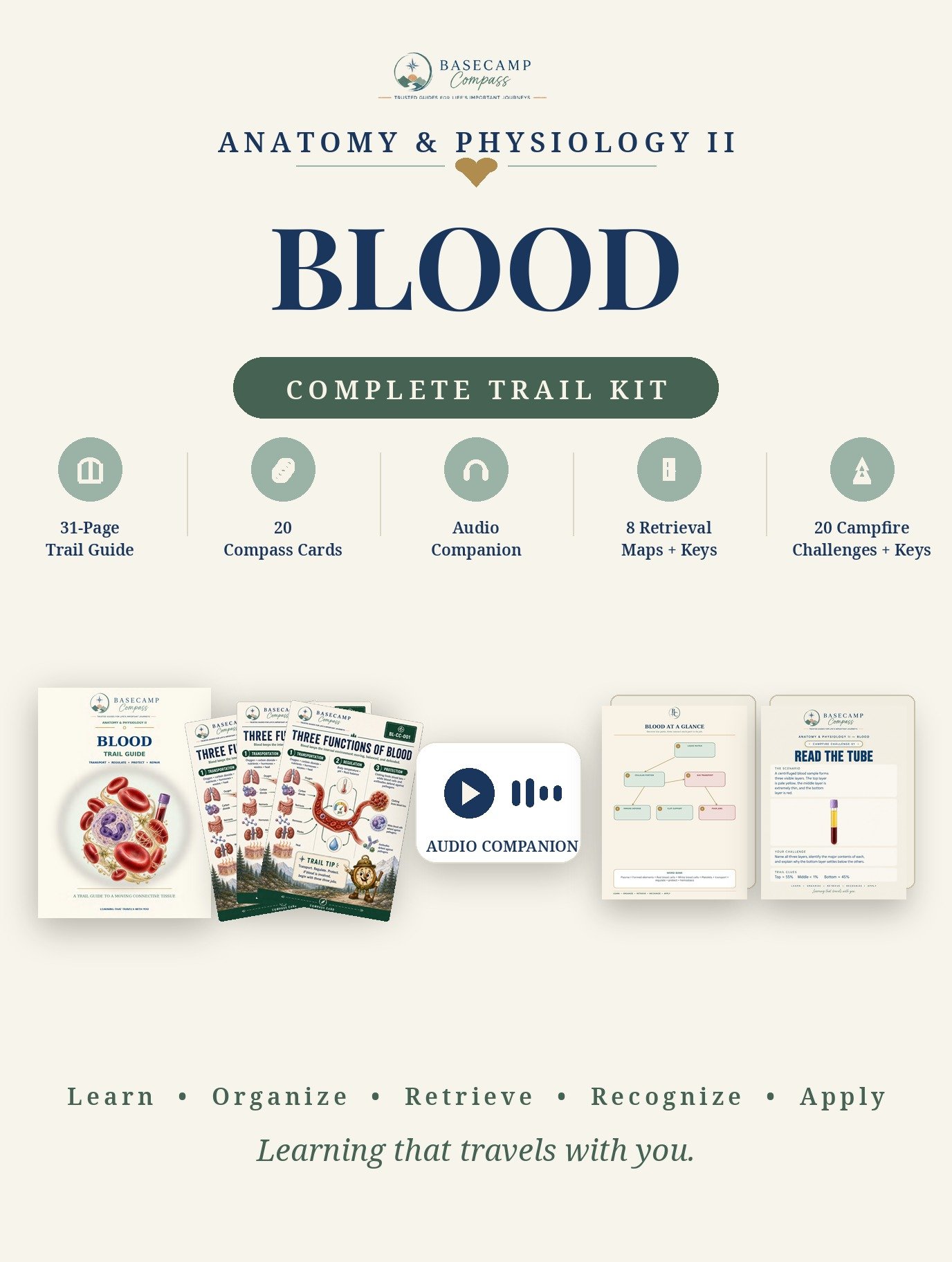
A complete A&P II study system with the 31-page Trail Guide, Compass Cards, Audio Companion, 8 fillable Retrieval Maps, and 20 Campfire Challenges with answer keys.

Original price was: $18.99.Current price is: $9.99.

DIGITAL · INSTANT ACCESS

What You'll Learn

Build a connected understanding of blood composition and function.
Organize plasma, formed elements, and plasma proteins.
Trace hematopoiesis and the development of blood-cell lineages.
Explain red blood cell structure, hemoglobin, and oxygen transport.
Connect erythropoietin with red blood cell production.
Follow the red blood cell life cycle from production through recycling.
Recognize common red blood cell imbalances and locate breakdowns in the pathway.
Identify the major leukocytes and connect each one to its defensive role.
Explain primary hemostasis, coagulation, and clot regulation.
Apply ABO and Rh compatibility principles.
Retrieve major pathways from memory using fillable visual maps.
Apply blood concepts to focused Campfire Challenge scenarios.
Use answer keys to recognize knowledge gaps and guide additional review.

Table of contents

31-Page Blood Trail Guide
Blood Compass Cards
Blood Audio Companion
8 Fillable Retrieval Maps
Complete Retrieval Map Answer Keys
20 Campfire Challenges
Complete Campfire Challenge Answer Keys
Whole Blood - Plasma - Plasma Proteins - Hematopoiesis - Red Blood Cells - Hemoglobin - Oxygen Transport - Erythropoietin - White Blood Cells - Hemostasis - Coagulation - ABO and Rh Compatibility

The A and P II Blood Complete Trail Kit provides a coordinated study system for learning, organizing, retrieving, recognizing, and applying blood concepts. Instead of relying on passive rereading alone, students move through several complementary resources that support different stages of learning.

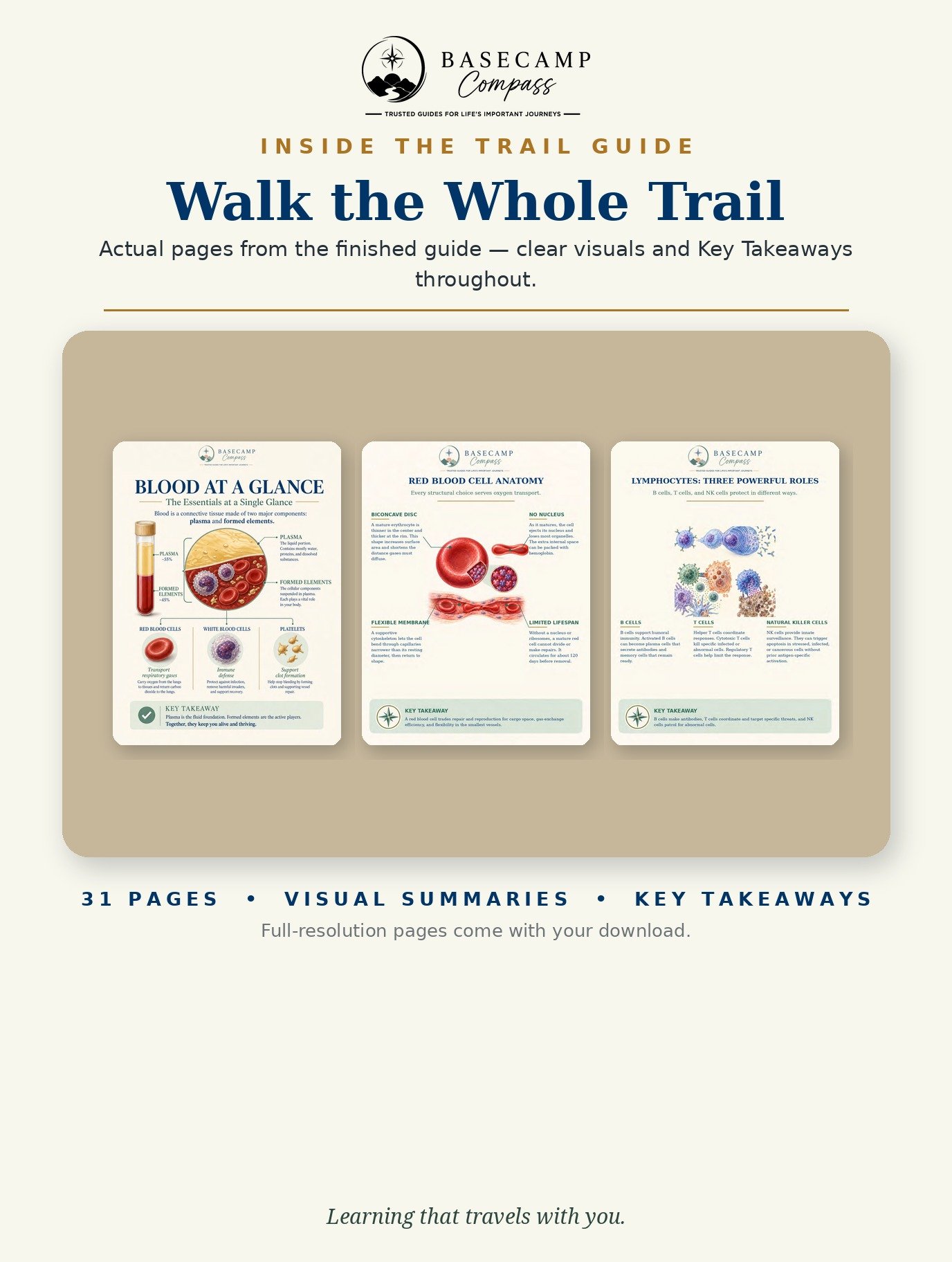
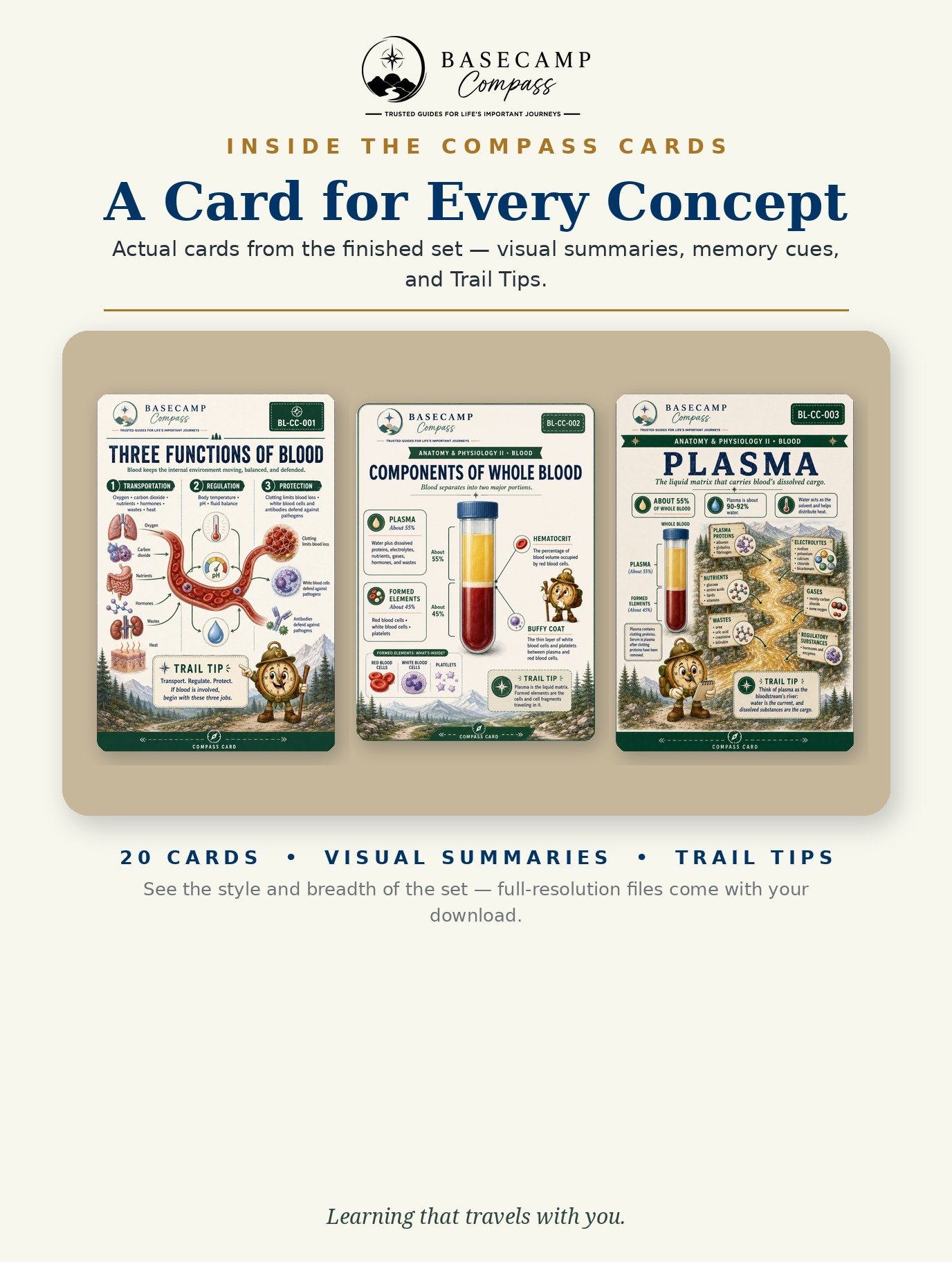
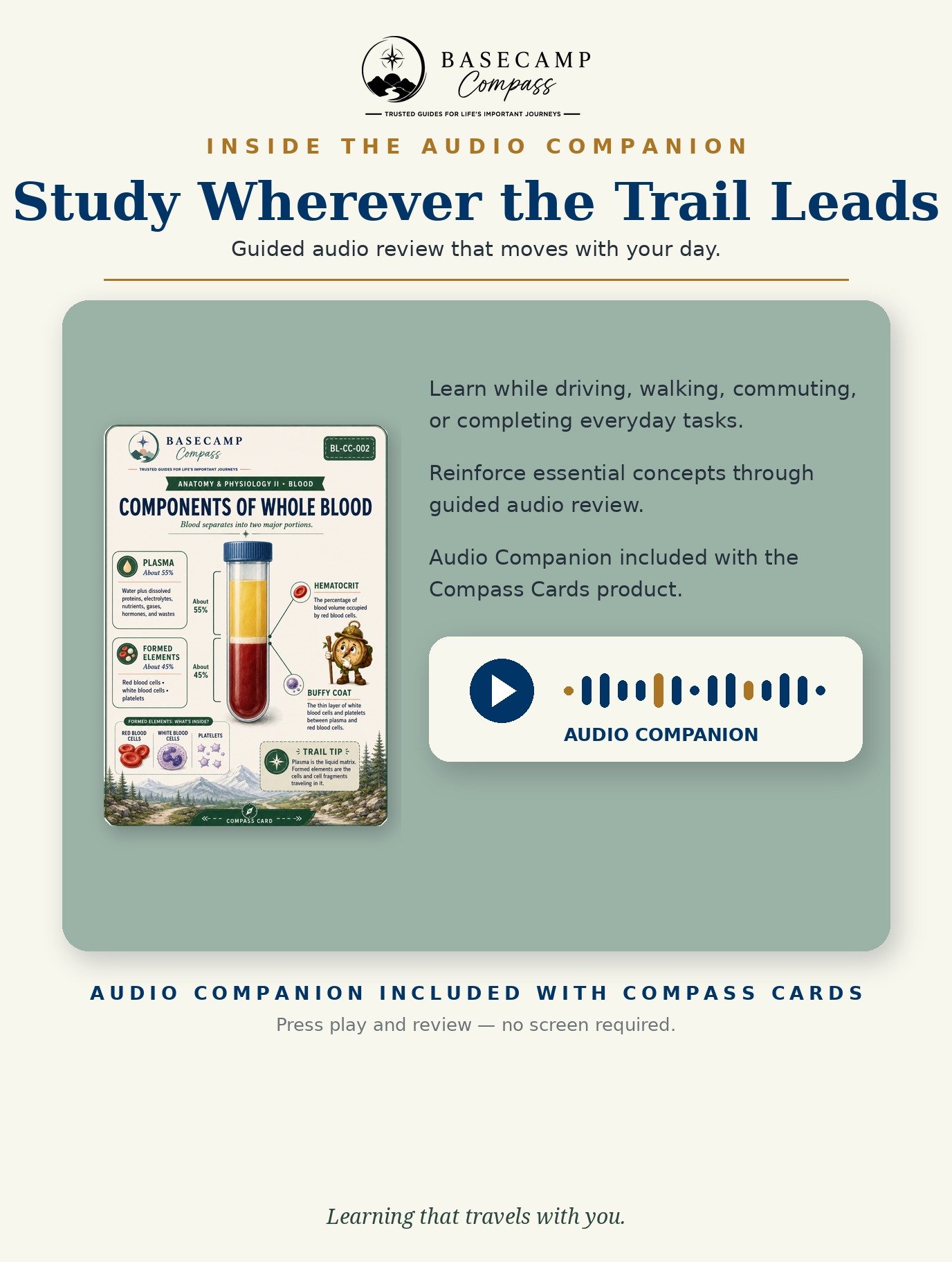
The 31-page Trail Guide builds understanding with concise explanations, realistic medical illustrations, and connected clinical concepts. The Compass Cards support focused visual review, while the Audio Companion allows students to continue studying away from the screen. Eight fillable Retrieval Maps challenge learners to rebuild major pathways and relationships from memory. Twenty Campfire Challenges then place those concepts into short applied scenarios that require interpretation, connection, and clinical reasoning.

Complete answer keys allow students to check their work, identify gaps, and return to the exact concept that needs reinforcement. Designed to complement A and P II coursework, the kit brings the major blood concepts together in one organized and portable study experience.
Reviews

There are no reviews yet.

Be the first to review “Complete Blood Trail Kit | A&P II”

Your email address will not be published. Required fields are marked *

How It Works: Your Learning Journey

LEARN

The Guide Teaches The Journey.

REMEMBER

Reinforce important concepts.

CHALLENGE

Test your knowledge and build confidence.

dashed arrow set vector doodle dot line thin pointer arrows | Basecamp Compass, LLC

Campfire Challenge Preview

Take a look inside

Sample 1 — Read the Tube (Challenge 01)
THE SCENARIO: A centrifuged blood sample forms three visible layers. The top layer is pale yellow, the middle layer is extremely thin, and the bottom layer is red. YOUR CHALLENGE: Name all three layers, identify the major contents of each, and explain why the bottom layer settles below the others. TRAIL CLUES: Top ~ 55% · Middle < 1% · Bottom ≈ 45%
Sample 2 — Remove the Repair: Fibrinolysis (Challenge 12)
THE SCENARIO: The vessel wall has healed. The clot that once protected the injury must now be removed without disrupting normal circulation. YOUR CHALLENGE: Explain how plasminogen activation leads to fibrin breakdown and why clot removal should remain localized. TRAIL CLUES: Plasminogen · Plasmin · Fibrin fragments
Sample 3 — Read the Differential: Leukocyte Patterns (Challenge 18)
THE SCENARIO: Two patients have normal-looking total white-cell counts. One has bacterial pneumonia; the other has a parasitic infection. YOUR CHALLENGE: Predict which leukocyte proportion is most likely elevated in each patient and explain why the differential matters. TRAIL CLUES: Neutrophils · Eosinophils · Pattern + clinical story
Scroll to Top