
Sale!

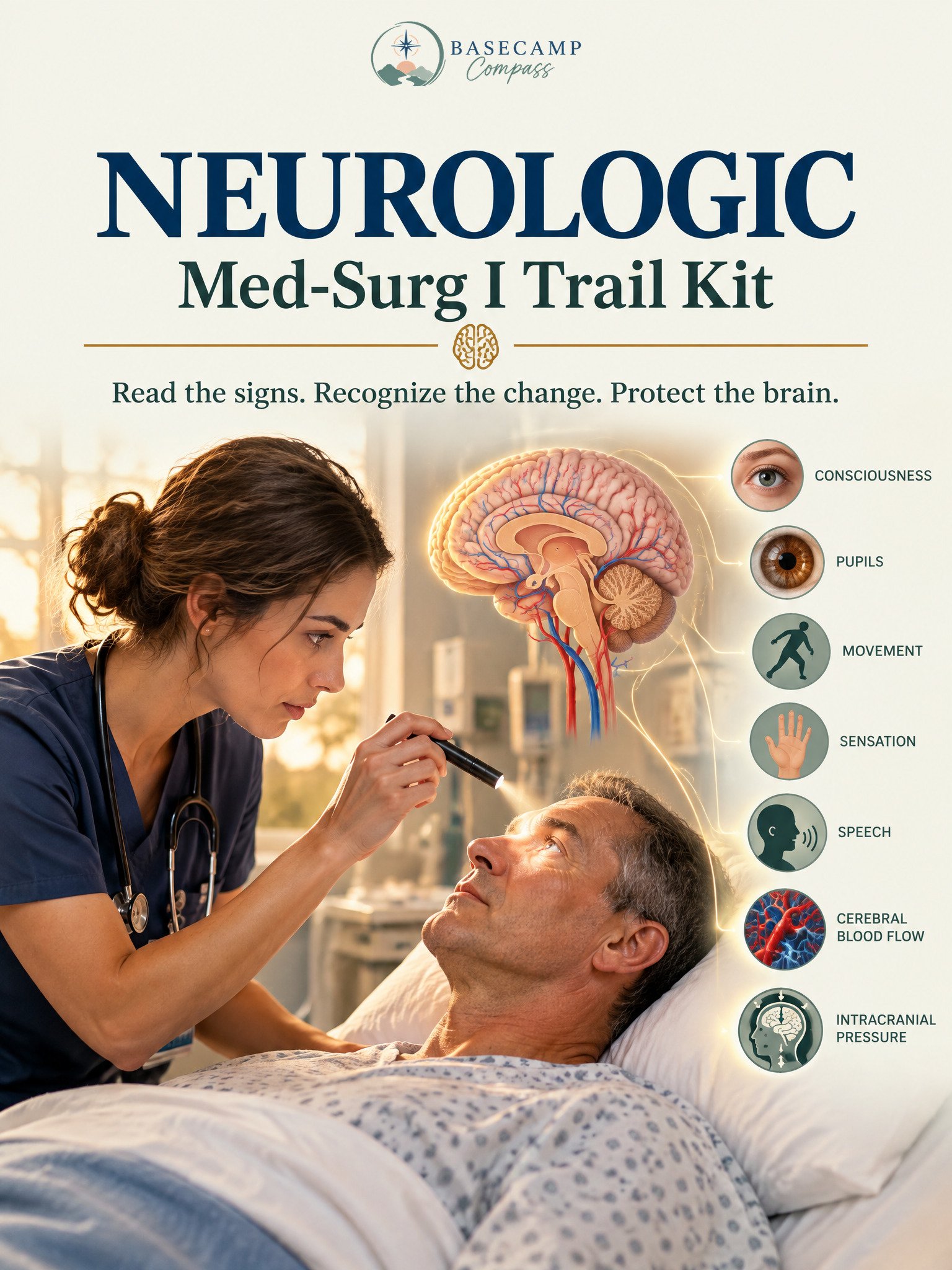
MedSurg I Neurologic Trail Kit

Read the signs. Recognize the change. Protect the brain. This Med-Surg I Neurologic study system combines a 48-page Trail Guide, 30 Compass Cards, 10 fillable Retrieval Maps with paired answers, and 20 Campfire Challenges with immediate paired rationales.

Original price was: $15.00.Current price is: $9.99.

DIGITAL · INSTANT ACCESS

What You'll Learn

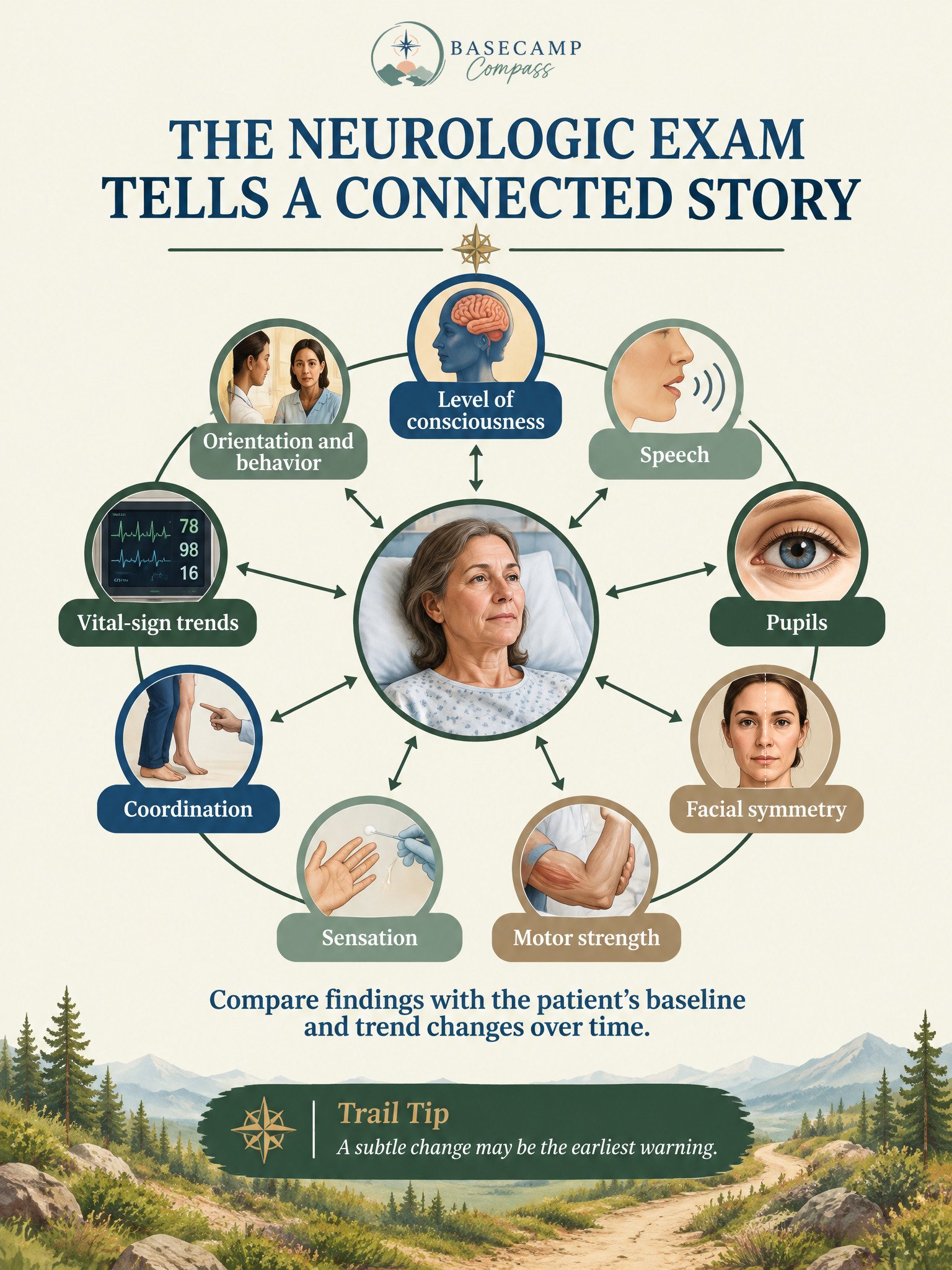
Perform and trend a focused neurologic assessment using consciousness, orientation, speech, pupils, cranial-nerve clues, motor function, sensation, coordination, and vital-sign changes.
Use the Glasgow Coma Scale as one part of a broader neurologic trend rather than as an isolated number.
Recognize early versus late signs of rising intracranial pressure and identify findings that suggest herniation.
Differentiate decorticate and decerebrate posturing and connect either pattern to urgent deterioration.
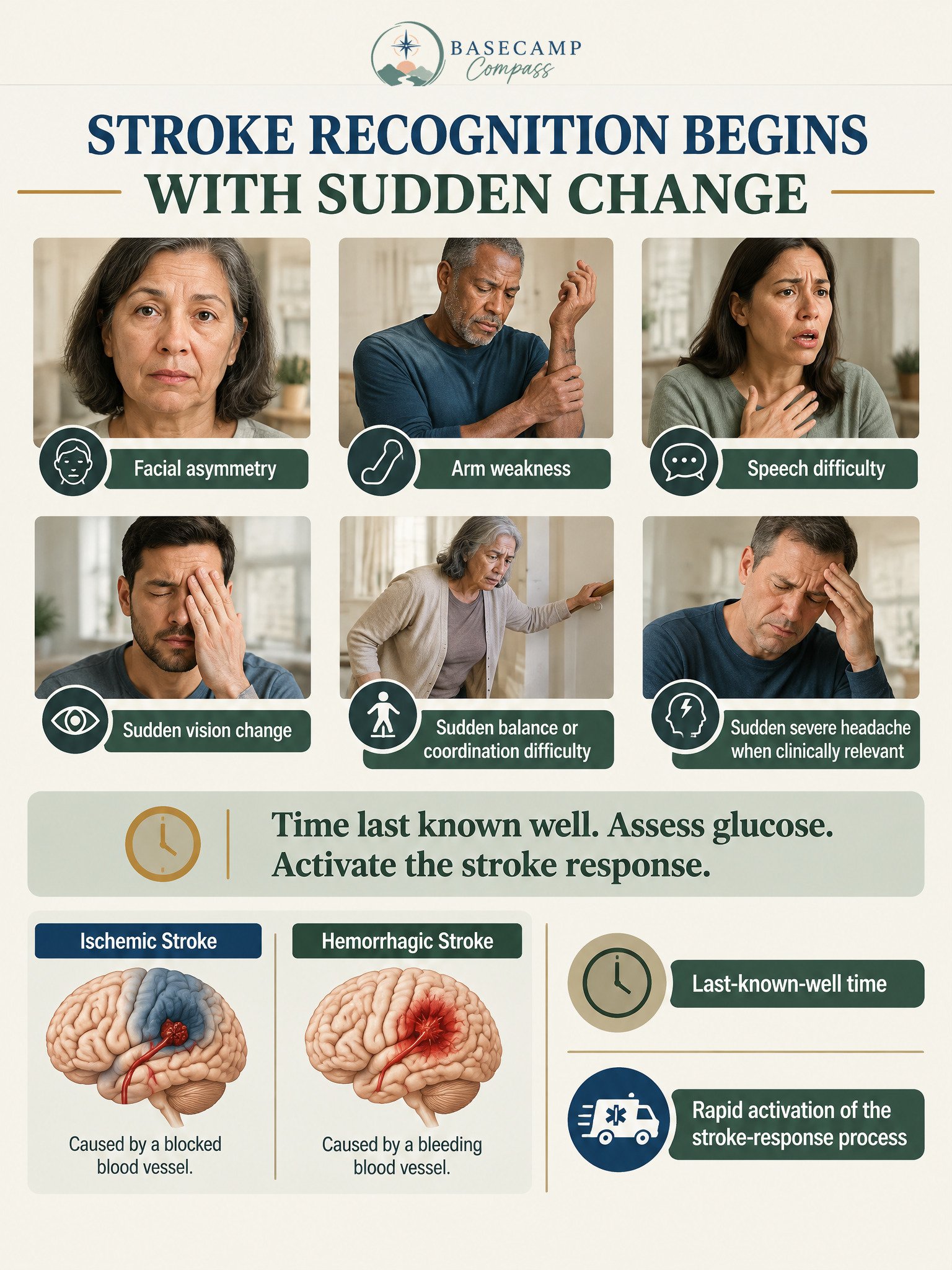
Recognize stroke with B.E. F.A.S.T., determine last known well, check glucose, activate the stroke response, and protect swallowing and oxygenation.
Distinguish ischemic and hemorrhagic stroke patterns while understanding that treatment depends on imaging and protocol.
Protect a patient during an active seizure, recognize status epilepticus, and complete a focused postictal assessment.
Recognize meningitis, encephalitis, traumatic brain injury, concussion deterioration, skull-fracture clues, and spinal-cord emergencies.
Differentiate spinal shock, neurogenic shock, and autonomic dysreflexia and prioritize the safest immediate response.
Compare Parkinson disease, multiple sclerosis, myasthenia gravis, Guillain-Barré syndrome, ALS, Bell palsy, delirium, and dementia.
Identify respiratory decline, altered consciousness, new focal deficits, and other neurologic red flags requiring escalation.

Table of contents

48-page visual Trail Guide
30 Compass Cards plus cover
10 fillable Retrieval Maps with 10 immediately paired answer pages plus cover
20 Campfire Challenges with a matching answer-key page after every two challenges
Digital PDF format for screen study or printing
Audio Companion

Neurologic nursing depends on noticing change early, connecting findings across the examination, and acting before subtle deterioration becomes an emergency. The Basecamp Compass Med-Surg I Neurologic Trail Kit turns the neurologic assessment into a connected clinical story—from level of consciousness, pupils, speech, symmetry, motor response, and sensation to stroke activation, seizure protection, intracranial pressure, infection, trauma, spinal emergencies, and progressive neuromuscular weakness.

The 48-page Trail Guide builds the physiology and bedside patterns step by step. Learners see how the central and peripheral nervous systems communicate, practice a repeatable focused assessment, interpret Glasgow Coma Scale and pupil findings, recognize rising intracranial pressure and herniation, and follow an evidence-aligned stroke response path that includes last-known-well time, glucose assessment, urgent imaging, and protocol-based treatment evaluation.

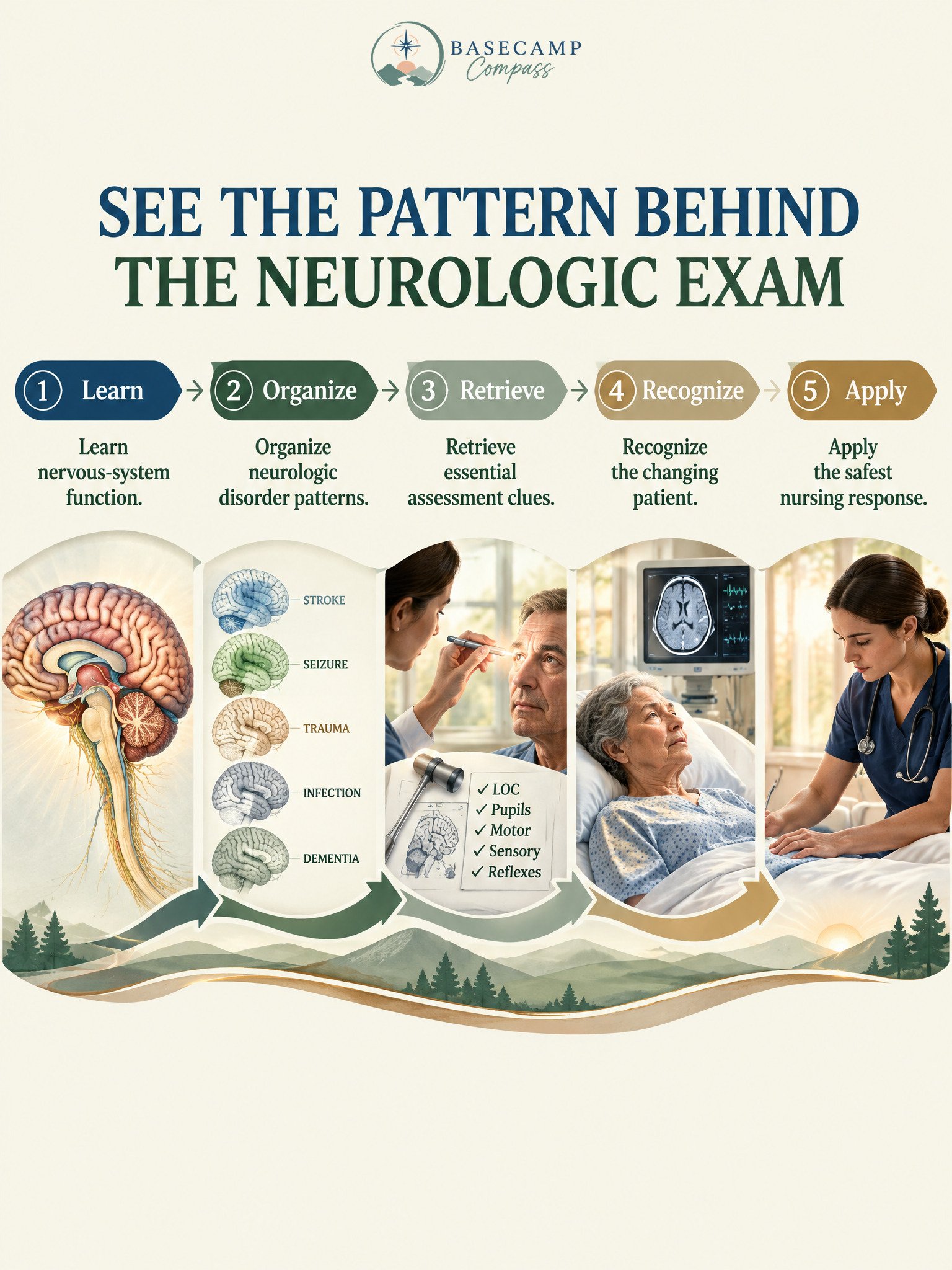
The guide then connects seizure care, meningitis and encephalitis, traumatic brain and spinal cord injury, neurogenic shock, autonomic dysreflexia, Parkinson disease, multiple sclerosis, myasthenia gravis, Guillain-Barré syndrome, ALS, Bell palsy, headache red flags, delirium, and dementia. The companion tools serve different jobs: Compass Cards support rapid retrieval, fillable Retrieval Maps require active reconstruction, and Campfire Challenges apply recognition and priority setting to realistic patient scenarios. Together, they follow Learn → Organize → Retrieve → Recognize → Apply.

What You Will Learn

  • Perform and trend a focused neurologic assessment using consciousness, orientation, speech, pupils, cranial-nerve clues, motor function, sensation, coordination, and vital-sign changes.
  • Use the Glasgow Coma Scale as one part of a broader neurologic trend rather than as an isolated number.
  • Recognize early versus late signs of rising intracranial pressure and identify findings that suggest herniation.
  • Differentiate decorticate and decerebrate posturing and connect either pattern to urgent deterioration.
  • Recognize stroke with B.E. F.A.S.T., determine last known well, check glucose, activate the stroke response, and protect swallowing and oxygenation.
  • Distinguish ischemic and hemorrhagic stroke patterns while understanding that treatment depends on imaging and protocol.
  • Protect a patient during an active seizure, recognize status epilepticus, and complete a focused postictal assessment.
  • Recognize meningitis, encephalitis, traumatic brain injury, concussion deterioration, skull-fracture clues, and spinal-cord emergencies.
  • Differentiate spinal shock, neurogenic shock, and autonomic dysreflexia and prioritize the safest immediate response.
  • Compare Parkinson disease, multiple sclerosis, myasthenia gravis, Guillain-Barré syndrome, ALS, Bell palsy, delirium, and dementia.
  • Identify respiratory decline, altered consciousness, new focal deficits, and other neurologic red flags requiring escalation.

What Is Included

  • 48-page visual Trail Guide
  • 30 Compass Cards plus cover
  • 10 fillable Retrieval Maps with 10 immediately paired answer pages plus cover
  • 20 Campfire Challenges with a matching answer-key page after every two-challenge set
  • Audio Companion
  • Nine optimized storefront JPEGs
  • Digital PDF format for screen study or printing.
Reviews

There are no reviews yet.

Be the first to review “MedSurg I Neurologic Trail Kit”

Your email address will not be published. Required fields are marked *

How It Works: Your Learning Journey

LEARN

The Guide Teaches The Journey.

REMEMBER

Reinforce important concepts.

CHALLENGE

Test your knowledge and build confidence.

dashed arrow set vector doodle dot line thin pointer arrows | Basecamp Compass, LLC

Campfire Challenge Preview

Take a look inside

Sample 1 — New Unequal Pupil
Challenge 1 – New Unequal Pupil — Scenario: A patient with a head injury becomes harder to awaken. The nurse notices one pupil is newly enlarged and poorly reactive compared with the baseline exam. Findings: Harder to arouse, new unilateral mydriasis, sluggish/non-reactive pupil. What is the priority interpretation and action? A. Administer a routine sedative and reassess in one hour. B. Recognize possible uncal herniation; notify the provider immediately and prepare for emergency intervention. C. Apply an eye patch and document the finding. D. Increase IV fluid rate to improve cerebral perfusion.
Sample 2 — Postictal Patient
Challenge 11 – Postictal Patient — Scenario: After a generalized seizure, a patient is drowsy, confused, and breathing noisily while lying supine. Findings: Postictal state, noisy breathing, confusion, drowsiness. What should the nurse assess first? A. Obtain a detailed social history. B. Airway, breathing, and circulation; turn the patient onto the side if safe. C. Give a sedative to stop agitation. D. Start an IV glucose bolus without assessment.
Sample 3 — Delirium or Dementia
Challenge 20 – Delirium or Dementia — Scenario: An older adult who was oriented yesterday becomes suddenly inattentive, disorganized, and intermittently confused. The family asks whether this is simply normal aging. Findings: Acute onset inattention, disorganization, fluctuating confusion. How should the nurse interpret the change? A. This is expected normal aging and should be ignored. B. This is likely delirium, an acute change that requires identifying and treating the underlying cause. C. This confirms long-standing dementia with no reversible component. D. The patient is just tired and needs only sleep medication.
Scroll to Top