
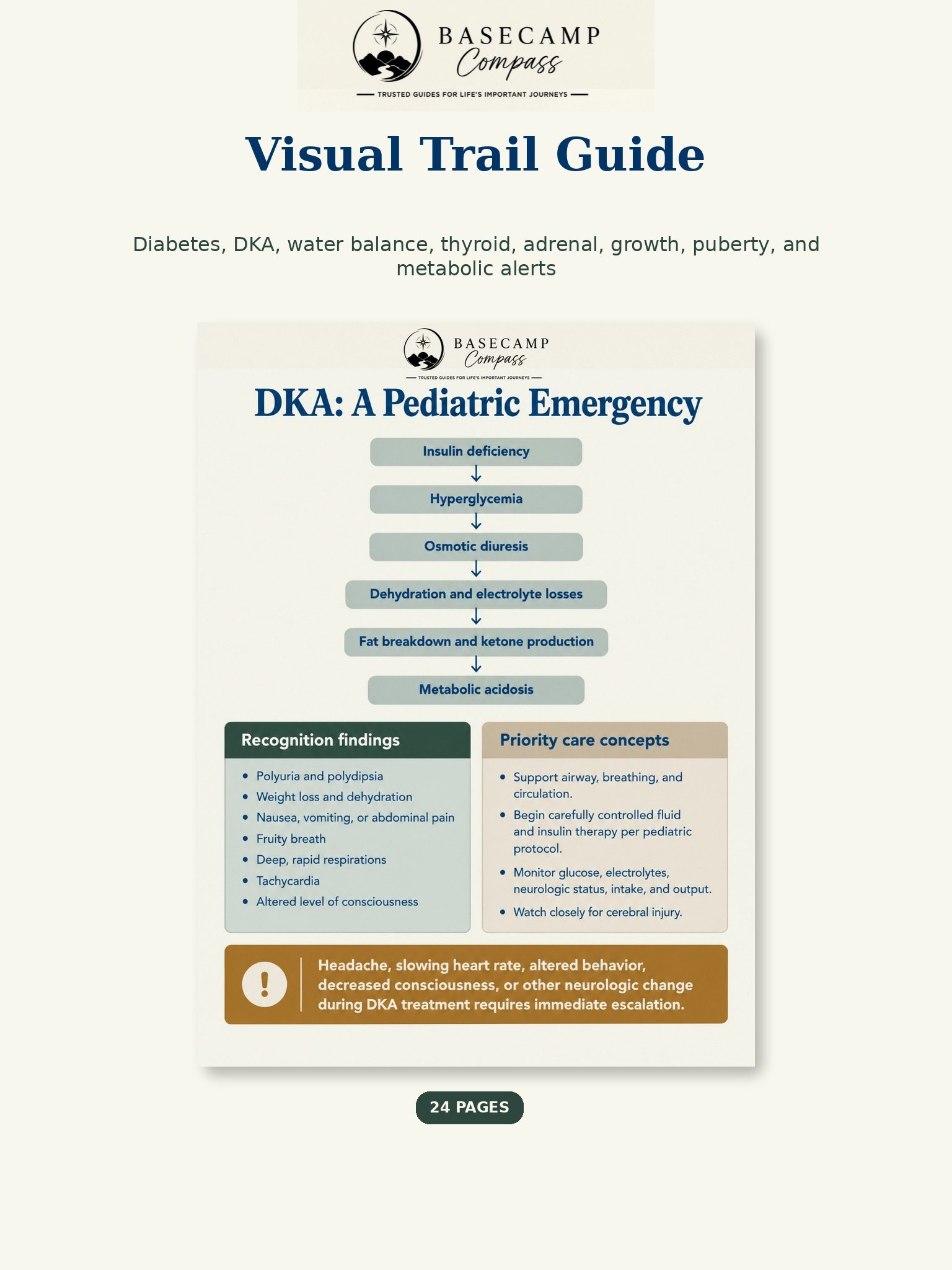
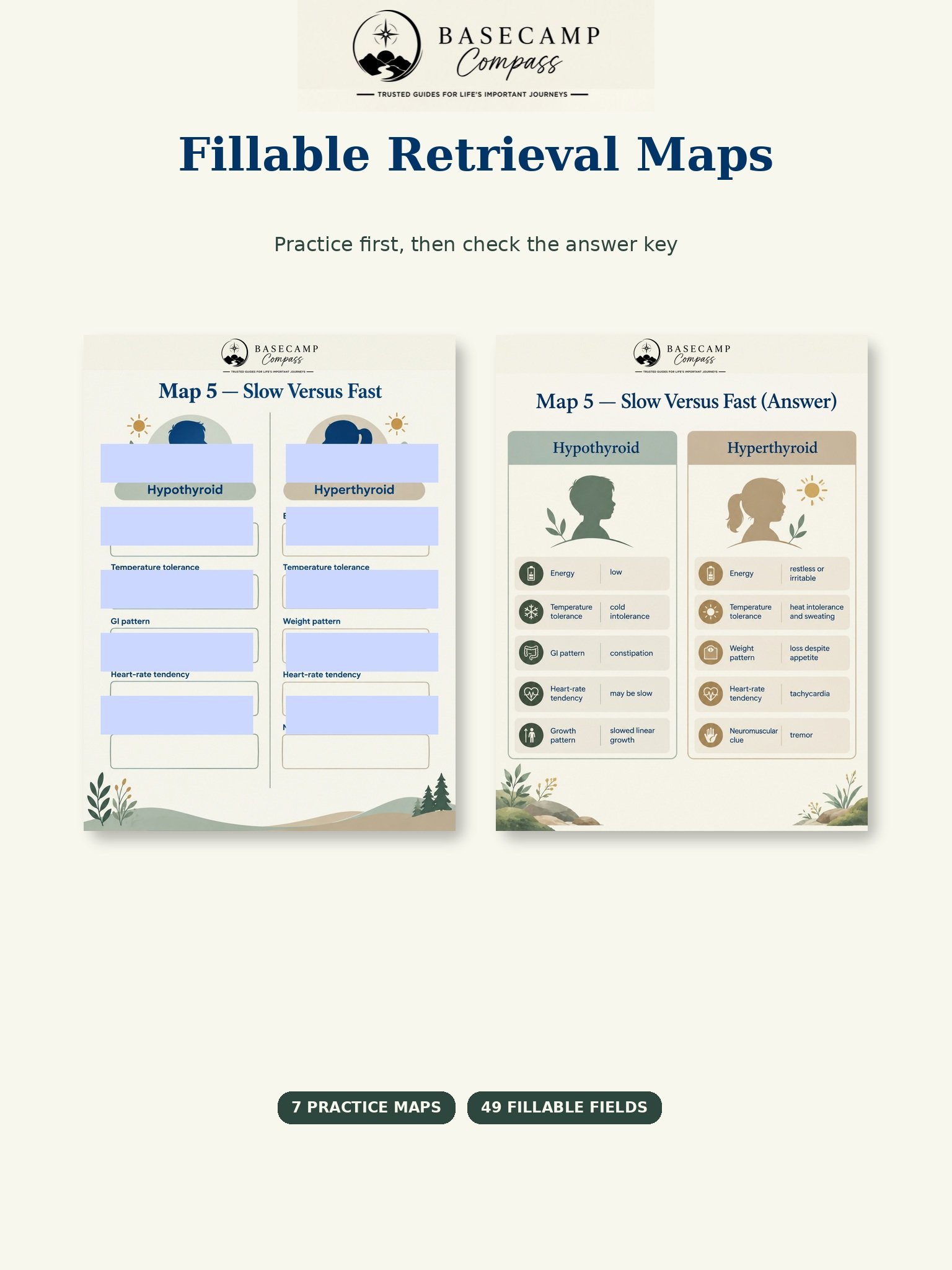
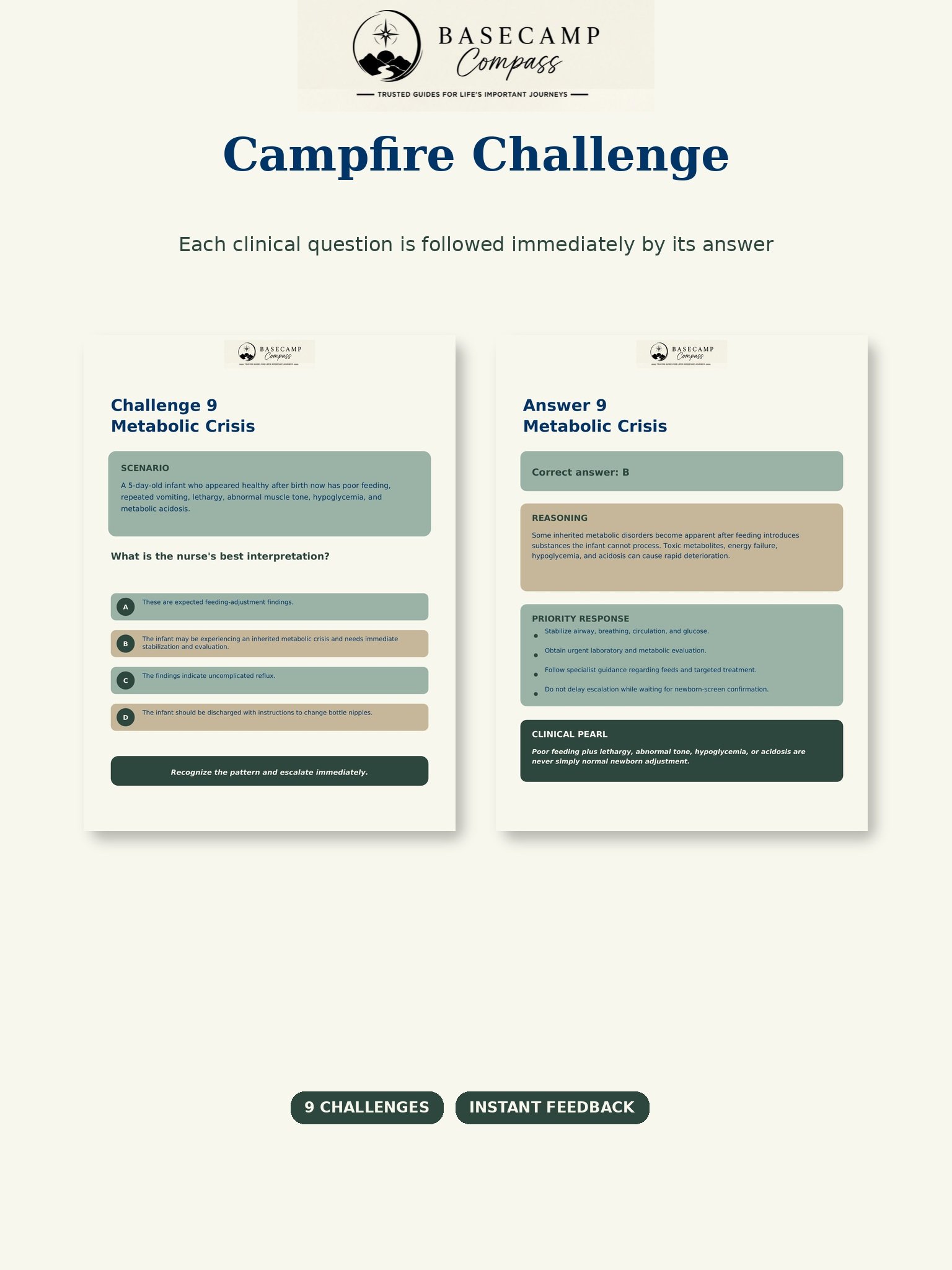
Move from visual review to retrieval practice to clinical reasoning with this pediatric endocrine bundle, all in one cohesive kit. The Pediatric Endocrine and Metabolic Disorders Trail Kit combines a visual Trail Guide, quick-reference Compass Cards, fillable Retrieval Maps, and Campfire Challenge cases. Each Retrieval Map student page is followed immediately by its answer key, and every Campfire Challenge is followed by its answer and rationale for instant feedback. The maps include 49 interactive fields that can be cleared and reused. This pediatric endocrine bundle is a study companion and does not replace assigned course materials, current clinical guidance, facility policy, or clinical judgment.
Sale!



Pediatric Endocrine and Metabolic Disorders Trail Kit
A complete 71-page pediatric nursing study kit with a 24-page Trail Guide, 12 Compass Cards, seven fillable Retrieval Maps with answer keys, and nine Campfire Challenges with immediate answers.
- Estimated Reading Time: 1 hour
- Pages: 51
- Skill Level: All Levels
- Format: Digital Download (PDF + Audio)
$15.00 Original price was: $15.00.$9.99Current price is: $9.99.
DIGITAL · INSTANT ACCESS
What You'll Learn
Recognize diabetes, DKA, hypoglycemia, water-balance, thyroid, adrenal, and metabolic patterns.
Connect assessment findings with priority nursing actions and reassessment.
Practice recall with seven fillable student maps and immediate answer keys.
Apply clinical priorities through nine Campfire Challenges with immediate rationales.
Review quickly with twelve visual Compass Cards.
Table of contents
24-page visual Trail Guide
12-page Compass Card set
Seven fillable Retrieval Maps with seven answer keys
Nine Campfire Challenge cases with nine immediate answer pages
Type 1 diabetes, insulin safety, hypoglycemia, DKA, DI, SIADH, thyroid and adrenal disorders, growth, puberty, newborn screening, and metabolic crises
Be the first to review “Pediatric Endocrine and Metabolic Disorders Trail Kit” Cancel reply
How It Works: Your Learning Journey
LEARN
The Guide Teaches The Journey.
REMEMBER
Reinforce important concepts.
CHALLENGE
Test your knowledge and build confidence.

Campfire Challenge Preview
Take a look inside
Sample 1 — New-Onset Diabetes
A 9-year-old has increased thirst, frequent urination, fatigue, and recent weight loss. Today the child has nausea and abdominal pain. Which assessment is the nurse’s priority? A. Ask the child to complete a detailed three-day food diary. B. Obtain a point-of-care glucose and assess for ketones, dehydration, breathing changes, and mental-status changes. C. Encourage vigorous physical activity to lower the glucose. D. Restrict oral fluids until the diagnosis is confirmed.
Sample 2 — Sick-Day Decision
A child with type 1 diabetes has influenza, poor appetite, and a fever. The caregiver says, “She is not eating, so I skipped all her insulin.” Which teaching is the priority? A Basal insulin is generally continued during illness unless the diabetes team specifically directs otherwise. B Insulin should always be stopped whenever food intake decreases. C Glucose monitoring is unnecessary during a mild illness. D Ketones only need to be checked when glucose is low.
Sample 3 — Metabolic Crisis
A 5-day-old infant who appeared healthy after birth now has poor feeding, repeated vomiting, lethargy, abnormal muscle tone, hypoglycemia, and metabolic acidosis. What is the nurse’s best interpretation? These are expected feeding-adjustment findings. The infant may be experiencing an inherited metabolic crisis and needs immediate stabilization and evaluation. The findings indicate uncomplicated reflux. The infant should be discharged with instructions to change bottle nipples. Recognize the pattern and escalate immediately.
Reviews
There are no reviews yet.