
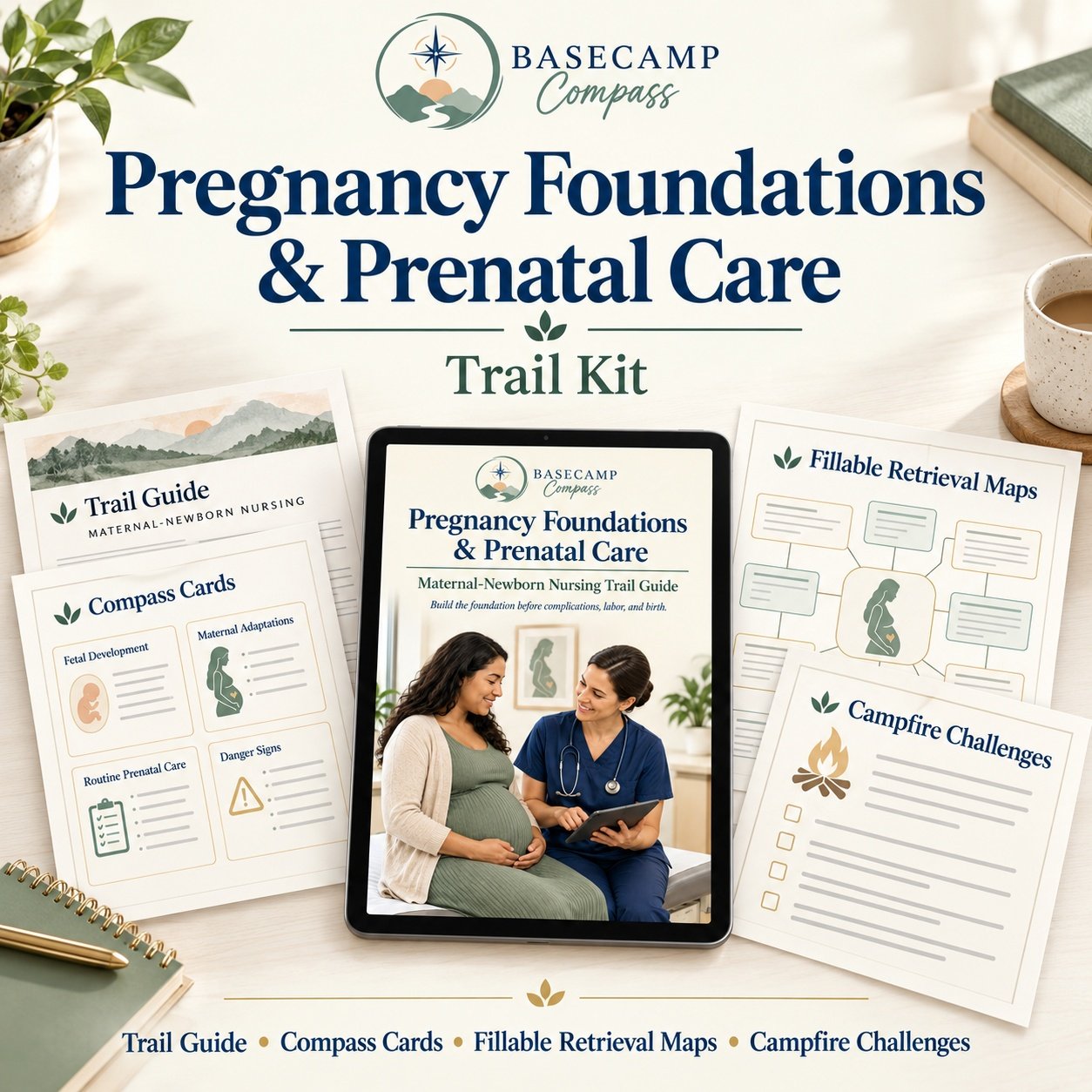
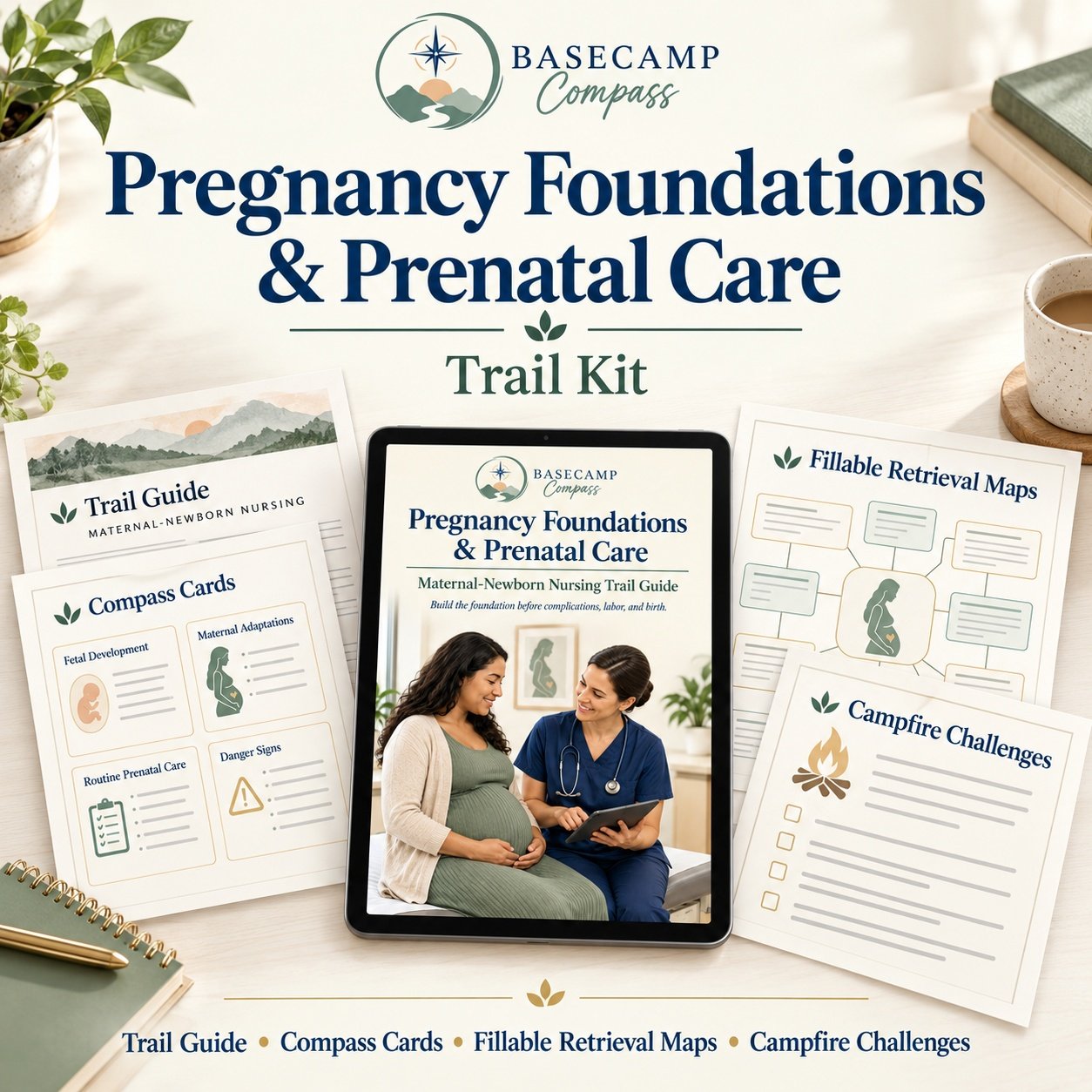
Bring concept learning, focused review, active recall, and clinical reasoning together in the Pregnancy Foundations & Prenatal Care Trail Kit. This coordinated Maternal–Newborn Nursing collection includes a 30-page Trail Guide, 15 Compass Cards, 6 fillable Retrieval Maps, and 6 fillable Campfire Challenges. Read the guide to build the framework, use the cards for focused review, retrieve the connections in the maps, and apply them to the clinical scenarios. Student and answer pages alternate within both practice PDFs. Use gravida, para, and GTPAL accurately, including multiple gestations. Connect early development, trimester patterns, and pregnancy signs. Explain dating concepts and the documented obstetric estimate. Designed for nursing-school study, the material can be used independently or alongside your course and clinical learning.
Sale!


Maternal Newborn Pregnancy Foundations & Prenatal Care Trail Kit
Bring concept learning, focused review, active recall, and clinical reasoning together in the Pregnancy Foundations & Prenatal Care Trail Kit. This coordinated Maternal–Newborn Nursing collection includes a 30-page Trail Guide, 15 Compass Cards, 6 fillable Retrieval Maps, and 6 fillable Campfire Challenges.
- Estimated Reading Time: 60 minutes
- Pages: 69
- Skill Level: All Levels
- Format: Digital Download (PDF + Audio)
$15.00 Original price was: $15.00.$9.99Current price is: $9.99.
DIGITAL · INSTANT ACCESS
What You'll Learn
Use gravida, para, and GTPAL accurately, including multiple gestations.
Connect early development, trimester patterns, and pregnancy signs.
Explain dating concepts and the documented obstetric estimate.
Compare expected body-system adaptations with concerning symptoms.
Link prenatal assessment, screening, nutrition, safety, and urgent warning signs.
Table of contents
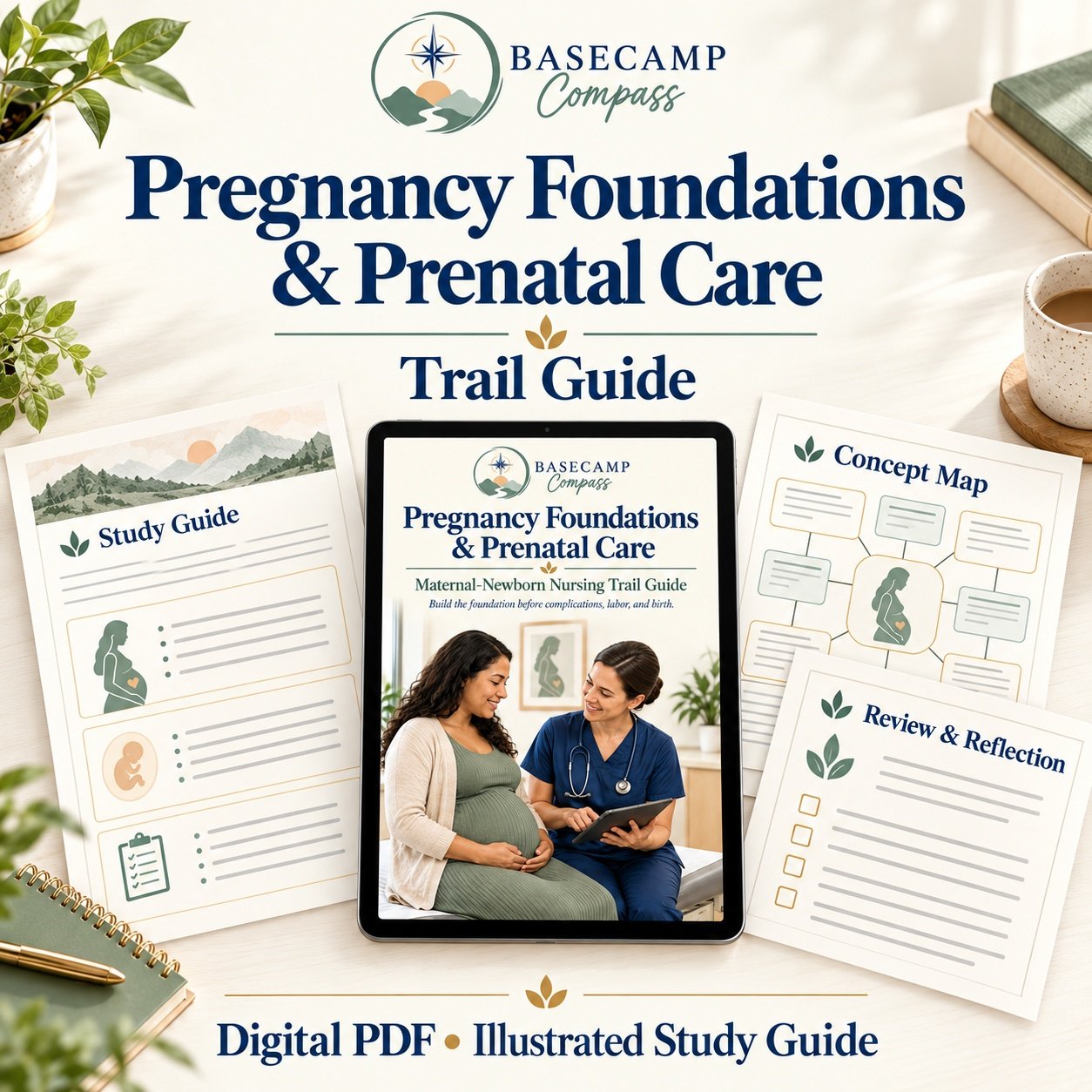
Trail Guide — 30 pages
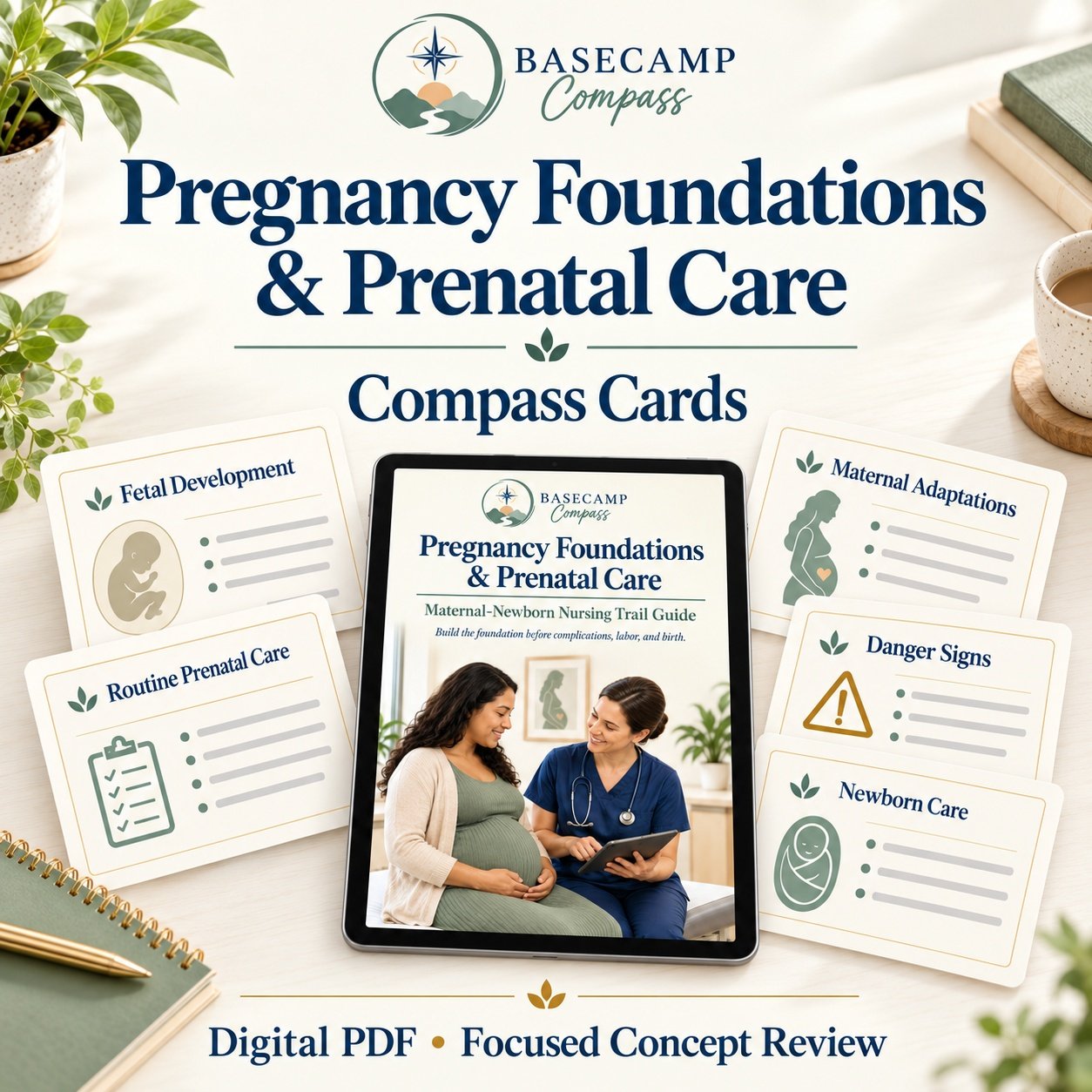
Compass Cards — 15 concept pages
Retrieval Maps — 6 student/answer pairs
Campfire Challenges — 6 student/answer pairs
1 review for Maternal Newborn Pregnancy Foundations & Prenatal Care Trail Kit
Add a review Cancel reply
How It Works: Your Learning Journey
LEARN
The Guide Teaches The Journey.
REMEMBER
Reinforce important concepts.
CHALLENGE
Test your knowledge and build confidence.
Campfire Challenge Preview
Take a look inside
Sample 1 — The GTPAL Trail
A patient is currently pregnant for the fourth time. The history includes one term birth, one preterm twin birth with both children living, and one pregnancy ending before the gestational threshold used for pregnancy-history documentation. What is the GTPAL? Why does the twin birth affect P and L differently?
Sample 2 — Expected Change or Warning Sign?
At a routine prenatal visit, a patient reports urinary frequency and mild fatigue, without pain, fever, bleeding, or fluid leakage. Which findings may reflect common pregnancy adaptations? What additional assessment is appropriate? Which symptoms would change the urgency?
Sample 3 — Do Not Normalize the Warning Sign
A pregnant patient reports a severe headache, visual changes, sudden swelling of the hands, and feeling that something is not right. Are these routine discomforts? What is the priority nursing response? Why is reassurance without assessment unsafe?
Skyler (verified owner) –
I understood my professor’s slides better after reviewing this guide and compass cards. After taking quiz I did feel more prepared to take my exam.