

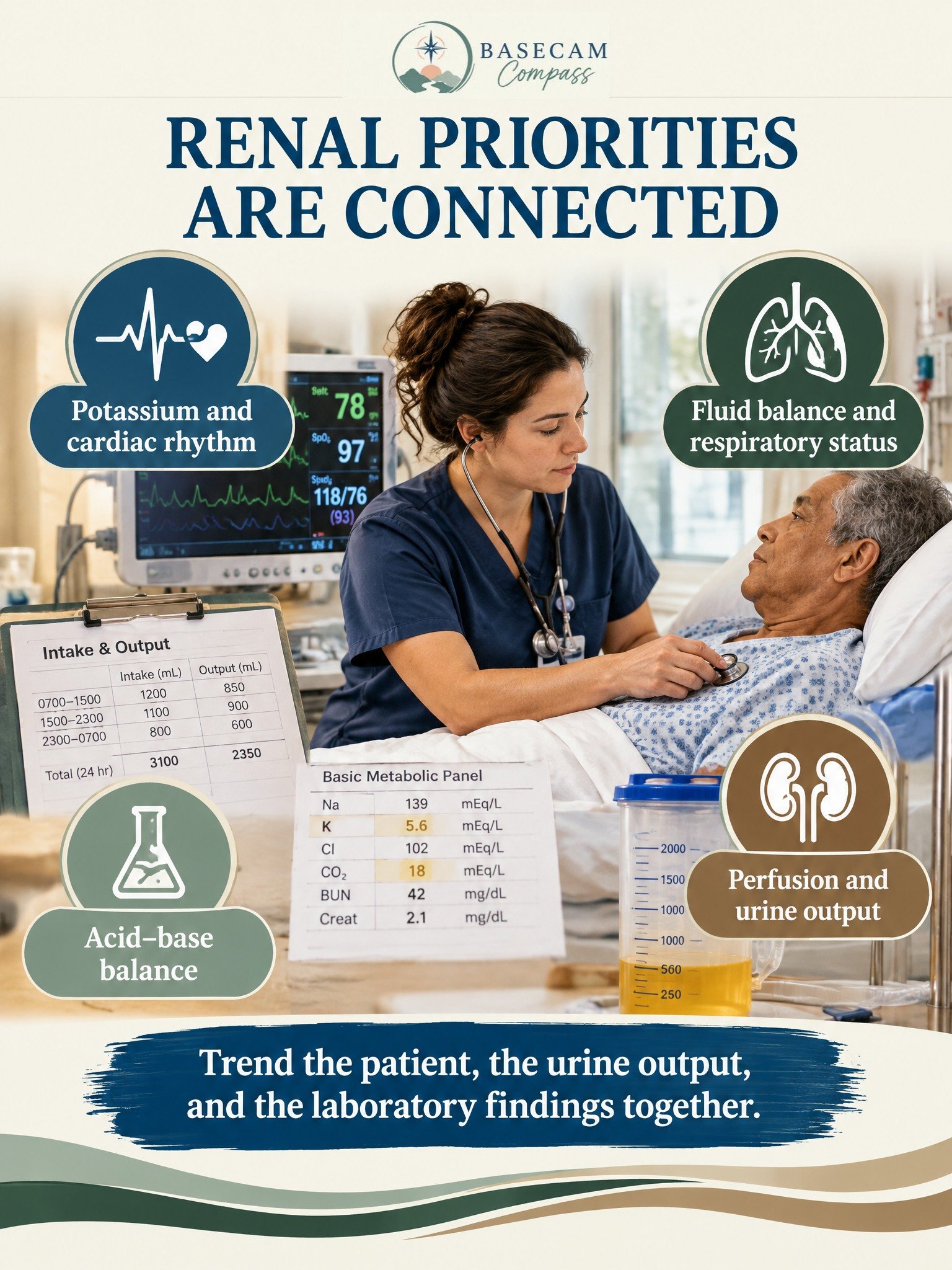
Renal nursing is pattern recognition in motion: follow perfusion, filtration, urine output, fluid status, electrolytes, acid-base balance, and the patient’s response. The Basecamp Compass Med-Surg I Renal & Urinary Trail Kit helps learners connect kidney physiology and urinary assessment to acute deterioration, chronic disease, renal replacement therapy, infection, obstruction, and nursing priorities.
The 44-page Trail Guide begins with the urinary tract, nephron flow, kidney functions, renal perfusion, assessment, diagnostic studies, urinalysis, and urine-output trends. It then builds a practical framework for prerenal, intrarenal, and postrenal acute kidney injury; the clinical course of AKI; urgent electrolyte, acid-base, pulmonary, and uremic complications; and the whole-body effects of chronic kidney disease. CKD staging is presented with the correct definition: G1 or G2 requires a persistent marker of kidney damage, while eGFR and albuminuria are interpreted together over time.
The guide continues through fluid overload, hyperkalemia, anemia, CKD-mineral and bone disorder, individualized nutrition, medication safety, dialysis, vascular access, peritoneal-dialysis safety, transplant care, cystitis, pyelonephritis, stones, infected obstruction, nephritic and nephrotic patterns, polycystic kidney disease, retention, catheter safety, and hematuria warning signs. Compass Cards make the essential differences retrievable. Fillable Retrieval Maps require learners to rebuild the patterns before checking the answer. Campfire Challenges apply the same knowledge to realistic patient scenarios. Together they follow Learn → Organize → Retrieve → Recognize → Apply.
What You Will Learn
- Explain renal perfusion, glomerular filtration, nephron flow, and the kidneys’ roles in fluid, electrolyte, acid-base, blood-pressure, erythropoietin, and vitamin-D regulation.
- Use assessment findings, urine output, creatinine, eGFR, electrolytes, urinalysis, imaging, and trend data to recognize renal change.
- Differentiate prerenal, intrarenal, and postrenal AKI and identify priorities for perfusion, obstruction, medication review, and complication monitoring.
- Recognize urgent AKI patterns including hyperkalemia, pulmonary edema, severe acidosis, uremic complications, and worsening oliguria or anuria.
- Interpret CKD using chronicity, eGFR category, albuminuria, and clinical trend rather than a single value.
- Connect CKD with anemia, mineral and bone disorder, fluid overload, hyperkalemia, nutrition considerations, and medication safety.
- Compare hemodialysis, peritoneal dialysis, continuous therapies, and kidney transplantation.
- Protect dialysis access and recognize hypotension, disequilibrium, infection, bleeding, access failure, cloudy PD effluent, and poor outflow.
- Differentiate cystitis, pyelonephritis, infected obstruction, stones, nephritic syndrome, nephrotic syndrome, retention, and catheter-associated risks.
- Recognize painless hematuria and other renal or urinary findings that require prompt evaluation and escalation.
What Is Included
- 44-page visual Trail Guide
- 30 Compass Cards plus cover
- 10 fillable Retrieval Maps with 10 immediately paired answer pages plus cover
- 20 Campfire Challenges with a matching answer-key page after every two-challenge set
- Audio Companion
- Nine optimized storefront JPEGs
- Digital PDF format for screen study or printing.

Reviews
There are no reviews yet.