
Be the first to review “MedSurg II Gastrointestinal Disorders Trail Guide” Cancel reply
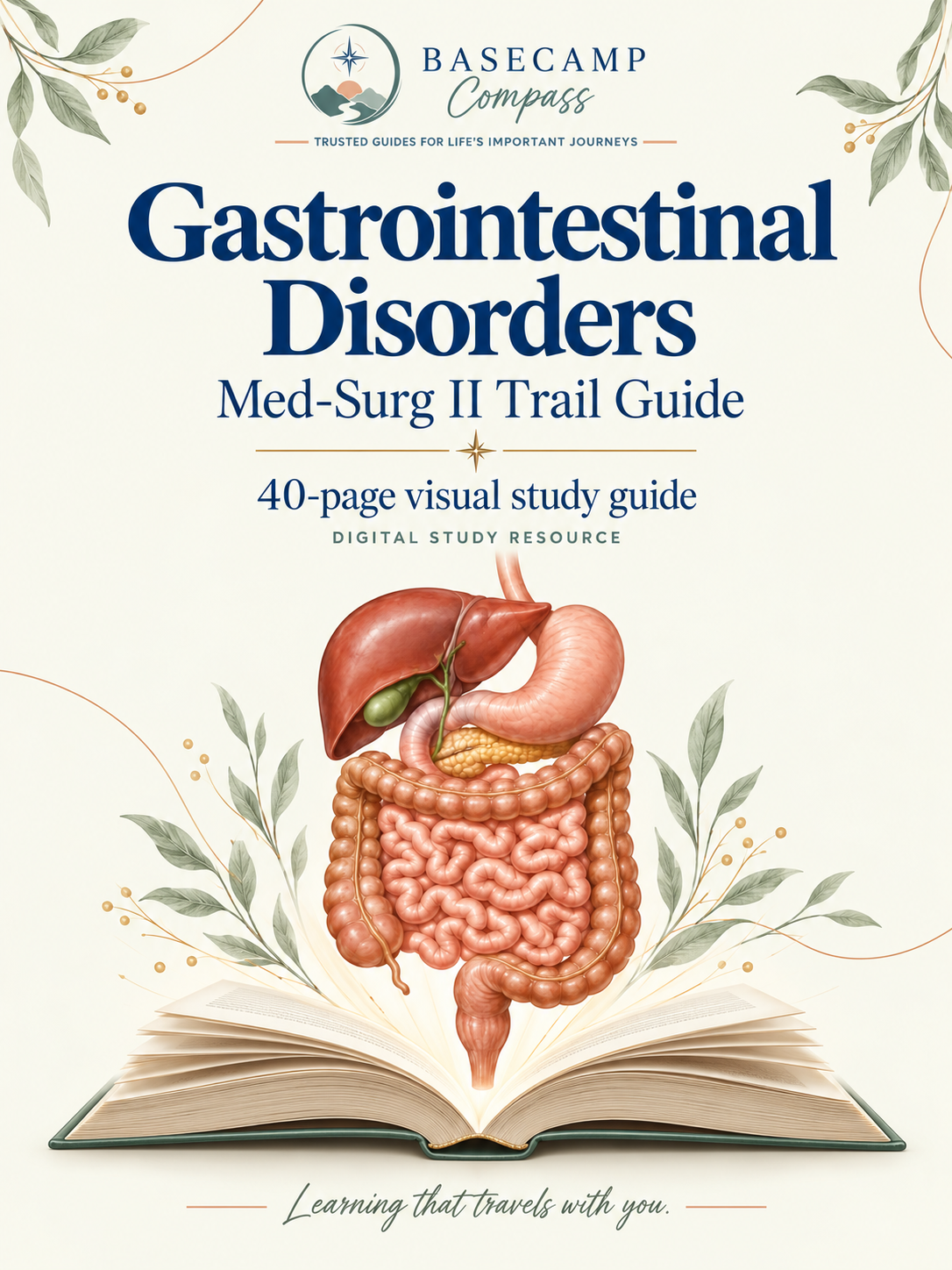
MedSurg II Gastrointestinal Disorders Trail Guide
Connect gastrointestinal symptoms with the assessment findings, risks and nursing priorities they reveal. Includes the Trail Guide PDF.
- Estimated Reading Time: 30 minutes
- Pages: 40
- Skill Level: All Levels
- Format: Digital Download (PDF)
$9.99
PDF · Instant download
What You'll Learn
Organize a focused GI history and abdominal assessment.
Connect GI bleeding findings with perfusion and stabilization priorities.
Recognize perforation, peritonitis, obstruction and ischemia warning signs.
Compare inflammatory bowel disorders, diverticulitis, appendicitis and ileus.
Relate vomiting, diarrhea and malabsorption to fluid, electrolyte and nutrition concerns.
Review safe tube use, enteral medications and parenteral nutrition monitoring.
Table of contents
GI Foundations, Focused Assessment and Diagnostic Connections
GERD, Gastritis, Peptic Ulcer Disease and GI Bleeding
Perforation, Peritonitis, Nausea, Vomiting and Bowel Pattern Changes
C. difficile Infection, Inflammatory Bowel Disease and Diverticular Disease
Appendicitis, Obstruction, Ileus, Ischemia and Hernias
Colorectal Cancer, Malabsorption and Celiac Disease
NG Tubes, Enteral Nutrition and Parenteral Nutrition
Ostomy Care, Bowel Surgery Recovery and Integrated Nursing Priorities
Companion Compass Card Sets
Recommended for this trail.



NCLEX Compass Cards plus Audio Companion
Build fast clinical recognition with 192 original NCLEX-style questions organized
$39.99

TRAIL KIT
Everything recommended
for this journey.
- First Week in the OR Trail Guide
- OR Fundamentals Compass Cards
- Patient Safety Compass Cards
- Documentation & Handoffs Cards

EXCLUSIVE CAMPFIRE
CHALLENGE CARDS
Only available inside Trail Kits,
Connect gastrointestinal symptoms with the assessment findings, risks and nursing priorities they reveal. The Basecamp Compass Gastrointestinal Disorders Trail Guide helps nursing students move from recognizing a symptom to understanding what to assess, what may be happening and which changes need prompt attention.
This 40-page visual guide follows the GI trail from focused history and abdominal assessment through common disorders, nutrition support and postoperative care. Explore GERD, gastritis and peptic ulcer disease, upper and lower GI bleeding, perforation and peritonitis, nausea and vomiting, diarrhea, C. difficile infection, constipation and fecal impaction. Comparison pages help organize ulcerative colitis and Crohn disease, diverticular conditions, appendicitis, mechanical obstruction and ileus.
The guide connects these patterns with fluid and electrolyte losses, perfusion, diagnostic testing and medication safety. Continue through hernias, colorectal cancer concepts, malabsorption and celiac disease, enteral and parenteral nutrition, NG tube safety, ostomy care and recovery after bowel surgery. Older-adult considerations and a final priority review help bring the information together.
Use it alongside your course materials for a first pass through the topic, a focused review before class or clinical, or a return to concepts that need more practice. The layout gives assessment, recognition and reassessment a consistent place in your study routine while keeping the patient’s whole clinical picture in view.
Includes the Trail Guide PDF. Choose the Gastrointestinal Disorders Trail Kit for Compass Cards, audio review, Retrieval Maps and Campfire Challenges. This nursing study companion supports your learning alongside your textbook and instructor guidance.
WHAT YOU WILL LEARN
– Organize a focused GI history and abdominal assessment.
– Connect GI bleeding findings with perfusion and stabilization priorities.
– Recognize perforation, peritonitis, obstruction and ischemia warning signs.
– Compare inflammatory bowel disorders, diverticulitis, appendicitis and ileus.
– Relate vomiting, diarrhea and malabsorption to fluid, electrolyte and nutrition concerns.
– Review safe tube use, enteral medications and parenteral nutrition monitoring.
– Identify ostomy and postoperative changes requiring escalation.
TABLE OF CONTENTS
– GI Foundations, Focused Assessment and Diagnostic Connections
– GERD, Gastritis, Peptic Ulcer Disease and GI Bleeding
– Perforation, Peritonitis, Nausea, Vomiting and Bowel Pattern Changes
– C. difficile Infection, Inflammatory Bowel Disease and Diverticular Disease
– Appendicitis, Obstruction, Ileus, Ischemia and Hernias
– Colorectal Cancer, Malabsorption and Celiac Disease
– NG Tubes, Enteral Nutrition and Parenteral Nutrition
– Ostomy Care, Bowel Surgery Recovery and Integrated Nursing Priorities
How It Works: Your Learning Journey
LEARN
The Guide Teaches The Journey.
REMEMBER
Reinforce important concepts.
CHALLENGE
Test your knowledge and build confidence.

Is this a printable file?
Yes. Your download is a print-ready, high-resolution PDF licensed for your personal professional use.
How quickly do I get it?
Instantly. The download link appears on the confirmation screen and in your email receipt.
Reviews
There are no reviews yet.