
Sale!

MedSurg II Neurologic Emergencies Trail Kit

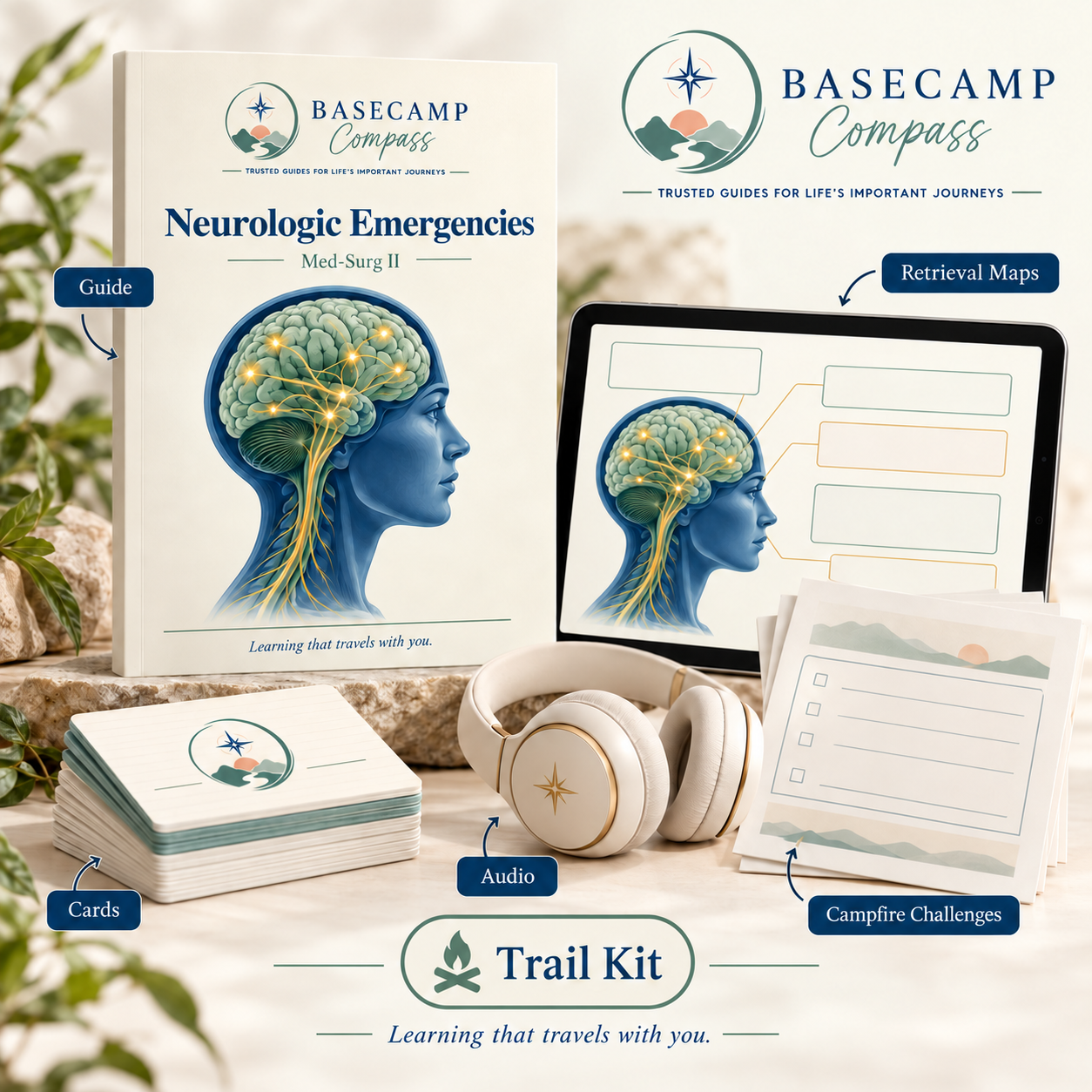
The MedSurg II Neurologic Emergencies Trail Kit brings learning, review, recall and scenario practice into one Med-Surg II study system — a 40-page Trail Guide, 18 Compass Cards with matching audio, ten Retrieval Maps, and twelve Campfire Challenges.

Original price was: $15.00.Current price is: $9.99.

DIGITAL · INSTANT ACCESS

What You'll Learn

Organize emergency concepts with the guide and review them with cards and audio.
Retrieve the connections in ten activities before checking the keys.
Compare overlapping emergency patterns without assuming a diagnosis from one sign.
Practice stroke, seizure, infection, head-injury and spinal-injury decisions.
Recognize airway, respiratory and perfusion threats that take priority.
Explain the best response and the safety concerns in the alternatives.
Use immediate answer keys to identify topics needing another review.

Table of contents

Trail Guide with 40 study pages
Compass Cards with 18 focused review pages
Matching Audio Companion
Printable and fillable Retrieval Maps with ten student/key pairs per format
Map subjects: Emergency first look; ICP/herniation; ischemic versus hemorrhagic stroke; stroke pathway; seizures/status; meningitis versus encephalitis; TBI/bleeding; spinal versus neurogenic shock; autonomic dysreflexia; emergency priority map
Campfire Challenges with twelve question/key pairs
Challenge subjects: Sudden focal deficit; severe headache with decline; pupil changes after trauma; prolonged seizure; post-seizure focal deficit; possible meningococcal infection; lucid interval with deterioration; delayed trauma symptoms; cervical injury with shock; autonomic dysreflexia; GBS respiratory decline; obstructed airway

Neurologic Emergencies Trail Kit brings learning, review, recall and scenario practice into one Med-Surg II study system. It includes a 40-page Trail Guide, 18 Compass Cards and matching audio, ten Retrieval Maps and twelve Campfire Challenges.

The kit connects emergency assessment and neurologic trends with stroke, increased intracranial pressure, seizures, CNS infections, head injury and spinal cord emergencies. Autonomic dysreflexia and neuromuscular respiratory decline help you practice recognizing serious changes before routine monitoring is enough.

The ten Retrieval Maps ask you to reconstruct the emergency patterns, assessments, priorities and escalation signs. Comparison activities distinguish ischemic from hemorrhagic stroke, meningitis from encephalitis and spinal from neurogenic shock. Every student activity is immediately followed by its matching answer key.

The maps come in printable and fillable formats containing the same ten activities and keys. The fillable PDF has 128 clean response boxes without handwriting lines. Enter and save responses in a forms-capable PDF reader, then compare your reasoning with the next-page key.

Twelve Campfire Challenges present clinical decisions followed immediately by the best response and explanations for all choices. Use the guide to learn and organize, the cards and audio to review, the maps to retrieve and the challenges to apply. This digital study companion works alongside course resources and does not replace clinical judgment or local protocols.

INCLUDED

  • 40-page Trail Guide PDF
  • 18-page Compass Cards PDF and matching Audio Companion
  • 20-page printable Retrieval Maps PDF with ten student/key pairs
  • 20-page fillable Retrieval Maps PDF with ten student/key pairs and 128 response fields
  • 24-page Campfire Challenges PDF with twelve question/key pairs

WHAT YOU WILL LEARN

  • Organize emergency concepts with the guide and review them with cards and audio.
  • Retrieve the connections in ten activities before checking the keys.
  • Compare overlapping emergency patterns without assuming a diagnosis from one sign.
  • Practice stroke, seizure, infection, head-injury and spinal-injury decisions.
  • Recognize airway, respiratory and perfusion threats that take priority.
  • Explain the best response and the safety concerns in the alternatives.
  • Use immediate answer keys to identify topics needing another review.

TABLE OF CONTENTS

  • Trail Guide with 40 study pages
  • Compass Cards with 18 focused review pages
  • Matching Audio Companion
  • Printable and fillable Retrieval Maps with ten student/key pairs per format
  • Map subjects: Emergency first look; ICP/herniation; ischemic versus hemorrhagic stroke; stroke pathway; seizures/status; meningitis versus encephalitis; TBI/bleeding; spinal versus neurogenic shock; autonomic dysreflexia; emergency priority map
  • Campfire Challenges with twelve question/key pairs
  • Challenge subjects: Sudden focal deficit; severe headache with decline; pupil changes after trauma; prolonged seizure; post-seizure focal deficit; possible meningococcal infection; lucid interval with deterioration; delayed trauma symptoms; cervical injury with shock; autonomic dysreflexia; GBS respiratory decline; obstructed airway

Reviews

There are no reviews yet.

Be the first to review “MedSurg II Neurologic Emergencies Trail Kit”

Your email address will not be published. Required fields are marked *

How It Works: Your Learning Journey

LEARN

The Guide Teaches The Journey.

REMEMBER

Reinforce important concepts.

CHALLENGE

Test your knowledge and build confidence.

dashed arrow set vector doodle dot line thin pointer arrows | Basecamp Compass, LLC

Campfire Challenge Preview

Take a look inside

Sample 1 — Sudden Facial Droop and Speech Difficulty
Campfire Challenge 1 – Sudden Facial Droop and Speech Difficulty — Scenario: A 72-year-old has right facial droop, arm drift and slurred speech discovered 30 minutes ago. The last observed usual baseline was breakfast two hours ago. BP 170/95, HR 88, RR 16, SpO2 96%; glucose is 110 mg/dL. Your decision: What is the first priority? Choose an answer A. Give aspirin before brain imaging. B. Complete a full examination before activating the pathway. C. Activate stroke response, assess ABCs, confirm the timeline and keep NPO. D. Offer water for a swallow trial first.
Sample 2 — Lucid Interval After Head Trauma
Campfire Challenge 7 – Lucid Interval After Head Trauma — Scenario: A 17-year-old briefly lost consciousness after a soccer head injury, then seemed well. An hour later there is increasing confusion, severe headache, vomiting and a seizure. Your decision: What is the most important action? Choose an answer A. Recognize possible expanding intracranial bleeding and activate emergency evaluation with airway and spine protection. B. Send the patient home with concussion advice. C. Offer food and water. D. Apply spinal precautions but delay notification until family arrives.
Sample 3 — Choosing the First Action With an Obstructed Airway
Campfire Challenge 12 – Choosing the First Action With an Obstructed Airway — Scenario: A 50-year-old is found unresponsive on a bathroom floor. GCS is 6; vomitus surrounds the mouth, respirations are gurgling and irregular, and SpO2 is 82%. Your decision: What is the first action? Choose an answer A. Activate emergency help, clear/suction the airway and support ventilation, protecting alignment if trauma is possible. B. Complete a full GCS examination before calling help. C. Insert an IV and draw labs first. D. Take a detailed neurologic history from family.
Scroll to Top