
Sale!

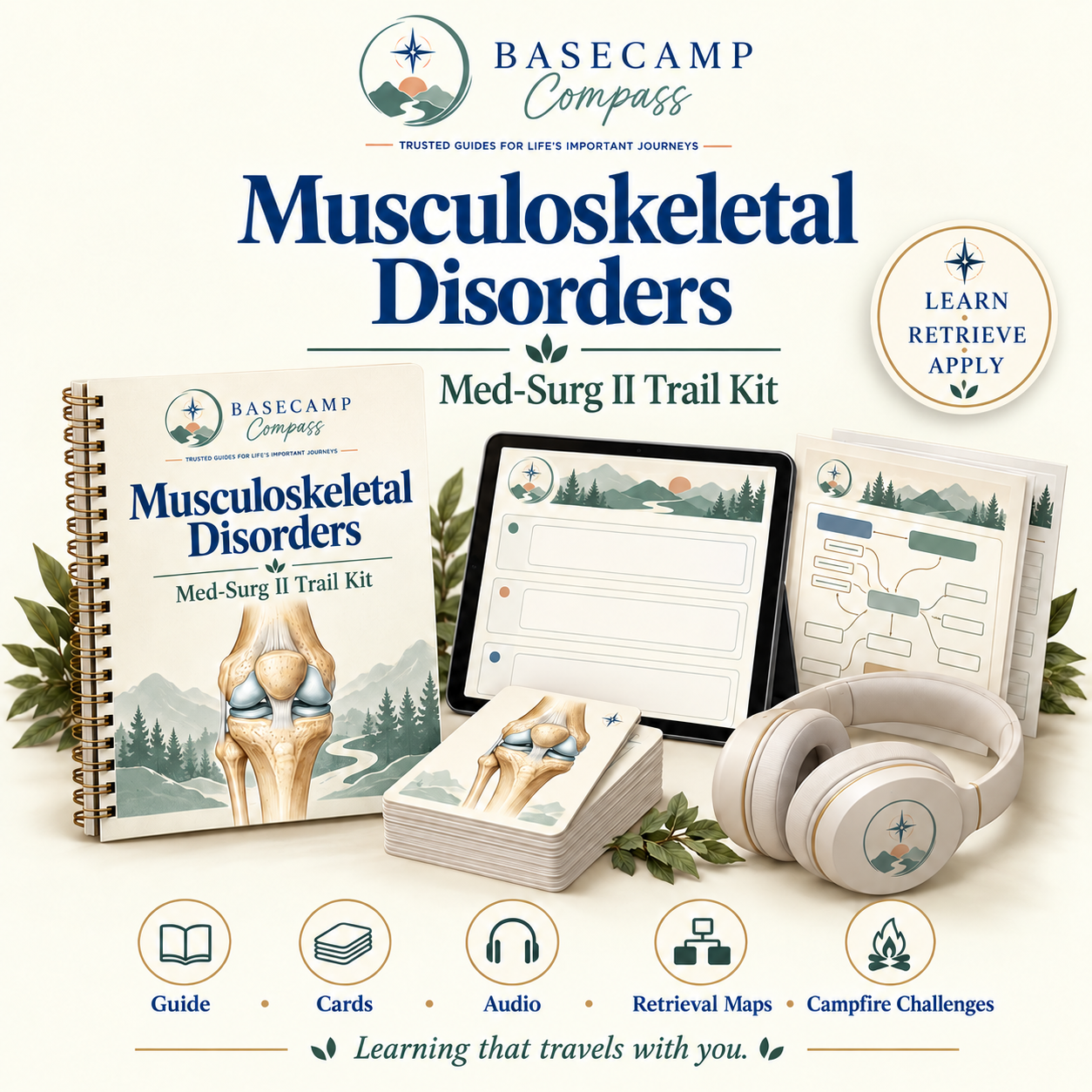
MedSurg II Musculoskeletal Disorders Trail Kit

The MedSurg II Musculoskeletal Disorders Trail Kit combines a 40-page Trail Guide, 18 Compass Cards with audio review, ten Retrieval Maps, and twelve Campfire Challenges to strengthen musculoskeletal assessment and clinical nursing judgment.

Original price was: $15.00.Current price is: $9.99.

DIGITAL · INSTANT ACCESS

What You'll Learn

Connect assessment findings with nursing priorities and escalation.
Retrieve relationships using ten activities and matched keys.
Compare fracture complications and common musculoskeletal disorders.
Apply priorities to twelve clinical scenarios.
Review correct answers and the reasoning behind each alternative.
Support safe device care, recovery and mobility.
Reinforce learning through visual, written and audio study.

Table of contents

Musculoskeletal Disorders Trail Guide - 40 pages
Musculoskeletal Disorders Compass Cards - 18 cards
Musculoskeletal Disorders Audio Companion
Ten Retrieval Maps with Matched Keys - Printable and Fillable Formats
Twelve Campfire Challenges with Answers and Rationales
Learn the patterns, retrieve the connections and apply them to nursing decisions with the Basecamp Compass Musculoskeletal Disorders Trail Kit. This Med-Surg II collection combines a visual guide, focused cards, audio review, active recall and clinical scenario practice.

Begin with the 40-page Trail Guide and 18 Compass Cards. Review assessment, fractures and orthopedic devices, then common joint and bone conditions, surgery and recovery. Connect neurovascular changes, respiratory symptoms, bleeding and infection concerns with timely nursing assessment and escalation. The Audio Companion provides a listening format for returning to the card topics.

Use ten Retrieval Maps to reconstruct assessment, fracture care, compartment syndrome, fat versus pulmonary embolism, device safety, hip fracture and joint replacement, osteoarthritis versus gout, osteoporosis, bone versus joint infection and complication priorities. Printable and fillable PDFs contain the same ten activities. Every student page is followed immediately by its matching key; fillable boxes have no writing lines.

Apply your reasoning in twelve Campfire Challenges involving cast-related compromise, pulse-preserved compartment syndrome, respiratory distress, pelvic hemorrhage, an open fracture, possible pulmonary embolism, hip dislocation, delirium, pin-site infection and a hot swollen joint. Every question is followed by its answer and rationale, including explanations for the alternatives.

Work through the components together or choose the format that fits your study session. Review visually, explain connections from memory, check the key and apply your reasoning to a scenario. Use alongside your textbook, course materials and instructor guidance. Clinical care follows the patient-specific plan, orders, facility policies and current protocols.

INCLUDED

  • 40-page Trail Guide PDF
  • 18 Compass Cards in a PDF
  • Audio Companion
  • Ten Retrieval Maps with matched keys in printable and fillable PDFs
  • Twelve Campfire Challenges with answers and rationales

WHAT YOU WILL LEARN

  • Connect assessment findings with nursing priorities and escalation.
  • Retrieve relationships using ten activities and matched keys.
  • Compare fracture complications and common musculoskeletal disorders.
  • Apply priorities to twelve clinical scenarios.
  • Review correct answers and the reasoning behind each alternative.
  • Support safe device care, recovery and mobility.
  • Reinforce learning through visual, written and audio study.

TABLE OF CONTENTS

  • Musculoskeletal Disorders Trail Guide – 40 pages
  • Musculoskeletal Disorders Compass Cards – 18 cards
  • Musculoskeletal Disorders Audio Companion
  • Ten Retrieval Maps with Matched Keys – Printable and Fillable Formats
  • Twelve Campfire Challenges with Answers and Rationales

Reviews

There are no reviews yet.

Be the first to review “MedSurg II Musculoskeletal Disorders Trail Kit”

Your email address will not be published. Required fields are marked *

How It Works: Your Learning Journey

LEARN

The Guide Teaches The Journey.

REMEMBER

Reinforce important concepts.

CHALLENGE

Test your knowledge and build confidence.

dashed arrow set vector doodle dot line thin pointer arrows | Basecamp Compass, LLC

Campfire Challenge Preview

Take a look inside

Sample 1 — Severe Pain Beneath a New Cast
Campfire Challenge 1 – Severe Pain Beneath a New Cast — Scenario: An 18-year-old with a closed tibial fracture had a fiberglass cast applied 4 hours ago. Thirty minutes after prescribed morphine, pain is 9/10 and increasing. Passive toe stretch causes marked pain; the foot has new numbness and tense swelling. Your decision: What is the priority nursing action? Choose an answer A. Notify the provider immediately while performing a focused neurovascular reassessment. B. Give another analgesic dose and reassess in 30 minutes. C. Independently cut off the cast to inspect the injury. D. Explain that severe pain is expected and encourage deep breathing.
Sample 2 — Sudden Dyspnea After Joint Replacement
Campfire Challenge 7 – Sudden Dyspnea After Joint Replacement — Scenario: A 68-year-old is postoperative day 3 after knee replacement. Sudden dyspnea, pleuritic chest discomfort, respiratory rate 28/min, SpO2 89% on room air and heart rate 118/min develop. Your decision: What is the first nursing response? Choose an answer A. Give PRN oxycodone and wait for the discomfort to improve. B. Encourage incentive spirometry and walking. C. Apply oxygen per protocol, support breathing in a tolerated position and activate emergency response. D. Wait for a D-dimer result before intervening.
Sample 3 — First Action in a Musculoskeletal Emergency
Campfire Challenge 12 – First Action in a Musculoskeletal Emergency — Scenario: A 25-year-old has a splinted forearm fracture. Two hours later there is severe pain, paresthesia, tense swelling and marked pain with passive finger extension. The radial pulse remains palpable. Your decision: What is the first action? Choose an answer A. Apply ice and elevate high above the heart before deciding whether to call. B. Give more analgesia and wait 30 minutes before reassessment. C. Remove and rewrap the splint independently, then defer notification. D. Notify the provider immediately while reassessing and preparing for possible emergency fasciotomy.
Scroll to Top