
Sale!

MedSurg II Endocrine Disorders Trail Kit

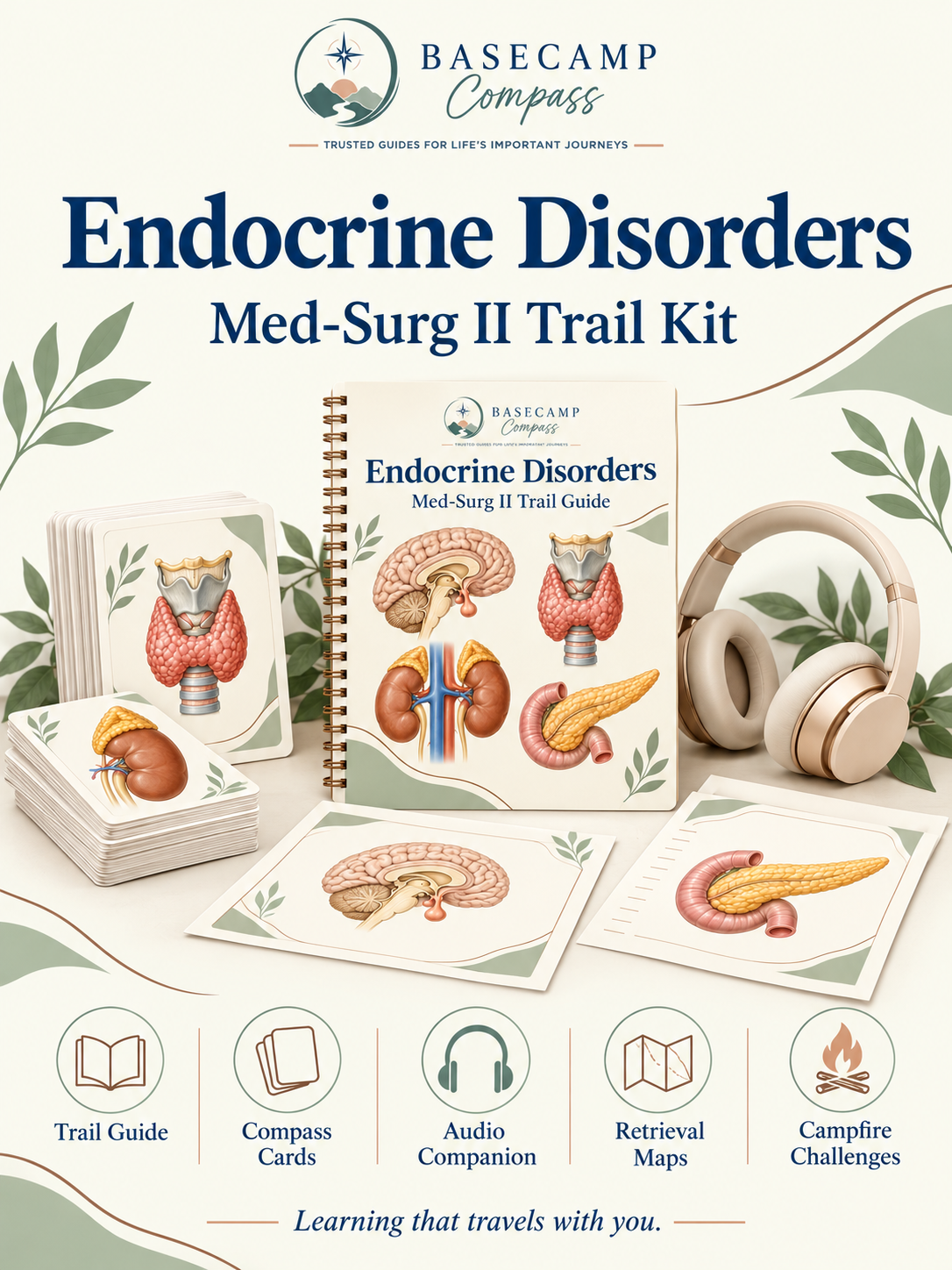
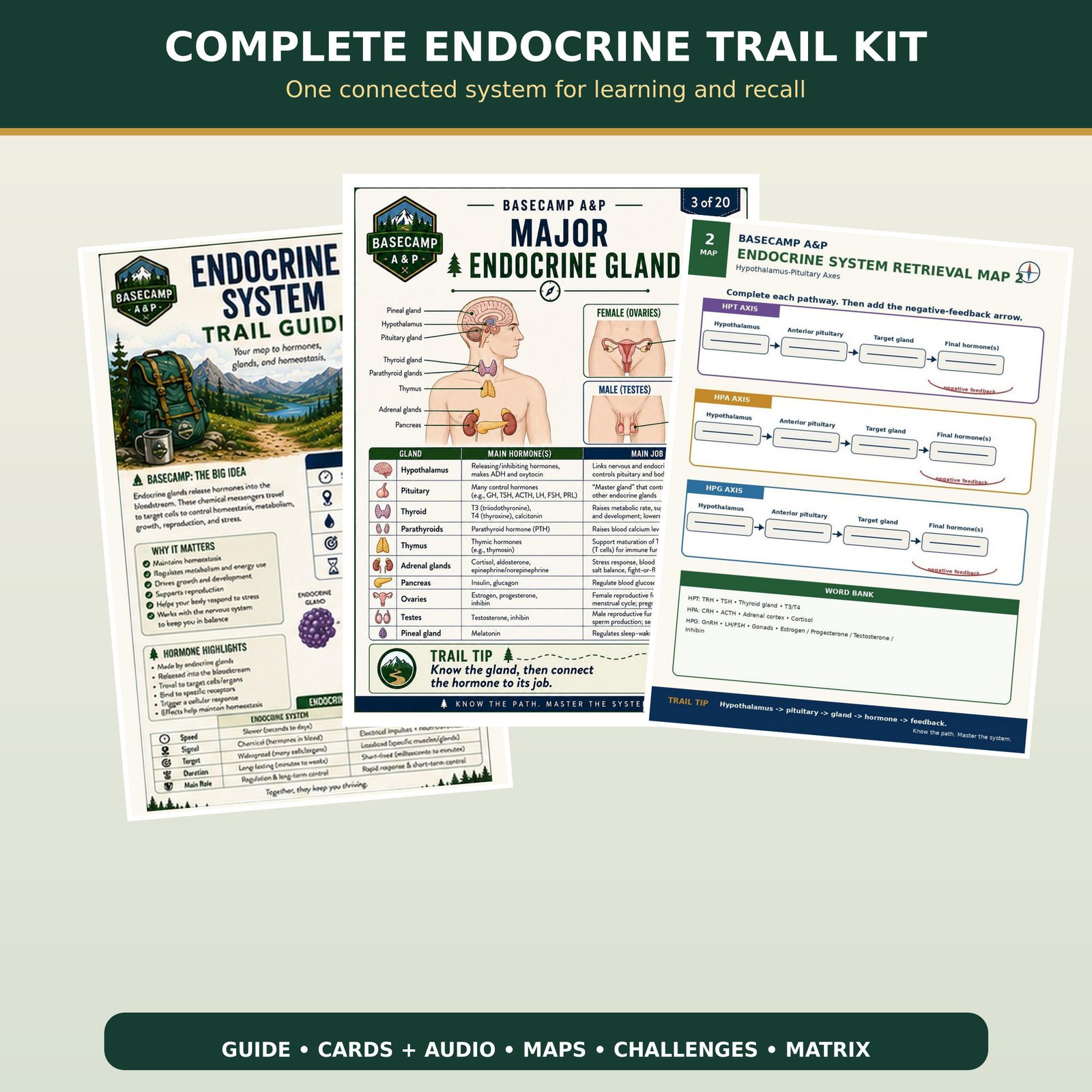
Complete learning system: 40-page trail guide, 18 compass cards, audio companion, retrieval maps, and campfire challenges for endocrine disorders.

Original price was: $15.00.Current price is: $9.99.

DIGITAL · INSTANT ACCESS

What You'll Learn

Connect endocrine function with assessment and laboratory patterns.
Compare pituitary, thyroid, parathyroid, and adrenal disorders.
Organize fluid, electrolyte, and medication connections.
Recall nursing priorities using guided Retrieval Maps.
Recognize emergencies and changes requiring escalation.
Apply learning to nursing scenarios and review answer rationales.
Reinforce concepts through visual, written, and audio study.

Table of contents

Endocrine Disorders Trail Guide
Endocrine Disorders Compass Cards
Endocrine Disorders Audio Companion
Endocrine Disorders Retrieval Maps and Answer Keys
Endocrine Disorders Campfire Challenges and Answer Rationales

Learn the endocrine patterns, organize the connections, and practice deciding what matters first. The Basecamp Compass Endocrine Disorders Trail Kit brings visual learning, active recall, clinical scenarios, and audio review together in one nursing study collection.

Begin with the 40-page Trail Guide to connect hormone function with assessment findings, laboratory trends, medication considerations, and nursing priorities. Use the 18 Compass Cards for focused visual review and the Audio Companion to reinforce concepts while listening.

Put the information into your own words with 10 Retrieval Maps covering assessment, pituitary patterns, diabetes insipidus and SIADH, thyroid disorders and emergencies, thyroidectomy complications, adrenal disorders, and emergency priorities. Printable and fillable formats support handwritten or typed responses, with answer keys to check your understanding.

Finish with 12 Campfire Challenges that apply the patterns to nursing scenarios. Answer keys explain the correct choice and why the alternatives are less appropriate, helping you examine your reasoning.

The kit covers pituitary, thyroid, parathyroid, and adrenal disorders, with particular attention to fluid balance, electrolytes, medication safety, and emergencies. Use the components together or choose the format that fits your study session. Built around Learn → Organize → Retrieve → Recognize → Apply, it supports your learning alongside your nursing course materials.

Included

  • 40-page Trail Guide PDF
  • 18 Compass Cards in a PDF
  • Audio Companion
  • 10 Retrieval Maps with answer keys in printable and fillable PDF formats
  • 12 Campfire Challenges with answers and rationales

Basecamp Compass products are designed as study companions. They support learning and clinical preparation but do not replace assigned course materials, professional instruction, facility policy, or clinical judgment.
Reviews

There are no reviews yet.

Be the first to review “MedSurg II Endocrine Disorders Trail Kit”

Your email address will not be published. Required fields are marked *

How It Works: Your Learning Journey

LEARN

The Guide Teaches The Journey.

REMEMBER

Reinforce important concepts.

CHALLENGE

Test your knowledge and build confidence.

dashed arrow set vector doodle dot line thin pointer arrows | Basecamp Compass, LLC

Campfire Challenge Preview

Take a look inside

Sample 1 — Sudden Polyuria and Rising Sodium
Campfire Challenge 1: Sudden Polyuria and Rising Sodium — Scenario: A 34-year-old client is 24 hours after transsphenoidal pituitary surgery. Urine output is 6.8 L in 24 hours, serum sodium is 150 mEq/L, and urine specific gravity is 1.002. The client is alert, thirsty, and hemodynamically stable. The team has begun a prescribed fluid-replacement and sodium-monitoring plan. Your decision: Which prescribed medication directly replaces the missing hormone effect in this central DI pattern? Choose one answer A. Acetaminophen. B. Desmopressin. C. Spironolactone. D. Furosemide.
Sample 2 — Vomiting, Weakness, and Hyperkalemia
Campfire Challenge 7: Vomiting, Weakness, and Hyperkalemia — Scenario: A 30-year-old client with autoimmune primary adrenal insufficiency develops vomiting and diarrhea after a GI illness. The client is lethargic, BP is 90/60 mmHg, heart rate 110/min, potassium is 6.2 mEq/L, and sodium is 132 mEq/L. The emergency team is notified and cardiac monitoring has begun; current ECG has no acute conduction changes. Your decision: Which prescribed intervention treats the underlying adrenal crisis while supporting perfusion? Choose one answer A. Parenteral hydrocortisone and IV fluid resuscitation. B. Oral sodium polystyrene sulfonate as the only treatment. C. Hemodialysis as the only initial treatment. D. […]
Sample 3 — Choosing the First Action in an Endocrine Crisis
Campfire Challenge 12: Choosing the First Action in an Endocrine Crisis — Scenario: An unresponsive 55-year-old client arrives in the emergency department after days of lethargy and a recent thyroid disorder. Temperature is 35.2 C, heart rate 48/min, BP 72/44 mmHg, and respiratory rate 8/min. Your decision: What is the nurse’s first action? Choose one answer A. Draw thyroid tests before assessing breathing. B. Give IV levothyroxine before initial stability assessment. C. Activate the emergency team and immediately assess/support airway, breathing, and circulation. D. Apply warming as the only initial action.
Scroll to Top