

Sale!

Fluid, Electrolyte & Acid-Base Balance Complete Trail Kit | A&P II

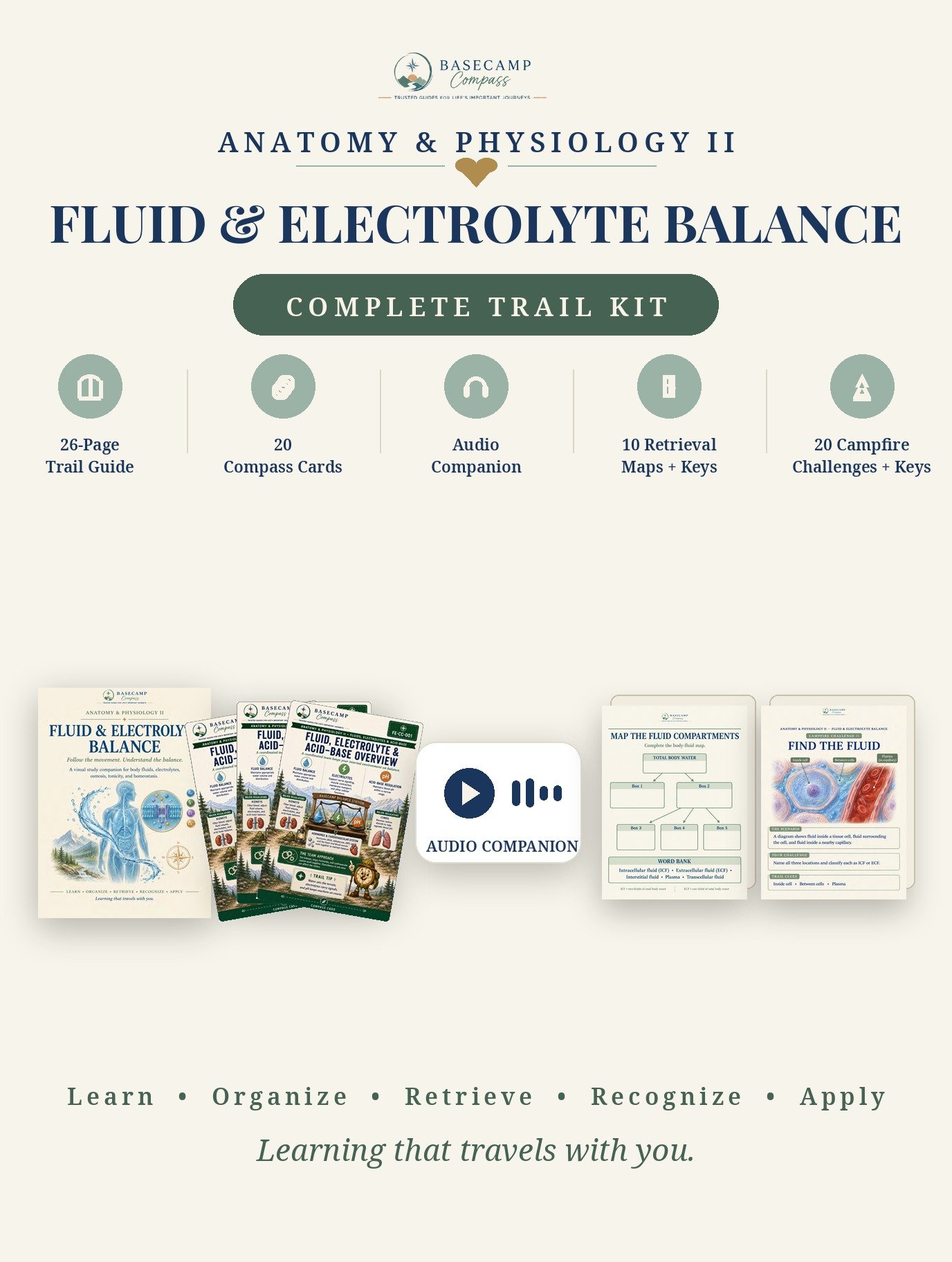
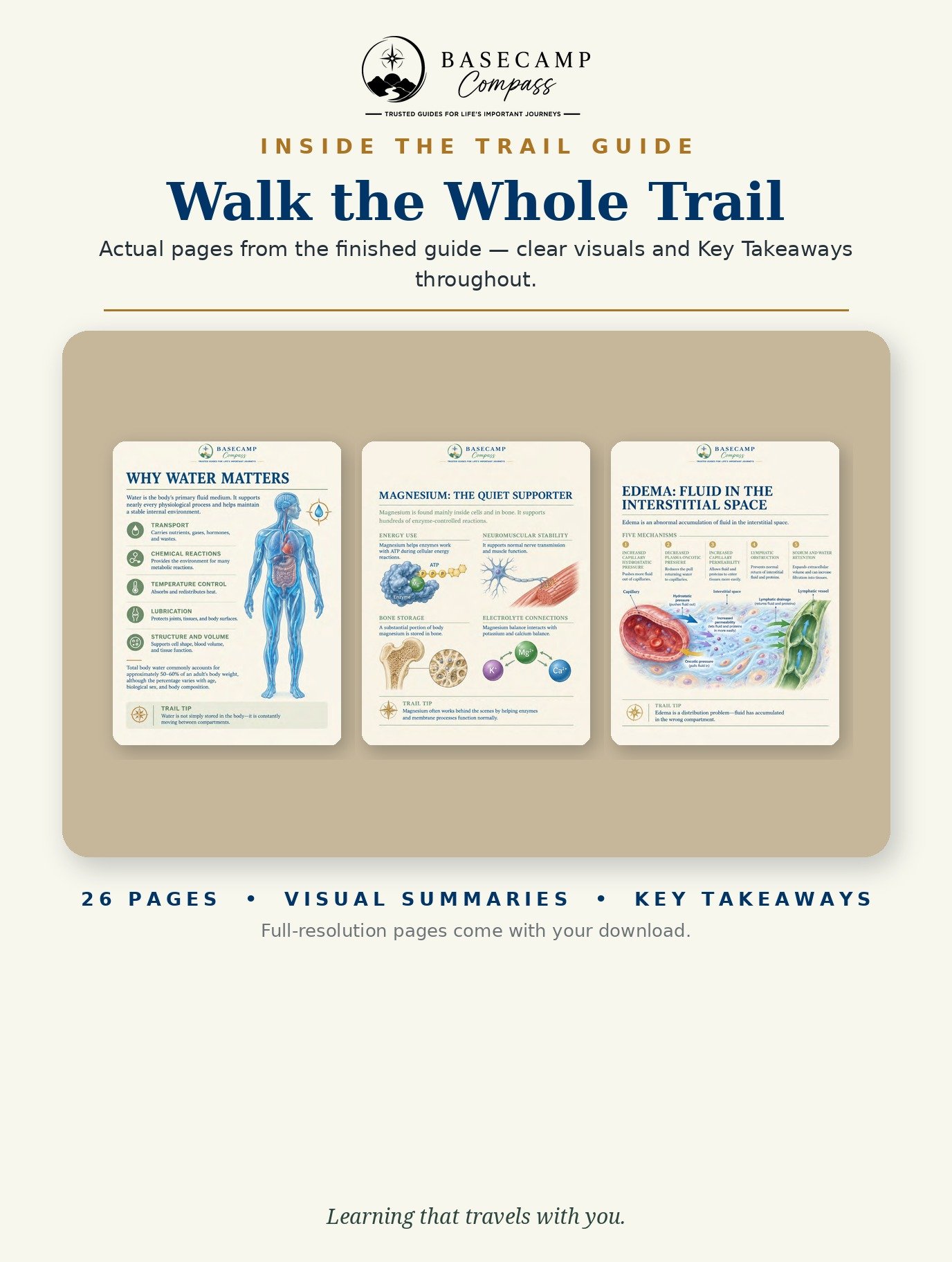
A complete A&P II study system with the 26-page Trail Guide, Compass Cards, Audio Companion, 10 fillable Retrieval Maps, and 20 Campfire Challenges with answer keys.

Original price was: $18.99.Current price is: $9.99.

DIGITAL · INSTANT ACCESS

What You'll Learn

Map total body water into intracellular and extracellular fluid compartments.
Explain diffusion, osmosis, filtration, active transport, osmolarity, and tonicity.
Predict water movement and changes in cell volume under different conditions.
Identify major electrolyte locations, physiological functions, and regulatory relationships.
Follow the four basic nephron processes and connect them with fluid and electrolyte balance.
Trace ADH, RAAS, aldosterone, natriuretic-peptide, and thirst responses.
Analyze water loss, water excess, edema, and changes in extracellular volume.
Distinguish volume changes from osmolarity changes and connect each with its physiological effects.
Compare chemical, respiratory, and renal regulation of acid–base balance.
Recognize basic respiratory and metabolic acid–base patterns and follow an ABG interpretation sequence.
Apply fluid, electrolyte, renal, hormonal, and acid–base concepts through retrieval activities and clinical-style challenges.

Table of contents

Body-Fluid Compartments and Water Balance
Solute Movement, Osmolarity, and Tonicity
Major Electrolytes and Their Functions
Kidney Regulation and Nephron Processes
ADH, RAAS, Aldosterone, Natriuretic Peptides, and Thirst
Fluid Deficit, Water Excess, Edema, and Fluid Shifts
Acid–Base Regulation and Compensation
Acid–Base Disorders and ABG Interpretation
Compass Cards and Audio Review
Fillable Retrieval Maps with Answer Keys
Campfire Challenges with Answer Keys

Learn, organize, retrieve, recognize, and apply essential fluid, electrolyte, and acid–base concepts with the Basecamp Compass A&P II Complete Trail Kit. This visual, active-learning study companion connects body-fluid compartments, solute movement, tonicity, electrolyte function, kidney regulation, hormonal control, fluid disturbances, acid–base balance, and ABG interpretation.

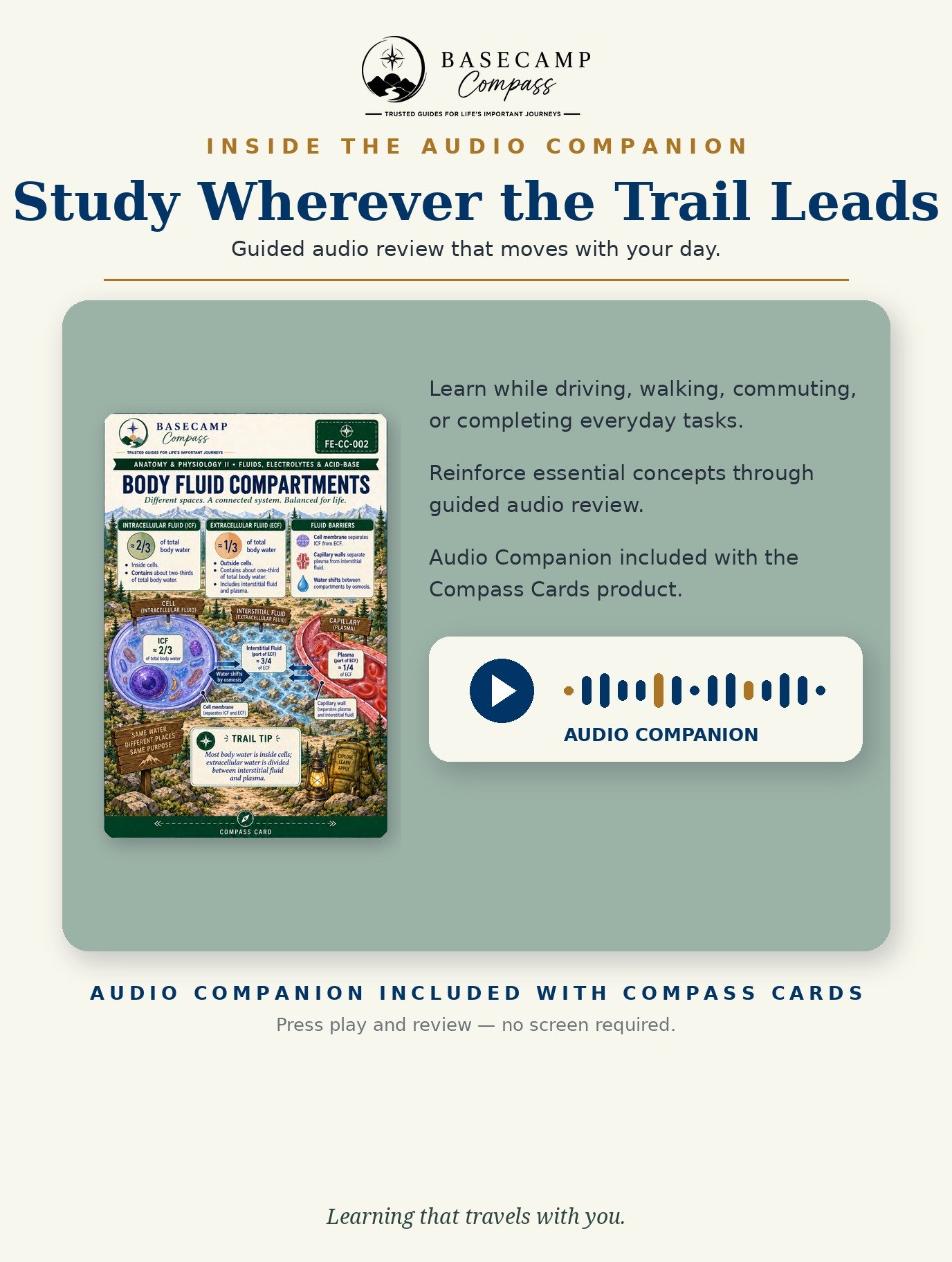
Begin with the 26-page illustrated Trail Guide to build and organize your understanding. Reinforce high-yield concepts with 20 Compass Cards and the Audio Companion. Strengthen active recall with 10 fillable Retrieval Maps, then apply what you know to 20 Campfire Challenges. Matching answer keys support correction, guided review, and independent study.

Designed to complement an A&P II course, this kit can be used to preview new material, organize lecture content, practice retrieval, or review before an exam. It is a study companion—not a replacement for the assigned textbook, instructor materials, or required laboratory work.

Learning that travels with you.
Reviews

There are no reviews yet.

Be the first to review “Fluid, Electrolyte & Acid-Base Balance Complete Trail Kit | A&P II”

Your email address will not be published. Required fields are marked *

How It Works: Your Learning Journey

LEARN

The Guide Teaches The Journey.

REMEMBER

Reinforce important concepts.

CHALLENGE

Test your knowledge and build confidence.

dashed arrow set vector doodle dot line thin pointer arrows | Basecamp Compass, LLC

Campfire Challenge Preview

Take a look inside

Sample 1 — Follow the Water (Challenge 02)
THE SCENARIO: A selectively permeable membrane separates a dilute solution from a more concentrated solution. (Dilute solution = lower solute concentration; concentrated solution = higher solute concentration; water moves toward higher solute concentration.) YOUR CHALLENGE: Predict the direction of net water movement and name the process. TRAIL CLUES: Water · Effective solute concentration · Osmosis
Sample 2 — Defend the Volume (Challenge 12)
THE SCENARIO: Renal perfusion falls. YOUR CHALLENGE: Trace RAAS from renin through angiotensin II and aldosterone. State the final effects. TRAIL CLUES: Renin · ACE · Vasoconstriction · Sodium retention · Potassium secretion
Sample 3 — Three Lines of Defense (Challenge 20)
THE SCENARIO: Hydrogen ion concentration begins to change. YOUR CHALLENGE: (From the printed page) Chemical buffers act in seconds — they accept or release H+ to resist pH change (e.g., bicarbonate, hemoglobin, proteins). Respiratory control acts in minutes — the lungs adjust CO2 elimination by changing the rate and depth of breathing. Renal control acts over hours to days — the kidneys regulate H+ secretion and HCO3− reabsorption to maintain acid-base balance. (Use the scenario + the three-lines summary above as the body; the source page’s diagram text is heavily diagram-bound.)
Scroll to Top