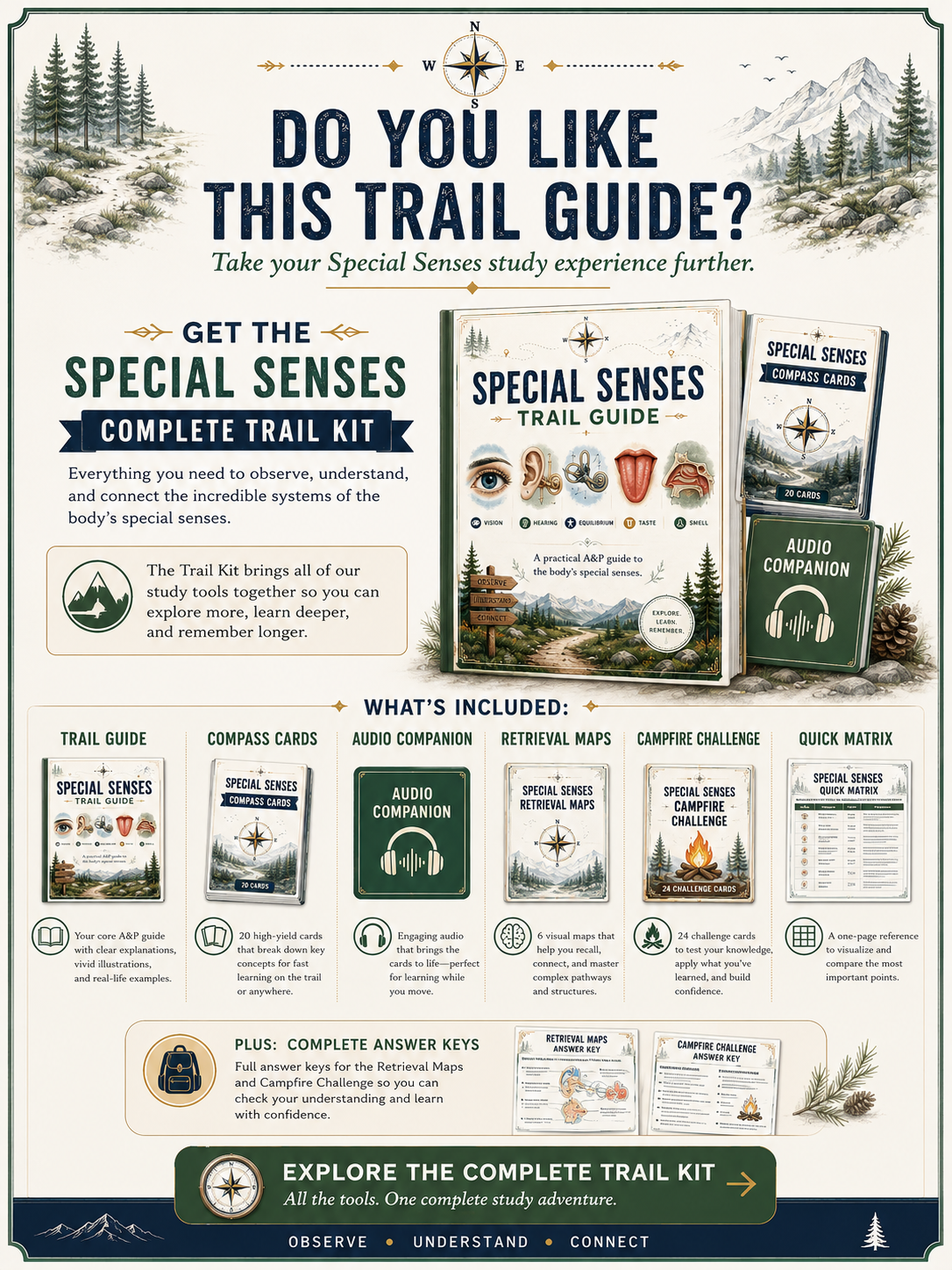
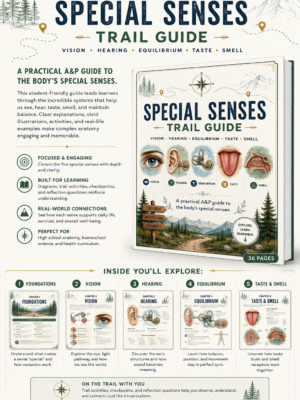
Special Senses Trail Guide | Visual Anatomy & Physiology Study Guide
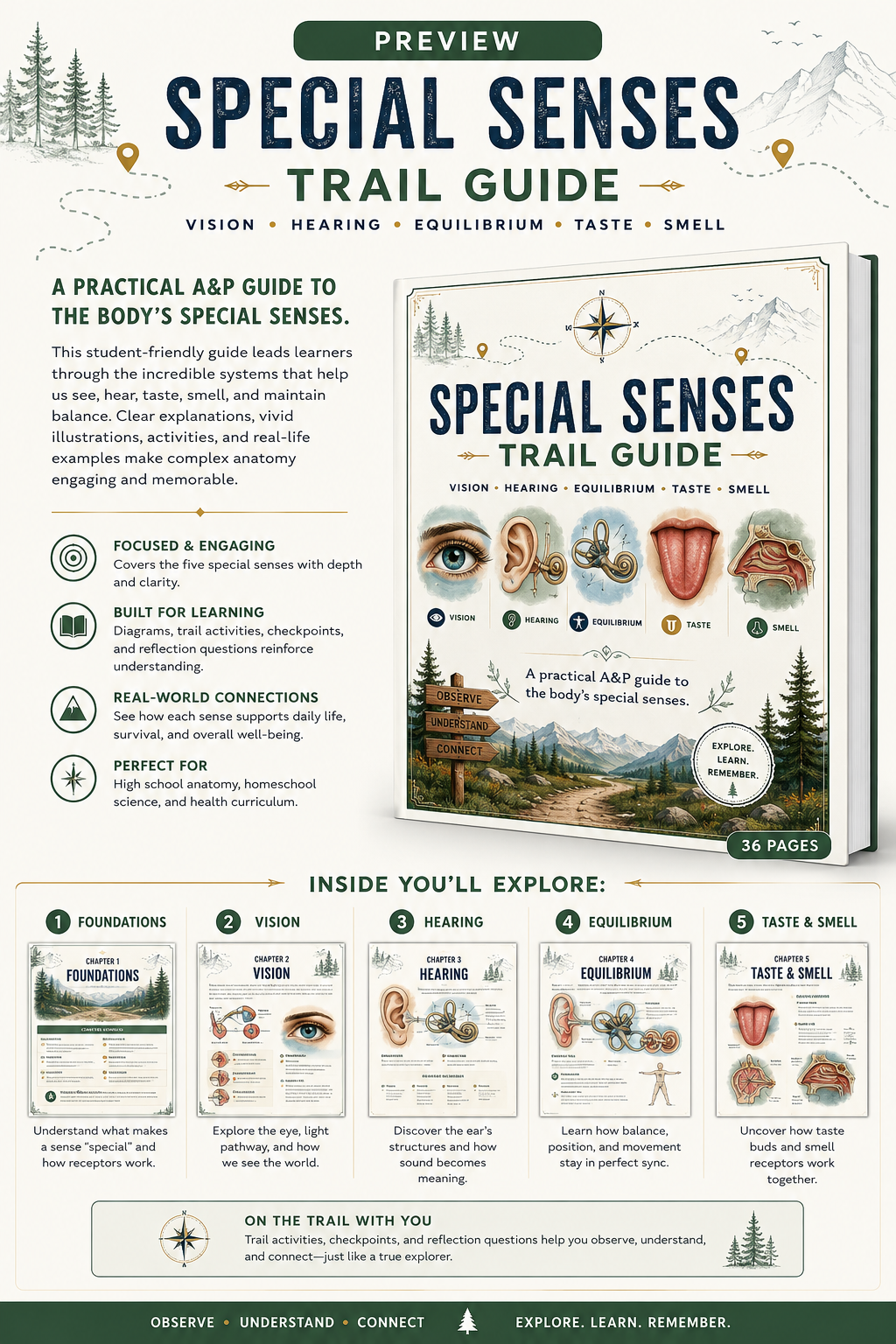
Explore vision, hearing, equilibrium, taste, and smell with a beautifully illustrated 36-page A&P Trail Guide designed to turn complex sensory anatomy and pathways into clear, connected concepts.
- Estimated Reading Time: 1 - 2 hours
- Pages: 36
- Skill Level: Intermediate
- Format: Digital Download (PDF)
$11.99
PDF · Instant download
What You'll Learn
Foundations of the Special Senses
Vision: Eye Anatomy, Retina & Visual Pathways
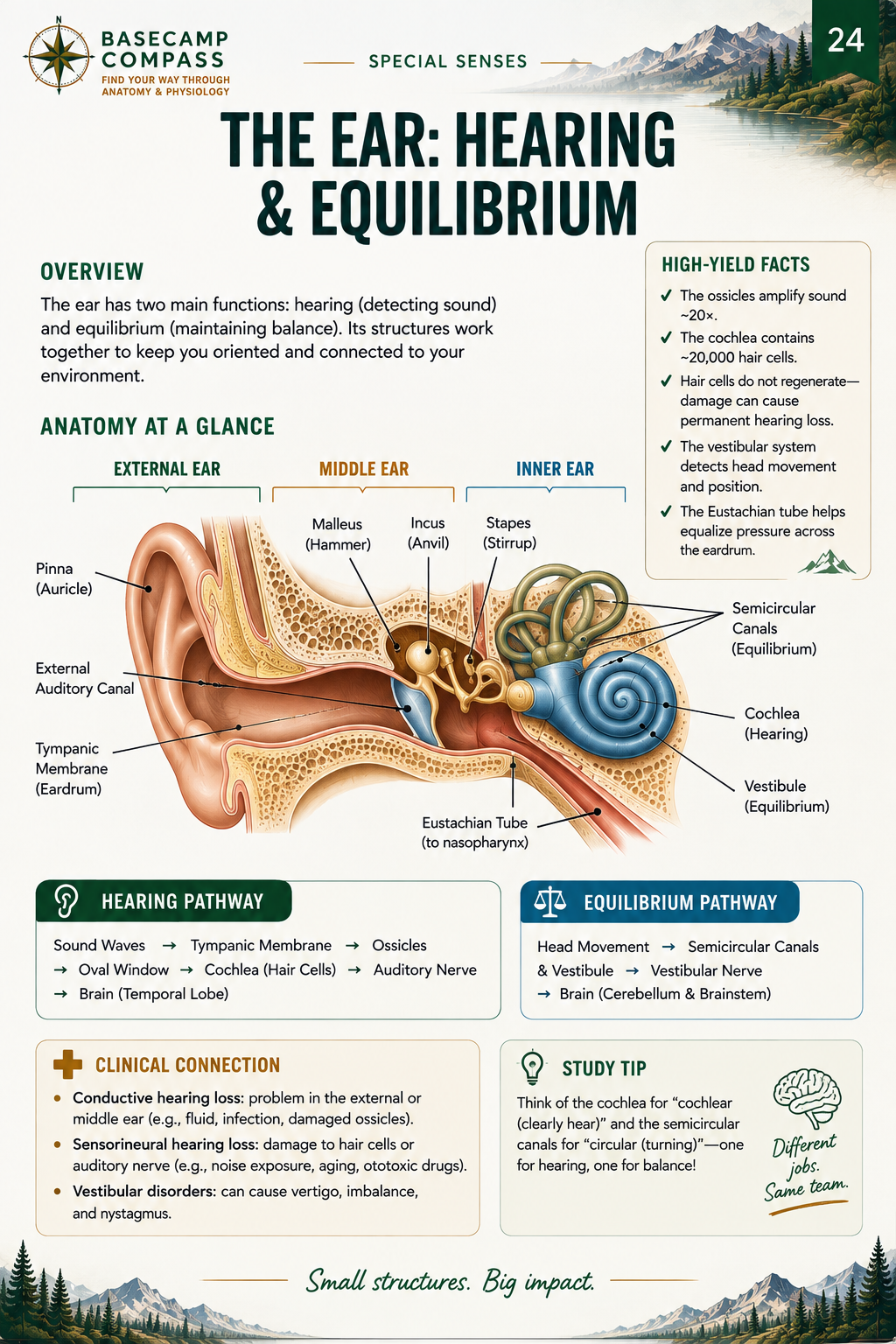
Hearing: Ear Anatomy, Sound Transmission & Auditory Pathways
Equilibrium: Vestibular Anatomy, Movement & Balance
Taste & Smell: Receptors, Cranial Nerves & Sensory Pathways
Table of contents
Foundations
Vision
Hearing
Equilibrium
Taste & Smell
Follow the Path from Stimulus to Perception
The special senses require students to connect anatomy with physiology.
Where is the receptor?
What stimulus activates it?
Which cranial nerve carries the information?
Where does the signal travel?
And how does the brain ultimately interpret it?
The Special Senses Trail Guide was designed to make those connections easier to see.
Across 36 highly visual pages, students explore the anatomy and physiology behind vision, hearing, equilibrium, taste, and smell.
Inside the Trail Guide
Foundations
Begin by distinguishing special senses from general senses and exploring the common pathway from stimulus to receptor, cranial nerve, brain processing, and perception.
Vision
Explore:
- Eye anatomy
- Accessory structures of the eye
- Three tunics
- Anterior and posterior cavities
- Aqueous and vitreous humor
- Intraocular pressure
- Cornea and lens
- Accommodation and near vision
- Retina anatomy
- Rods and cones
- Phototransduction
- Path of light through the eye
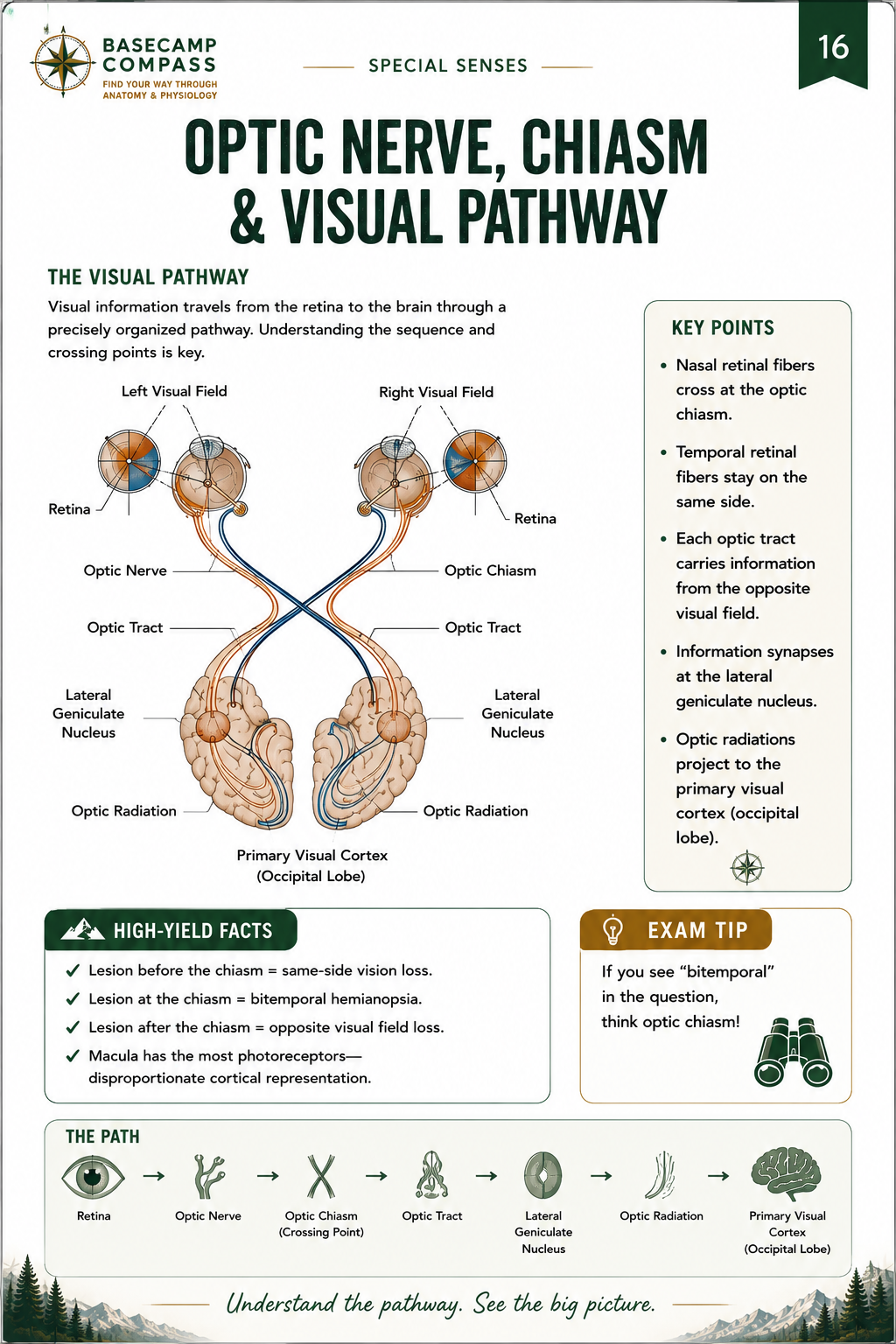
- Optic nerve, optic chiasm, and visual pathway
- Visual fields
- Pupillary light reflex
- Common vision exam traps
Hearing
Follow sound through:
- Outer ear
- Middle ear
- Auditory ossicles
- Inner ear
- Cochlea
- Organ of Corti
- Hair-cell transduction
- Pitch and loudness
- Auditory pathway to the brain
Equilibrium
Connect:
- Vestibular apparatus
- Semicircular ducts
- Utricle
- Saccule
- Linear acceleration
- Rotational acceleration
- Head position and balance
Taste & Smell
Explore:
- Gustation
- Taste receptors
- Taste cranial nerves
- Gustatory pathways and cortical processing
- Olfaction
- Olfactory epithelium
- Olfactory pathway from odorant to cortex
The guide concludes with a high-yield Five Special Senses Trail Summit comparison.
Designed for Understanding, Not Just Memorization
Throughout the guide, students encounter visual diagrams, comparisons, pathway sequences, study notes, key takeaways, clinical connections, and exam-focused reminders.
The goal is to help students understand how the pieces connect, making later retrieval and application easier.
How It Works: Your Learning Journey
LEARN
The Guide Teaches The Journey.
REMEMBER
Reinforce important concepts.
CHALLENGE
Test your knowledge and build confidence.
Campfire Challenge Preview
Sample Challenge Questions
Is this a printable file?
Yes. Your download is a print-ready, high-resolution PDF licensed for your personal professional use.
How quickly do I get it?
Instantly. The download link appears on the confirmation screen and in your email receipt.
Reviews
There are no reviews yet.