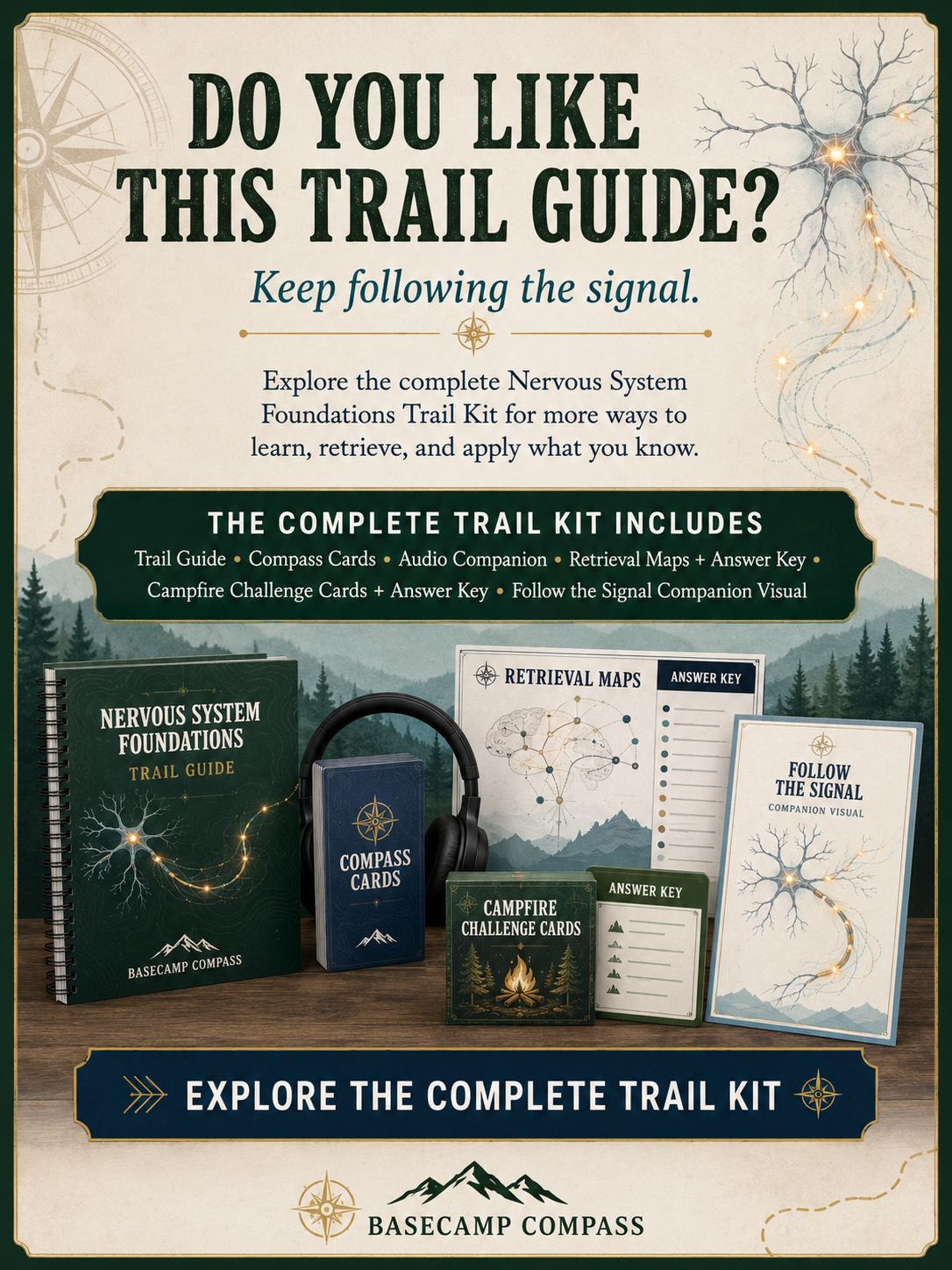
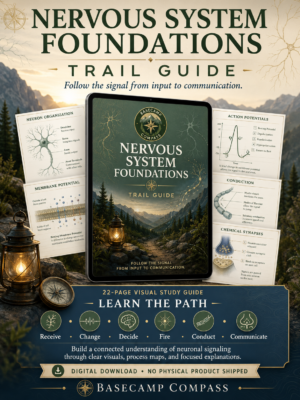
Nervous System Foundations Trail Guide
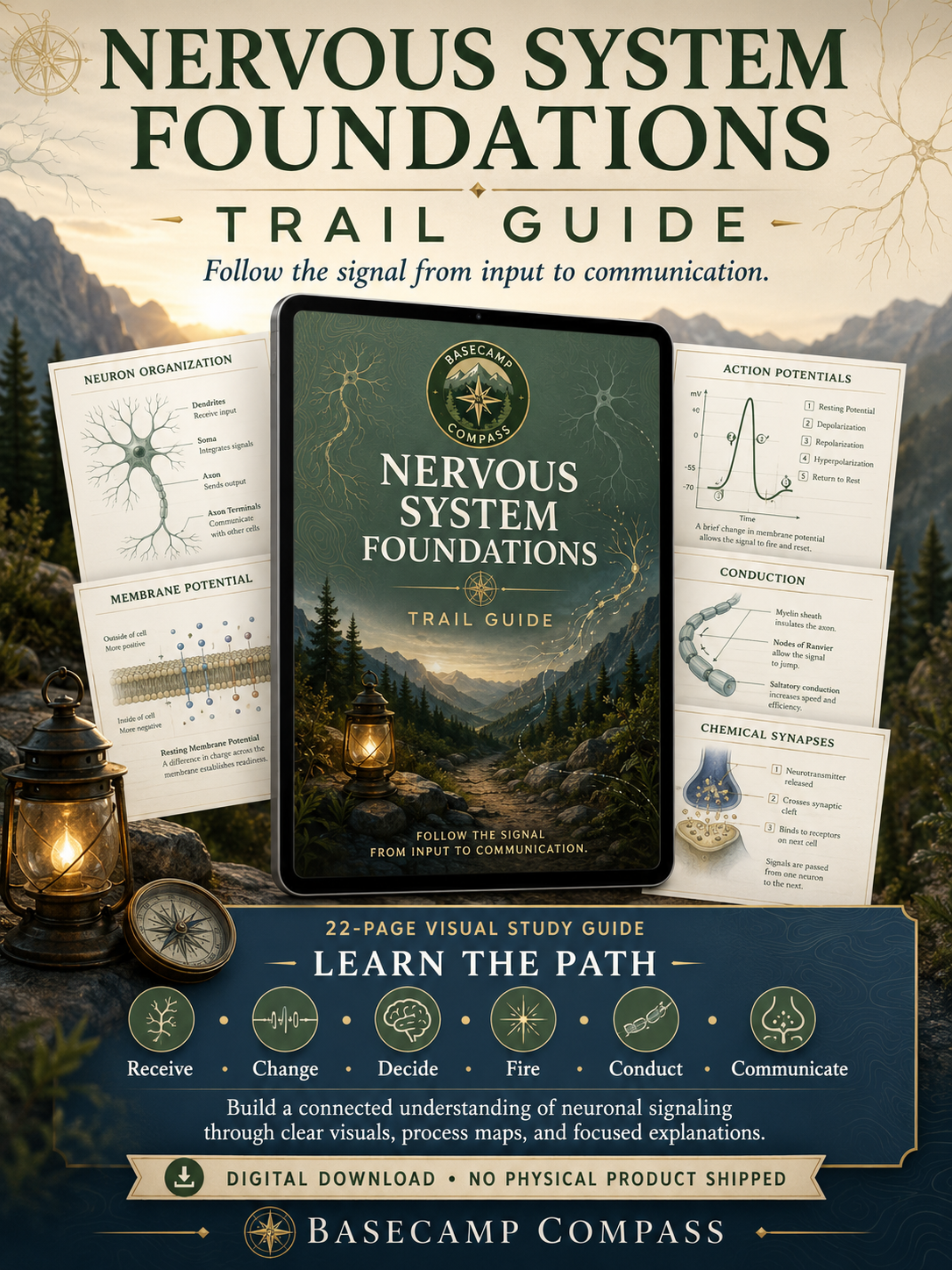
Follow nervous-system information from input to the next cell with this 22-page visual Anatomy and Physiology Trail Guide. Students learn how nervous-system organization, neuron structure, membrane potentials, action potentials, conduction, and synaptic communication connect to form one continuous signal pathway.
- Estimated Reading Time: 1 hour
- Pages: 22
- Skill Level: All Levels
- Format: Digital Download (PDF)
$11.99
PDF · Instant download
What You'll Learn
Organize the central and peripheral divisions of the nervous system.
Compare neurons with the major types of glial cells.
Connect each part of a neuron with its role in neural signaling.
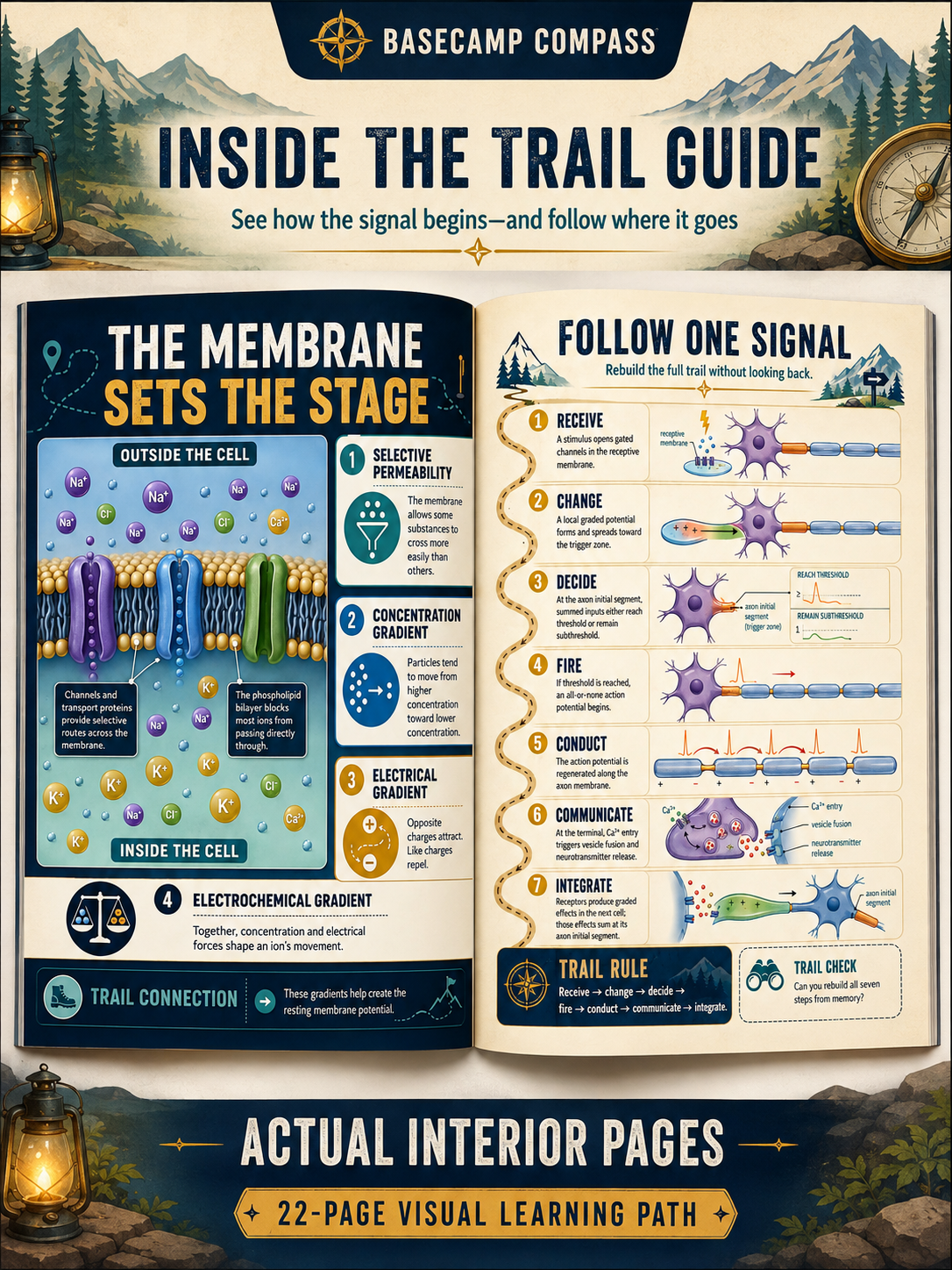
Explain how selective permeability and ion gradients establish resting membrane potential.
Identify the roles of sodium, potassium, chloride, and large intracellular anions.
Compare graded potentials, EPSPs, IPSPs, and action potentials.
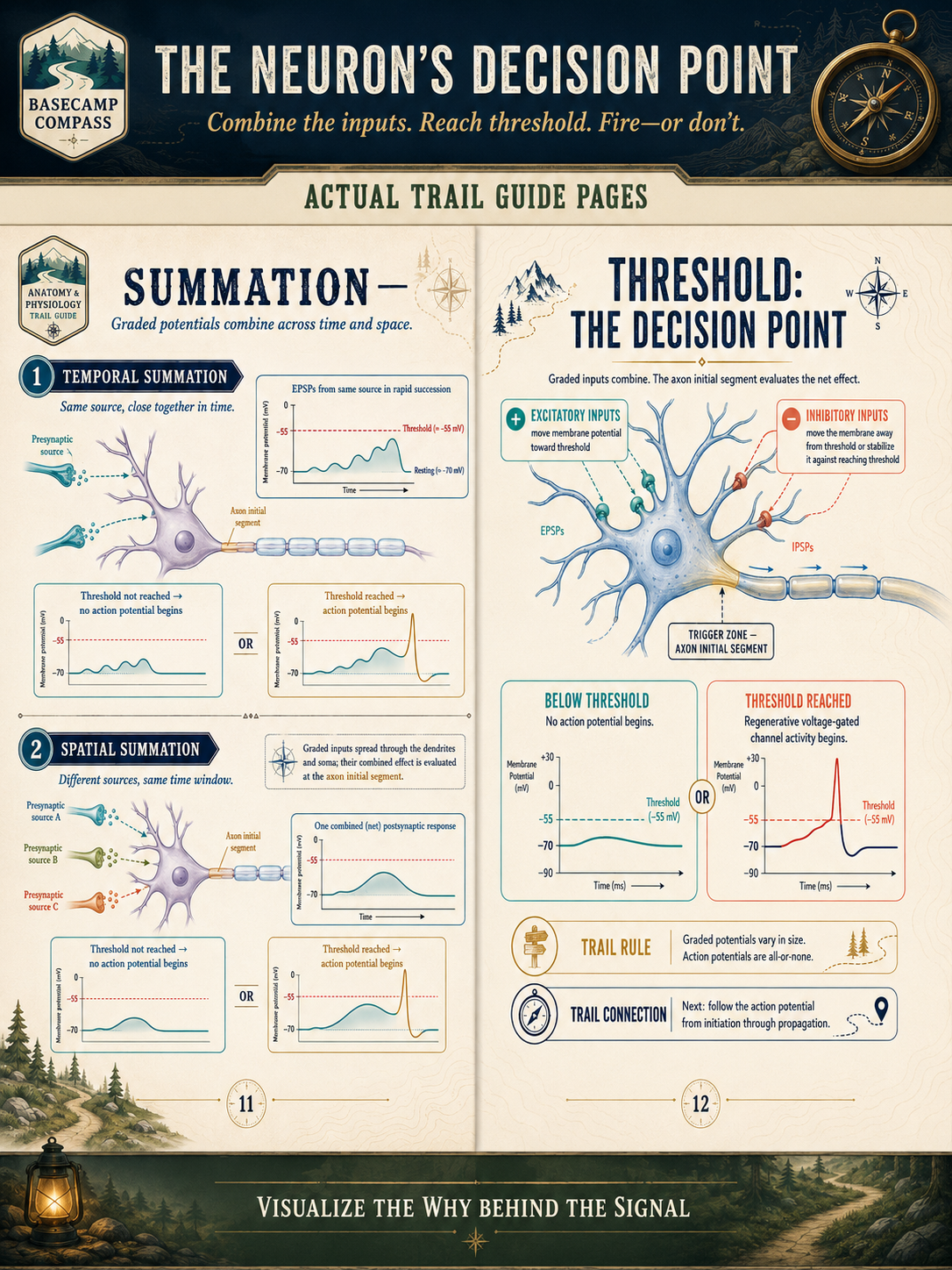
Explain temporal and spatial summation.
Describe how a neuron integrates inputs and determines whether threshold is reached.
Follow the phases of an action potential.
Explain refractory periods and their role in one-way signaling.
Compare continuous and saltatory conduction.
Identify how myelination and axon diameter affect conduction speed.
Trace communication across a chemical synapse.
Explain why neurotransmitter effects depend on the receptor.
Reconstruct the complete path of a neural signal from input to the next neuron.
Table of contents
Nervous System Foundations
Your Signal Trail
Nervous System Organization
Meet the Nervous-System Cells
Neuron Structure Predicts Function
The Membrane Sets the Stage
Meet the Main Ions
Resting Membrane Potential
Graded Potentials
EPSPs & IPSPs: Small Signals, Big Decisions
Summation
Threshold: The Decision Point
The Action Potential
Refractory Periods: Why the Neuron Needs a Reset
Action-Potential Propagation
What Changes Conduction Speed?
The Chemical Synapse
Neurotransmitters Don’t Work Alone
The Next Neuron Integrates
Follow One Signal
End-of-Trail Retrieval Challenge and Common Mix-Ups
Trail Check: Can You Rebuild the Whole Signal?
Understanding nervous-system physiology requires more than memorizing the phases of an action potential. Students must see how organization, cell structure, membrane properties, electrical changes, and chemical communication work together.
The Nervous System Foundations Trail Guide turns that complex process into a clear visual journey.
The guide begins with nervous-system organization and the roles of neurons and glia. It then follows a signal as a neuron receives input, develops graded potentials, integrates excitatory and inhibitory effects, reaches threshold, generates an action potential, conducts that signal along the axon, and communicates across a chemical synapse.
Visual explanations, process diagrams, comparisons, common mix-ups, and retrieval prompts help students understand both what happens and why it happens.
What’s Included
• One 22-page Nervous System Foundations Trail Guide
• Visual explanations and process diagrams
• A complete receive–change–decide–fire–conduct–communicate signal sequence
• Common mix-up comparisons
• End-of-guide retrieval and self-check prompts
• Printable digital PDF format
Key Topics Covered
• Central and peripheral nervous-system organization
• Sensory/afferent and motor/efferent divisions
• Neurons and glial cells
• Neuron structure and structure–function relationships
• Selective permeability and concentration gradients
• Major ions involved in neuronal signaling
• Resting membrane potential
• Graded potentials and their properties
• EPSPs and IPSPs
• Temporal and spatial summation
• Threshold and the action-potential decision point
• Depolarization, repolarization, and hyperpolarization
• Voltage-gated ion channels
• Absolute and relative refractory periods
• Continuous and saltatory conduction
• Myelination, axon diameter, and conduction speed
• Chemical synaptic transmission
• Neurotransmitter release
• Receptor-dependent postsynaptic effects
• Integration in the next neuron
• The complete signal route from stimulus to response
How This Trail Guide Helps
• Organizes complicated physiology into a logical sequence
• Connects neuron anatomy with electrical and chemical events
• Uses visuals to make abstract membrane processes easier to follow
• Highlights relationships that are often missed in traditional notes
• Addresses commonly confused concepts
• Supports comprehension before memorization
• Provides a structured foundation for later nervous-system topics
• Works well for previewing, learning, reviewing, or exam preparation
Ideal For
• Anatomy and Physiology students
• Introductory neuroscience students
• Nursing and allied-health students
• Visual learners
• Students who find action potentials or synaptic signaling confusing
• Instructors and tutors seeking a clear supplementary resource
• Learners who want a concise alternative to rereading a textbook chapter
Suggested Study Method
- Follow the guide in order during your first review.
- Pause at each stage and explain what caused the next event.
- Use the common mix-ups section to check important distinctions.
- Complete the retrieval challenge without looking back.
- Revisit only the pages connected to concepts you could not explain.
How It Works: Your Learning Journey
LEARN
The Guide Teaches The Journey.
REMEMBER
Reinforce important concepts.
CHALLENGE
Test your knowledge and build confidence.
Campfire Challenge Preview
Sample Challenge Questions
Is this a printable file?
Yes. Your download is a print-ready, high-resolution PDF licensed for your personal professional use.
How quickly do I get it?
Instantly. The download link appears on the confirmation screen and in your email receipt.
basecampcompass@gmail.com (store manager) –
good